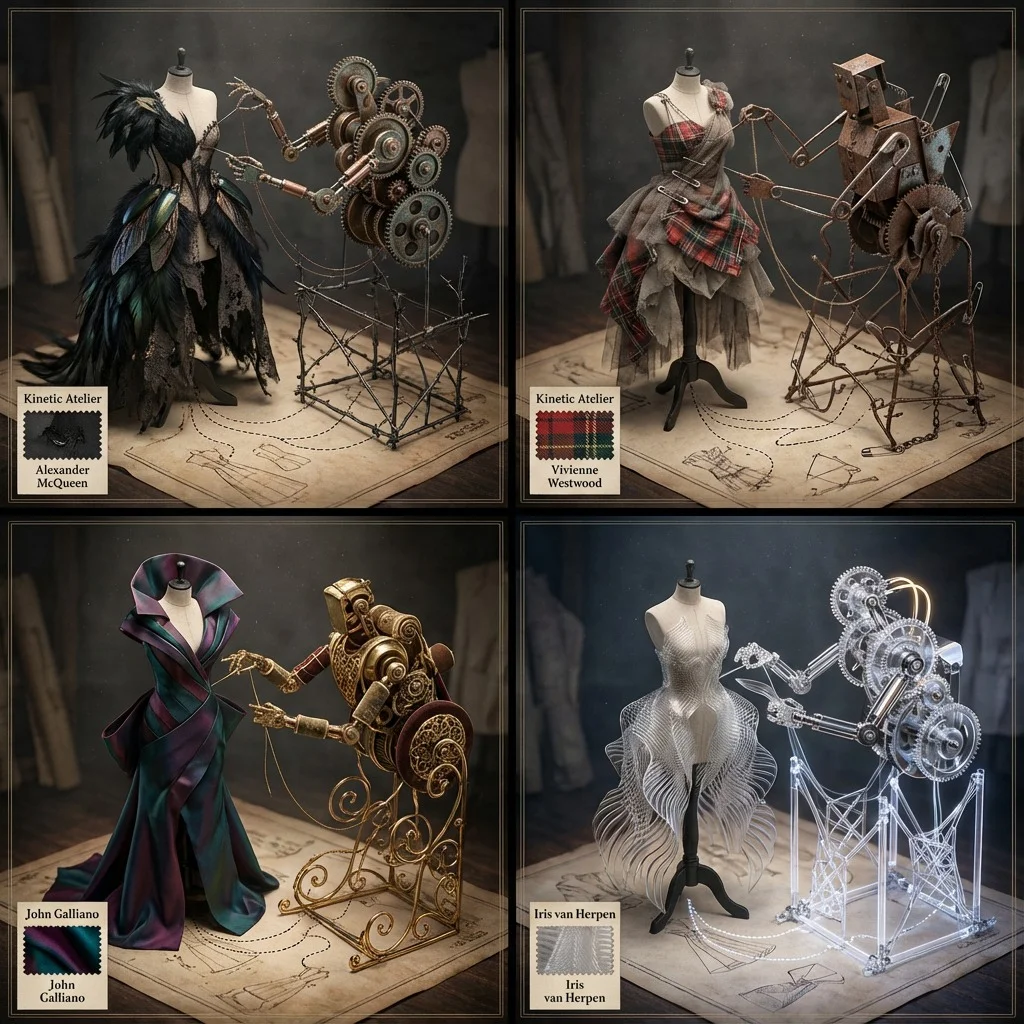
Image Nano Banana Pro
The Fabric of Fashion: A Kinetic Design Exploration
Unravel the essence of fashion through a dynamic 2x2 grid, showcasing the intricate relationships between iconic designers in a stunning miniature diorama.
Prompt
<instructions> Input Variable: [INSERT DESIGNER] (e.g., Alexander McQueen, Iris van Herpen, Coco Chanel)

    System Instruction:
Act as a Fashion Historian. Create a 2x2 Grid of "Kinetic Atelier Dioramas."
    Goal:   Analyze the Input Designer, then identify     4 Distinct Designers   (Peers, Rivals, or Successors) that share their DNA. Render one in each panel.

    1. The Curation Logic (The Brain):
     Analyze Input: Identify the core style (e.g., if McQueen: Dark Romanticism, Structure, Savage Beauty).
     Select 4 Unique Subjects:
           Panel 1:   The Input Designer (The Master).
           Panel 2:   A Historical Influence (The Ancestor).
           Panel 3:   A Contemporary Rival (The Competitor).
           Panel 4:   A Modern Successor (The Future).

    2. The Visual Syntax (The Automaton):
Each panel features a miniature dress form standing on a vintage sewing pattern.
       The Mechanism:   A complex     Brass & Copper Automaton   surrounds the mannequin. It uses mechanical arms with needles for fingers to "sew" the dress in real-time.
       The Transformation:   The dotted lines on the paper floor physically lift up into the air, turning into     Wireframe Scaffolding   that supports the fabric.

    3. Style Adaptation (Per Panel Rules):
The AI must adapt the   materials of the machine to the designer:
     If the Designer is Punk (e.g., Westwood): Use rusty iron, safety pins, and plaid fabric.
     If the Designer is Ethereal (e.g., Van Herpen): Use clear acrylic gears, 3D printed mesh, and laser-cut fabric.
     If the Designer is Classic (e.g., Chanel): Use pearl-inlaid brass, velvet ropes, and tweed fabric.

    4. The Label (The Metadata):
   A "Fabric Swatch Card" is pinned to the bottom corner of each panel.
       Text Rule:   It must display the specific name of the designer in that panel (e.g., "Vivienne Westwood" or "John Galliano"), NOT just the Input Name.

    5. Atmosphere:
       Lighting:   Moody Atelier lighting. Dust motes dancing in the light beams.
       View:   Isometric Macro.

    Output:   2x2 Grid, Hyper-Realistic Miniature Photography, distinct designers per panel.

</instructions>
Published: January 2, 2026 by @Gdgtify