Image ChatGPT Image 2
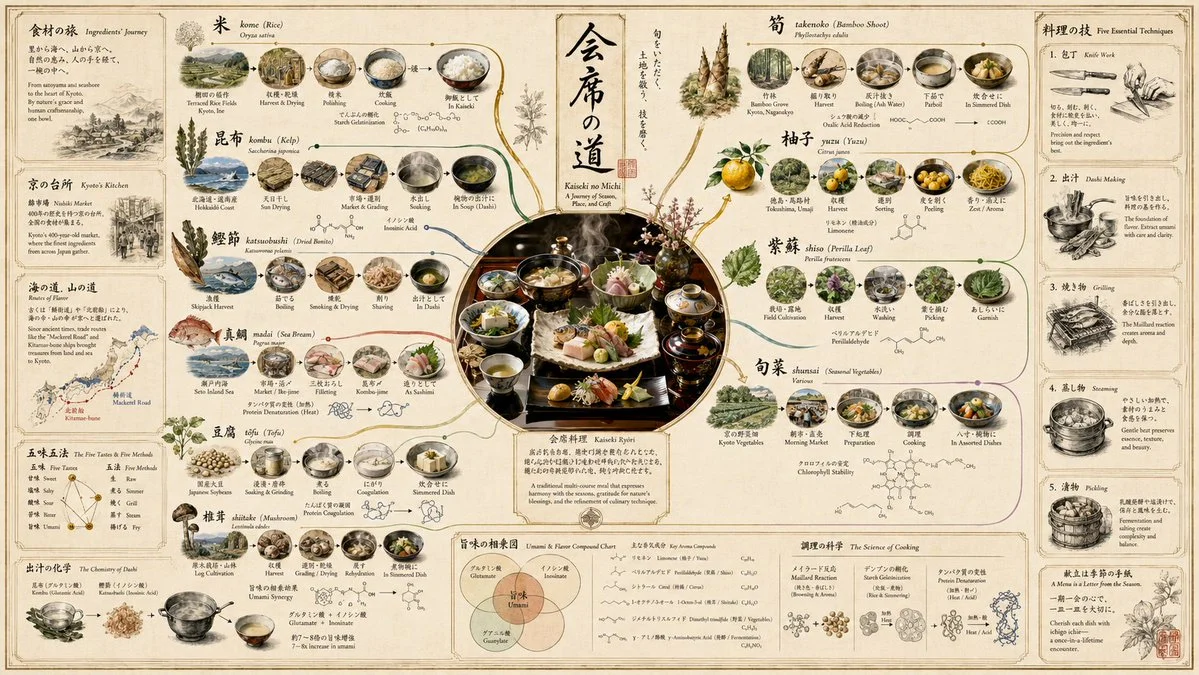
A gastronomic manuscript traces each ingredient's journey from origin to plate.
A luminous dish floats at the center, surrounded by provenance lines in ingredient colors, with cross-section vignettes showing transformation stages.
Prompt
16:9, $ DISH: ["traditional Japanese kaiseki course", "classic French consommé with garnish", "Oaxacan mole negro", "Neapolitan pizza Margherita"] $ VIEW: "ingredient provenance network converging on final plating" $ MEDIUM: "gastronomic manuscript with supply-chain cartography"Gastronomic manuscript of [$DISH], presented as a convergence diagram where every ingredient's journey is traced from origin to plate. At the center floats the finished dish in exquisite photorealistic detail — steam rising, textures glistening, plated on period-appropriate serveware — rendered as a luminous focal point. Radiating outward from the dish like spokes of a wheel, each ingredient traces a provenance line back to its source. A tomato's line flows through a market stall, a distribution warehouse, a farm field, to the specific cultivar's genetic origin in the Andes. A spice's line crosses ocean trade routes on a miniature age-of-sail map. Each line is rendered in the ingredient's characteristic color — saffron gold, basil green, chili red — and varies in thickness according to the ingredient's proportional importance in the recipe. Along each provenance line, transformation stages appear as sequential cross-section vignettes: raw ingredient → butchered/processed → cooked component → final placement. Cooking chemistry is visualized at molecular level — Maillard reaction cascades shown as golden molecular chain formations, caramelization as amber crystal lattices, protein denaturation as structural unfolding diagrams. Five technique insets show key preparation methods in the style of Diderot's Encyclopédie engravings — knife cuts, flame temperatures, fermentation vessels — with both artisan hands and scientific instrumentation visible. Flavor compound overlaps between ingredients are shown as a Venn diagram of aromatic molecules rendered in the style of a perfume chemist's chart. The background is warm cream linen paper, with the overall composition resembling a treasure map crossed with a chemistry textbook. Annotations use both culinary French/origin-language terminology and IUPAC chemical nomenclature. The aesthetic fuses Escoffier's precision with Harold McGee's food science and the visual poetry of a Renaissance herbal.
Published: May 25, 2026 by Gadgetify