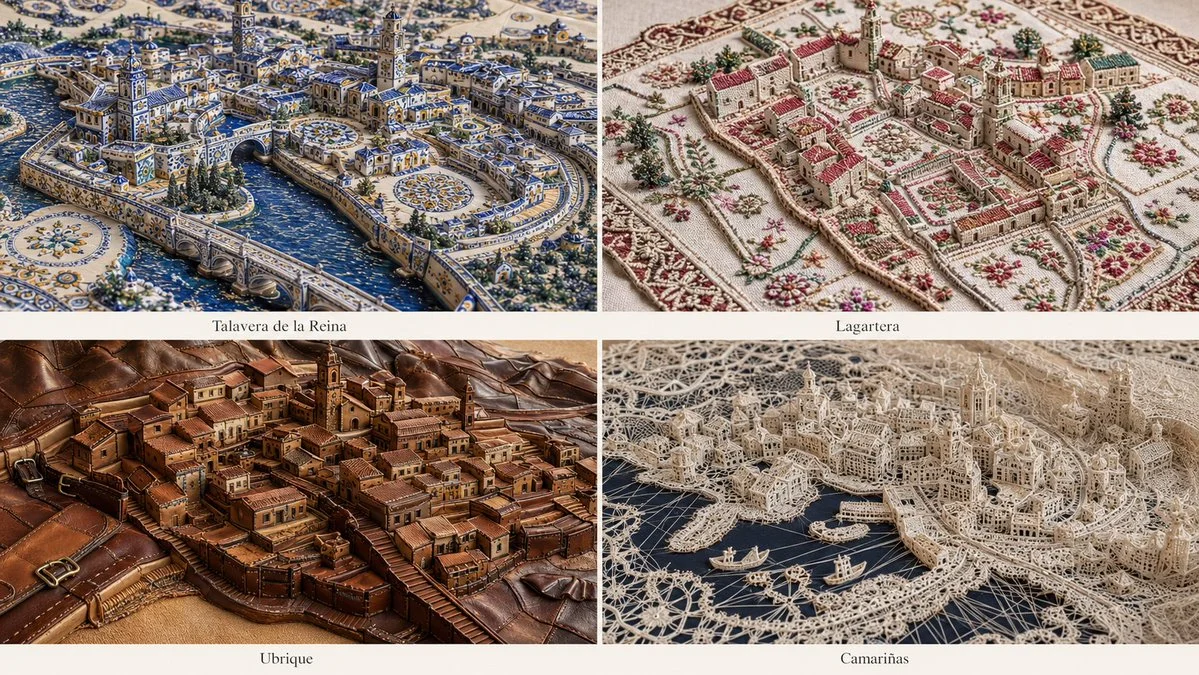
Image ChatGPT Image 2
A miniature atlas-map built from woven fibers and ceramic tiles
Four isometric city panels crafted from local materials: Oaxaca's woven streets, Seto's ceramic rivers, Jaipur's carved walls, and Fez's tiled plazas.
Prompt
Input = Country

Act as a world-class craft historian, visual artist, and geography expert. Research 4 lesser-known cities in the country. For each, identify one locally significant craft, textile, ceramic, pattern, handmade object, or artisanal material associated with the city or region.

Function Draw ($ City, $ Craft)
Anchor: [City] :: [Craft] transformed into cartographic architecture::4

Morphology: An isometric miniature atlas-map of [City] built entirely from [Craft], streets, rivers, walls, plazas, towers, and neighborhoods formed through the craft’s techniques, stitches, tiles, knots, glaze, carving, weaving, embossing, or inlay becoming urban structure::3

Material Physics: The physical and handmade qualities of [Craft] dominate every surface, irregular edges, hand-tool marks, woven tension, glaze pooling, dyed fibers, ceramic cracks, carved relief, tactile imperfections::3

Illumination: Soft artisan studio lighting, raking light revealing texture, warm shadows, museum archive atmosphere::2

Render Stack: Isometric macro photography, handcrafted diorama, ultra-detailed texture capture, f/4, 8k, photorealistic material scan aesthetic::1

Negative: people, mass-produced look, generic map icons, flat vector style, unreadable labels, blurry, watermark, text::-1

Output: 2x2 grid. Each panel maps one city through its associated craft material. City name space underneath.
Published: May 23, 2026 by Gadgetify