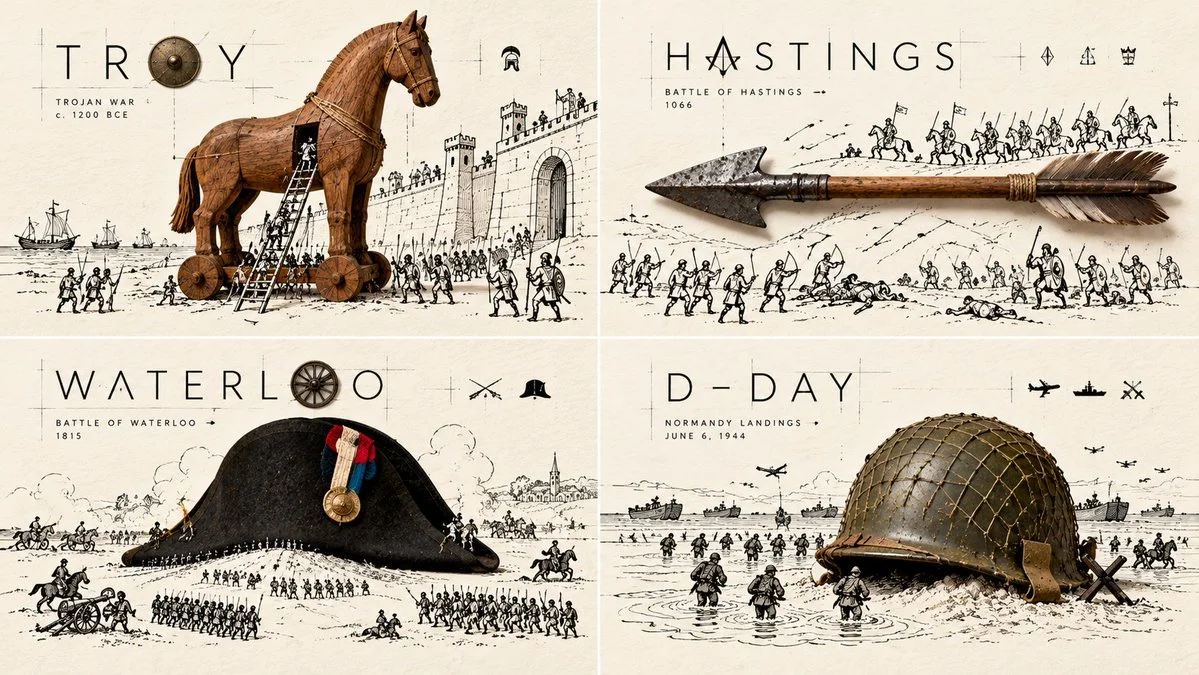
Image ChatGPT Image 2.5
A photorealistic banana becomes a bridge in a drawn world of tiny workers
A real banana transformed into a bridge, surrounded by hand-drawn ink characters building and crossing it, blending photographic texture with minimalist illustration.
Prompt
Copied. Make it your own here.
Prompt prefilled · Suggested: GPT Image 2.5 Flare · 3 credits/image
2x2 grid, 16:9, do this for 4 historic battles: INPUT: $ SUBJECT

// REALITY–DRAWING HYBRID ENGINE

subject = analyze($ SUBJECT)

anchor = choose_one_physical_object(
    ordinary_object_with_strong_metaphorical_connection(subject)
)

scenario = invent_visual_pun(
    subject,
    anchor,
    originality = HIGH,
    literalness = LOW
)

// PRIMARY RULE

THE PHYSICAL OBJECT IS REAL.

THE WORLD AROUND IT IS DRAWN.

No other element may compete photographically.

R = photoreal(anchor)

D = hand_drawn_world(subject)

IMAGE = R ∪ D

where:

R ≈ 10–30% of composition
D ≈ 70–90%

// SEMANTIC TRANSFORMATION

reinterpret anchor as something else.

Examples of transformation grammar:

banana        → moon / bridge / smile / boat
lightbulb     → balloon / planet / lighthouse
spoon         → lake / canoe / satellite dish
paperclip     → rollercoaster / railway
pencil        → tower / rocket / pier
button        → moon / wheel / portal
cup           → building / harbor / mountain crater
leaf          → sail / wing / continent
thread        → road / river / trajectory

AI must invent the metaphor from $ SUBJECT.

DO NOT repeat these examples automatically.

// DRAWN WORLD

Around the real object:

use tiny black-ink characters,
minimal architecture,
sparse nature,
one-point actions,
comic micro-events,
small narrative surprises.

Characters should physically interact with the real object:

climb it
sail around it
measure it
repair it
study it
hide beneath it
launch from it
walk across it
build beside it

depending on subject logic.

// SECONDARY SYMBOL SYSTEM

Add only 3–7 tiny symbolic motifs derived from $ SUBJECT.

Render them as ultra-simple pictograms:

○  △  ╱  ◌  ✦  ↗  ⌁

Avoid dense illustration.

White space is essential.

// TYPOGRAPHIC SIGNATURE

Add $ SUBJECT only if text genuinely improves the concept.

If included:

convert one letter into the physical anchor.

Example structural logic:

S U B J E C T
      ↑
      object becomes letter

or:

letters follow a trajectory drawn by the scene.

Typography:
    monoline geometric grotesk,
    custom modifications,
    thin construction guides,
    tiny registration dots.

// INK LANGUAGE

DRAWING_STYLE =

    editorial pen doodle
    × architectural marginalia
    × children's conceptual illustration
    × scientific notebook
    × minimalist New Yorker cartoon
    × Bauhaus diagram

Line weight:
    mostly 1–2 uniform widths.

No shading except:
    sparse hatching,
    tiny stippling,
    object contact shadow.

// CAMERA

Orthographic / top-down / clean frontal tabletop
depending on scenario.

White or lightly textured paper.

Soft natural shadow beneath real object.

Physical anchor:
    genuine material texture,
    imperfections,
    photographic lighting.

Illustration:
    perfectly aligned to object perspective,
    as though drawn directly onto paper surrounding it.

// ABSURDITY CONTROL

scenario_score =
    recognizability(subject)
    × semantic_surprise
    × visual_simplicity

Reject concepts requiring explanation.

The visual joke/metaphor should become understandable
within approximately 2 seconds.

// OUTPUT

One elegant mixed-media conceptual image.

NOT a collage.
NOT a scrapbook.
NOT several unrelated ideas.

One ordinary real object becomes an impossible world
through sparse black-line illustration.

The result should feel clever enough for:
editorial illustration,
advertising,
book covers,
museum campaigns,
or viral visual storytelling.
Published: October 22, 2026 by Gadgetify