Image ChatGPT Image 2
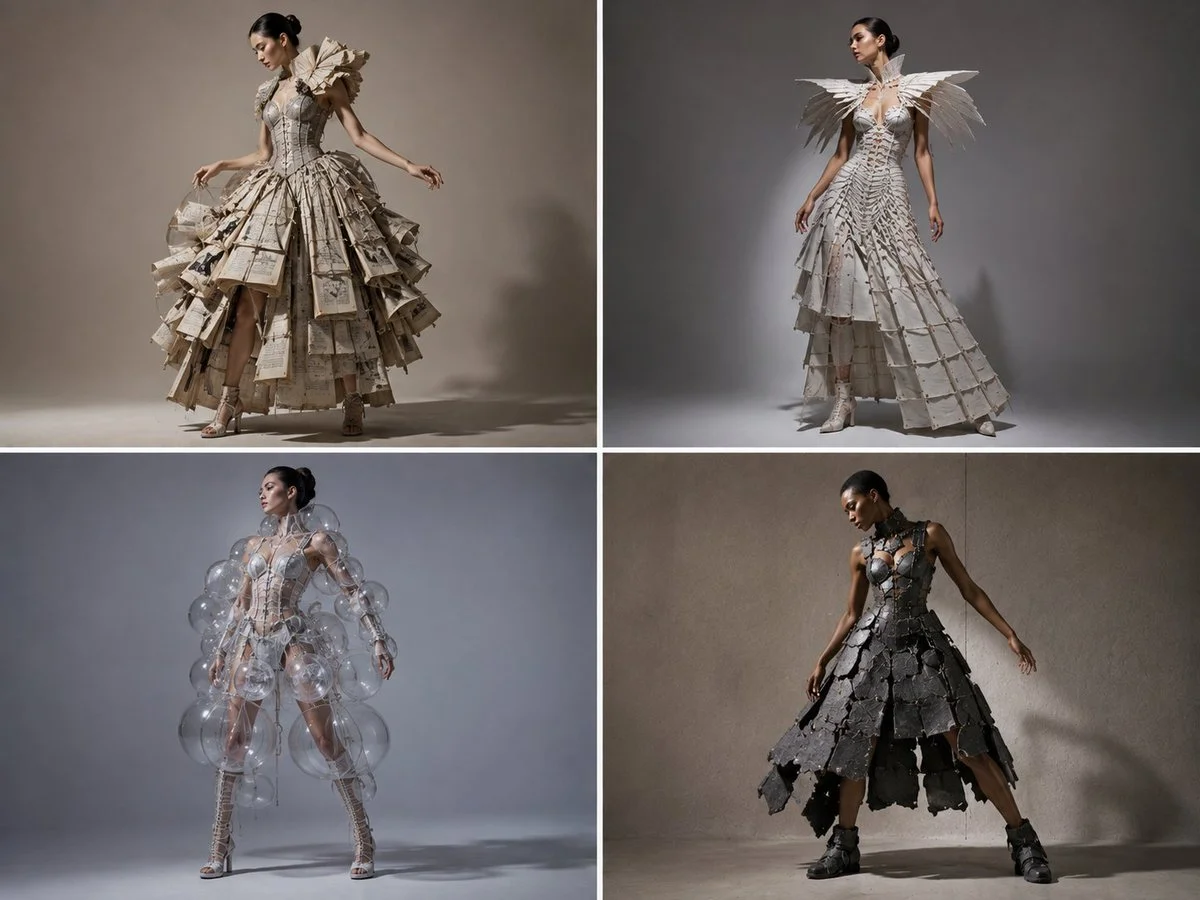
A shattered smartphone screen becomes a crystalline gown with visible lacing
A model wears a gown assembled from cracked smartphone glass panels, held by leather lacing. Raking light reveals the fractures and attachment points, while the silhouette remains elegant and wearable.
Prompt
2x2 grid, 16:9, ai picks subjects: input ::= [model / concept_context / stance_beat / capture_medium / structural_logic] a = { all usable components, fragments, textures, and mechanical properties inferred from concept_context } b = { the intended couture silhouette around model, represented as a wearable three-dimensional volume with openings for movement, vision, and breathing } c = { mapping rules inferred from structural_logic: flat components → panels, linear components → ribs or boning, flexible components → joints or drape zones, translucent components → veils or windows, dense components → low-mounted ballast or structural anchors } garment = (b ∩ wearable_volume) ∪ (a ∩ material_components) ∪ (c ∩ construction_mapping) assembly_rules := - replace conventional fabric only where the inferred source material can physically perform the required function. - preserve the source material’s real weight, brittleness, flexibility, gloss, porosity, and edge behavior. - use a concealed textile or harness substrate only where necessary for wearability. - reveal enough attachment points to explain how the unusual material remains on the body. - resolve intersections through cutting, fastening, lacing, riveting, stitching, lamination, binding, or fitted sockets. - do not merely texture-map the material onto a normal dress. stance := ai_infer(stance_beat, "a posture caused by the material’s true mass, stiffness, fragility, drag, temperature, or instability") capture := ai_infer(capture_medium); the camera must preserve both the overall silhouette and a clearly legible region of construction; choose depth of field from the medium rather than defaulting to extreme blur light := optimized for the actual material: raking light for relief, cross-polarized softness for reflective surfaces when needed, transmitted light for translucent matter, edge light for dark porous structures, never a generic glossy cgi setup imperfection := a cut edge, exposed cross-section, repair, binding, chip, frayed connector, uneven module, or slight deformation caused by wear maximize := j = 0.22 material_recognition + 0.20 wearability + 0.18 silhouette_strength + 0.15 bodily_response + 0.15 construction_legibility + 0.10 photographic_believability constraints := material_recognition >= 0.90 wearability >= 0.84 construction_legibility >= 0.86 photographic_believability >= 0.88 output := one full-length avant-garde fashion image in which the source material has genuinely become the garment’s construction system forbidden := surface-only texture substitution; unmodified conventional dress beneath a material skin; unsupported heavy components; material acting contrary to its nature; random source objects glued onto clothing; missing fasteners; floating fragments; craft-project aesthetic; excessive visual noise
Published: August 6, 2026 by Gadgetify