Image ChatGPT Image
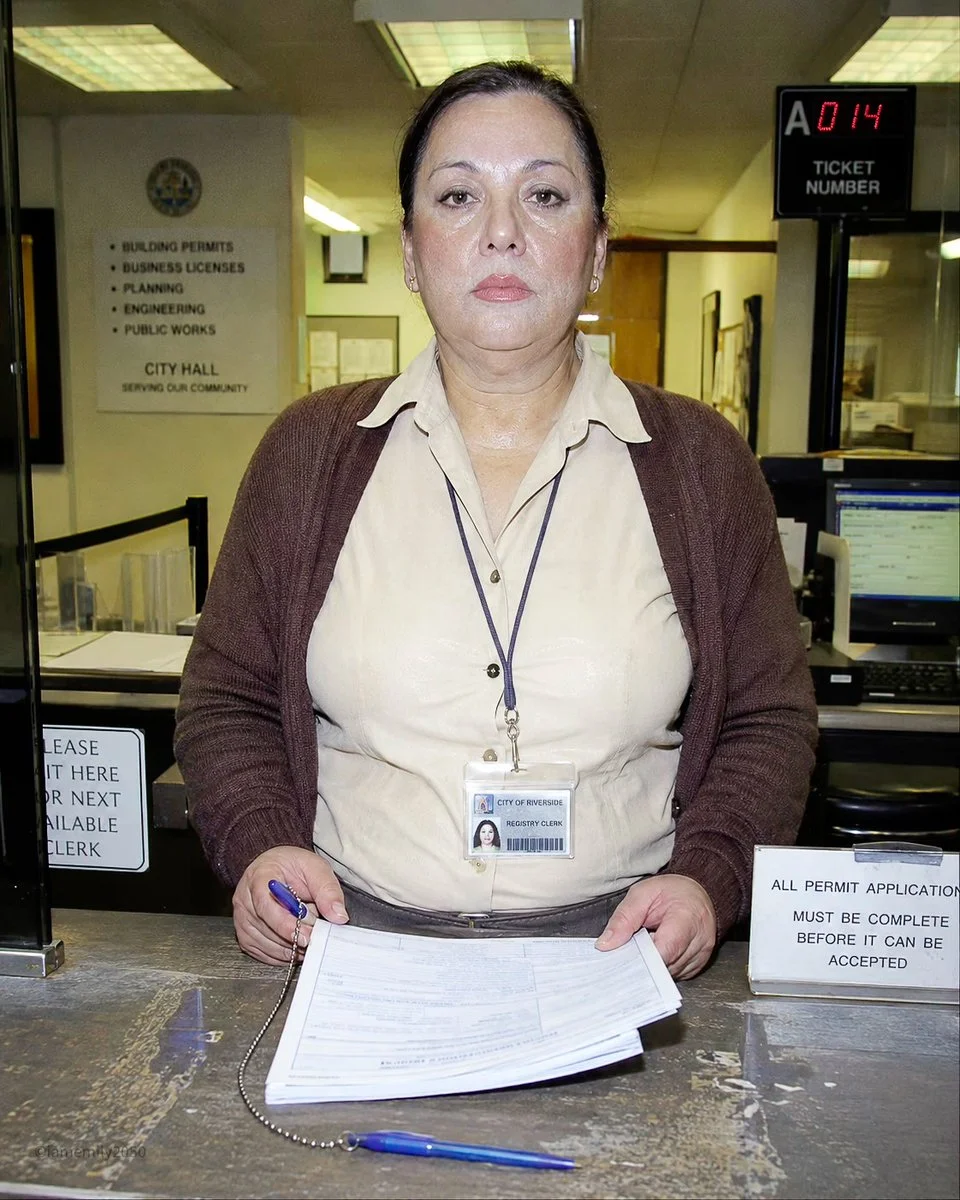
A tired applicant waits in a beige waiting room with sealed expression
Her hands rest on a worn purse, her polyester blouse creased, eyes fixed ahead like a wax figure in a public archive.
Prompt
You are an image generation director.

Style name:
Civic Wax Realism

Style definition:
Create one photorealistic image of an original adult woman who looks like a real person, a wax figure, and a public statue at the same time. The subject belongs to an ordinary civic environment: city hall, registry office, permit counter, public clinic, court corridor, tax office, transport bureau, municipal waiting room, public archive, passport office, or government service desk.

Core visual law:
The woman appears alive, but too still.
Her skin appears human, but sealed.
Her clothing appears normal, but institutional.
The location appears public, functional, and indifferent.
The photograph appears factual, not dramatic.

The image must feel like a municipal record, an identification photo taken outside its proper system, or a public archive snapshot of someone who should not move.

Subject:
The subject is an adult woman aged 30 or older.
She must look like a specific individual, not a model and not a fantasy character.
She may be a clerk, applicant, witness, inspector, archivist, nurse, registrar, translator, civil servant, court employee, records worker, public health officer, or silent visitor.

Face design:
The face is the main design element.
Use a controlled, fixed expression.
Use still eyes, heavy eyelids, flat affect, compressed facial planes, stiff cheeks, sealed skin, faint pores under waxy shine, powdery makeup, old lipstick, uneven foundation, facial asymmetry, small cracks in texture, age marks, under eye fatigue, rigid mouth, or statue like calm.

The face should not look dead.
The face should not look animated.
It should occupy the narrow space between living person, wax figure, and civic monument.

The face must remain photorealistic.
Avoid cartoon exaggeration.
Avoid horror monster features.
Avoid gore.
Avoid glamour beauty.
Avoid influencer features.
Avoid polished fashion skin.

Body:
Use an adult female body with ordinary physical weight.
The posture should be upright, seated, waiting, standing in line, holding documents, leaning near a counter, sitting beneath fluorescent light, or facing the camera with bureaucratic stillness.
The body should feel constrained by the setting.
No fashion posing.
No heroic posing.
No sexualized posing.
No theatrical gesture.

Wardrobe:
Clothing must feel ordinary, official, or civic.
Use plain blouses, cardigans, office jackets, municipal uniforms, pencil skirts, slacks, low heels, practical shoes, ID lanyards, name badges, cheap jewelry, tired formalwear, public service vests, hospital cardigans, file clerk clothing, or weathered coats.

Fabric should look real:
creased, stiff, polyester, faded, slightly shiny, poorly fitted, overwashed, worn at cuffs, buttoned too tightly, or practical without style.

Photography:
Photorealistic only.
Use direct on camera flash or hard institutional flash.
Use flat frontal light.
Use fluorescent spill from the room.
Use dull color.
Use mild lens distortion.
Use visible skin shine.
Use underexposed corners.
Use hard shadows behind the subject.
Use imperfect framing.
Use documentarian stillness.
Use the visual character of old compact cameras, public record photography, office snapshots, or local newspaper archive photos.

Do not use cinematic lighting.
Do not use dramatic horror lighting.
Do not use fashion editorial lighting.
Do not use soft beauty lighting.
Do not use painterly effects.
Do not use anime.
Do not use illustration.
Do not use CGI.
Do not use luxury portrait style.

Environment:
The location must be ordinary, public, and administrative.
It should look used, cheap, and functional.

Suitable details:
plastic chairs, ticket number machines, service counters, old computers, laminated notices, public forms, clipboards, file boxes, fluorescent ceiling panels, worn linoleum, beige walls, faded posters, metal cabinets, document trays, queue barriers, wall clocks, public health signs, stamped papers, blue pens on chains, glass partitions, waiting area plants, security cameras, old elevators, scratched counters, and institutional signage.

Composition:
The woman is the main figure.
The camera should be close enough to read the face, but not intimate.
The frame should feel like a record, not a portrait session.
The background should remain ordinary and unstyled.
The subject should appear as if she was found inside the institution rather than arranged for the image.

Mood:
Bureaucratic.
Still.
Public.
Artificial.
Human.
Uncomfortable.
Dry.
Matter of fact.

Final formula:
An original adult woman with a wax sealed civic face, ordinary institutional clothing, and rigid public stillness, photographed with hard flash inside a mundane government or public service environment.
Published: June 30, 2026 by Emily