Image ChatGPT Image 2.5
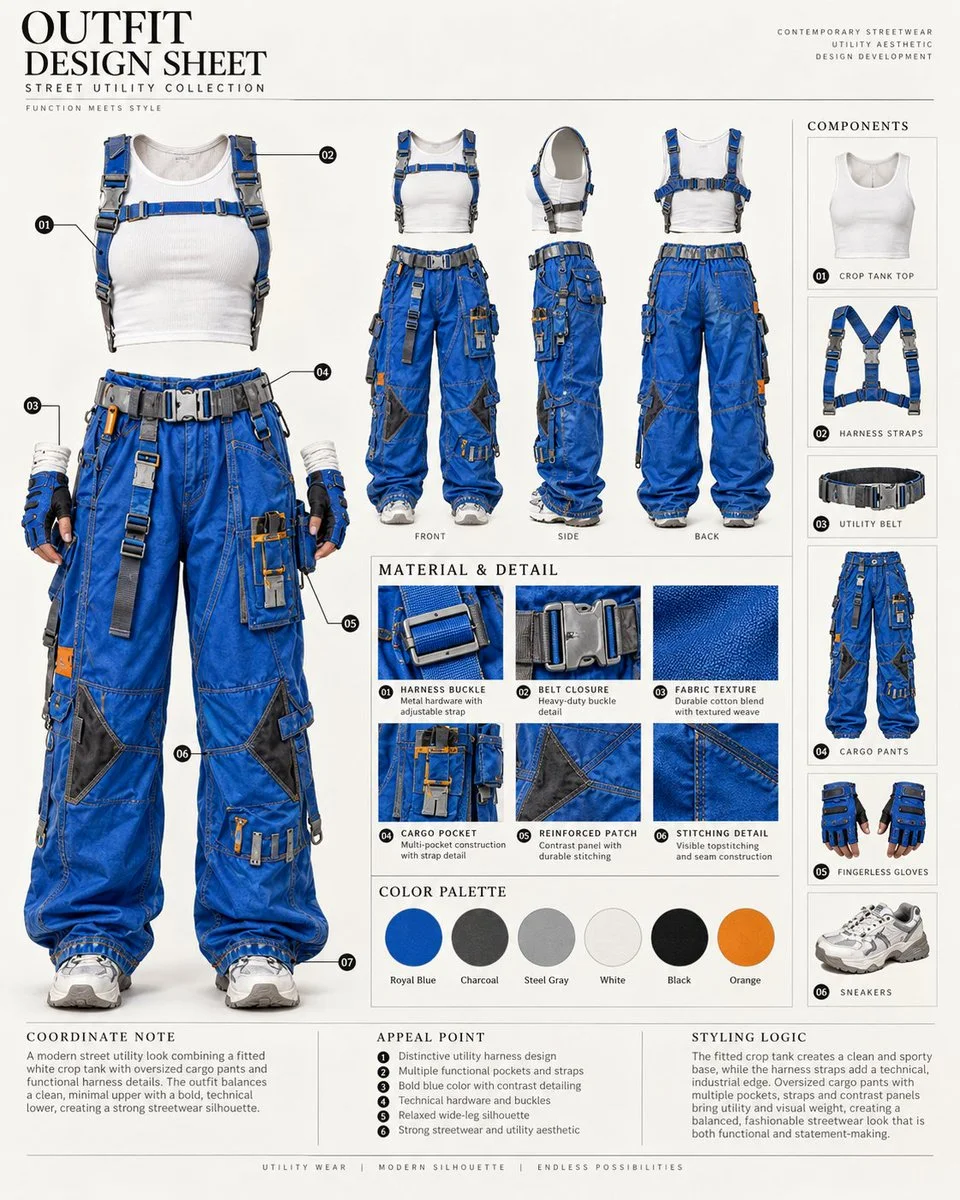
AI Transforms Outfit Reference into Professional Fashion Character Sheet
Upload any outfit image and AI generates a luxury fashion design board with numbered detail callouts and precise garment reconstruction.
Prompt
Create a premium professional fashion design character sheet based strictly on the provided reference image of the clothing/outfit.

The uploaded reference image is the primary and authoritative source for the outfit design. Analyze it carefully and reconstruct the clothing as accurately as possible while preserving its original design identity, silhouette, proportions, materials, colors, patterns, construction, accessories, and distinctive details.

The final result must look like a high-end professional fashion design / costume development presentation board, similar to a luxury fashion brand's internal design specification sheet.

1. OUTFIT REFERENCE LOCK

Use the uploaded clothing reference as the design source of truth.

Preserve:

exact garment type and overall silhouette
original colors and color relationships
fabric appearance
prints, patterns, stripes, checks, embroidery and graphics
collars, necklines and lapels
sleeves, cuffs and hems
buttons, zippers, buckles and closures
pockets and seams
stitching and construction details
layering structure
straps, belts and hardware
footwear
bags and other visible accessories
distinctive design elements

Do not redesign, simplify, modernize, beautify, or replace the outfit.

If the reference contains multiple clothing pieces, identify and reproduce every visible component separately.

If something is partially hidden in the reference, intelligently reconstruct it while remaining consistent with the visible design.

2. PROFESSIONAL CHARACTER SHEET PRESENTATION

Create a vertical 4:5 professional fashion presentation board with a clean editorial layout.

Place the complete outfit prominently in the center, presented as a professional fashion product/design visualization.

The clothing should be clearly visible from top to bottom.

Use a clean isolated presentation style, preferably on a sophisticated warm-white / ivory / very light neutral background.

The composition should resemble:

Luxury Fashion Lookbook + Costume Design Sheet + Technical Outfit Specification Board

Do NOT make it look like a normal fashion photograph.

Do NOT place the outfit on a distracting model unless the reference specifically requires a model-based presentation.

Prefer a clean floating garment / invisible mannequin / professionally arranged outfit presentation so the clothing itself remains the primary focus.

3. DESIGN BREAKDOWN

Surround the main outfit with professional annotation callouts.

Add thin elegant leader lines pointing toward important garment details.

Create approximately 6–10 numbered detail callouts, depending on how many meaningful elements exist in the reference.

Examples:

01 — Main Garment
Identify the primary clothing piece and its construction.

02 — Upper Detail
Describe collar, neckline, lapel, shoulder or upper construction.

03 — Sleeve / Cuff Detail
Describe sleeve shape, cuff construction, buttons or finishing.

04 — Fabric & Texture
Describe visible material, weave, finish, texture or surface quality.

05 — Pattern / Print Detail
Describe checks, stripes, graphics, embroidery, motifs or decorative elements.

06 — Closure / Hardware
Describe buttons, zipper, buckle, snaps, chains or other hardware.

07 — Lower Garment
Describe trousers, skirt, shorts, dress structure or other lower-body component.

08 — Accessories / Footwear
Describe shoes, bag, belt, jewelry or other visible accessories.

Only include categories that are actually relevant to the reference.

4. MATERIAL & DETAIL PANEL

Add a dedicated MATERIAL & DETAIL section.

Show several small professional close-up crops of the outfit focusing on:

fabric texture
stitching
embroidery
buttons
hardware
prints
seams
trims
distinctive construction details

Each crop should look like a professional fashion-development reference photograph.

Use small numbered labels beneath the details.

5. COLOR PALETTE

Add a COLOR PALETTE section.

Extract the dominant colors directly from the reference outfit.

Display approximately 4–7 clean circular color swatches.

Under each swatch, provide a short professional color name such as:

Ivory
Charcoal
Burgundy
Olive
Navy
Sand
Black

Do not invent unrelated colors.

The palette must accurately represent the actual clothing.

6. COORDINATE / DESIGN NOTES

Add a small professional text section titled:

COORDINATE NOTE

Briefly explain:

overall styling direction
silhouette
layering
visual balance
relationship between garments
distinctive design language

Keep the text concise and editorial.

7. APPEAL POINT

Add a section titled:

APPEAL POINT

List approximately 4–6 short design highlights explaining what makes the outfit visually distinctive.

Examples may include:

distinctive silhouette
contrast detailing
structured tailoring
layered construction
statement hardware
unique pattern placement
unusual proportions
refined finishing

These observations must be based on the actual reference.

8. STYLING LOGIC

Add a small section titled:

STYLING LOGIC

Explain how the individual pieces work together visually and why the combination creates the overall look.

Keep it concise, professional and fashion-editorial.

9. TYPOGRAPHY & GRAPHIC DESIGN

Use a premium minimalist fashion-editorial typography system.

Use:

elegant serif typography for major headings
clean modern sans-serif for technical information
thin fine-line dividers
subtle numbered labels
precise leader lines
balanced margins
generous negative space
sophisticated editorial hierarchy

The page should feel like a real luxury fashion house design document, not an AI-generated poster.

Do not overcrowd the page.

10. IMAGE QUALITY & REALISM

Ultra-realistic professional fashion photography / product visualization.

Extremely high detail.

Accurate fabric behavior.

Realistic stitching.

Realistic material texture.

Physically believable garment construction.

Sharp garment edges.

Natural shadows.

Subtle studio lighting.

Premium commercial photography quality.

Clean high-resolution rendering.

No artificial plastic appearance.

No CGI-looking surfaces.

No distorted garments.

No random accessories.

No unnecessary decorative elements.

11. UNIVERSAL OUTFIT ADAPTATION

This prompt must work regardless of the uploaded outfit.

The reference may contain:

men's clothing
women's clothing
children's clothing
unisex clothing
casualwear
formalwear
streetwear
sportswear
uniforms
traditional clothing
cultural clothing
bridalwear
eveningwear
fantasy costumes
historical clothing
futuristic clothing
outerwear
complete outfits
single garments
garments with accessories

Automatically adapt the character sheet structure to whatever is actually present in the reference image.

Do not force irrelevant sections or clothing categories.

If the reference contains only one garment, focus the sheet on that garment.

If it contains a complete outfit, document the complete outfit.

If accessories are present, include them.

If accessories are absent, do not invent them.

12. ABSOLUTE ACCURACY RULE

REFERENCE IMAGE > CREATIVE INTERPRETATION

The uploaded reference always takes priority.

Do not change:

garment identity
silhouette
color
pattern
proportions
construction
distinctive details

unless necessary to reconstruct an obscured portion that is not visible.

The final character sheet should make it possible for a fashion designer, costume designer, illustrator, or AI image-generation system to understand exactly what the original outfit looks like and how it is constructed.

FINAL OUTPUT

A single polished 4:5 vertical professional fashion character sheet, centered around the accurately reconstructed reference outfit, with elegant editorial layout, technical callouts, material/detail crops, color palette, styling notes, and professional fashion-design documentation.

Premium fashion house aesthetic.
Minimal. Sophisticated. Technical. Editorial. Ultra-realistic.
No unnecessary creativity. Preserve the reference design.
Published: September 14, 2026 by M. Asif