Image Nano Banana Pro
Architectural Legacy: The Art of Material Histories
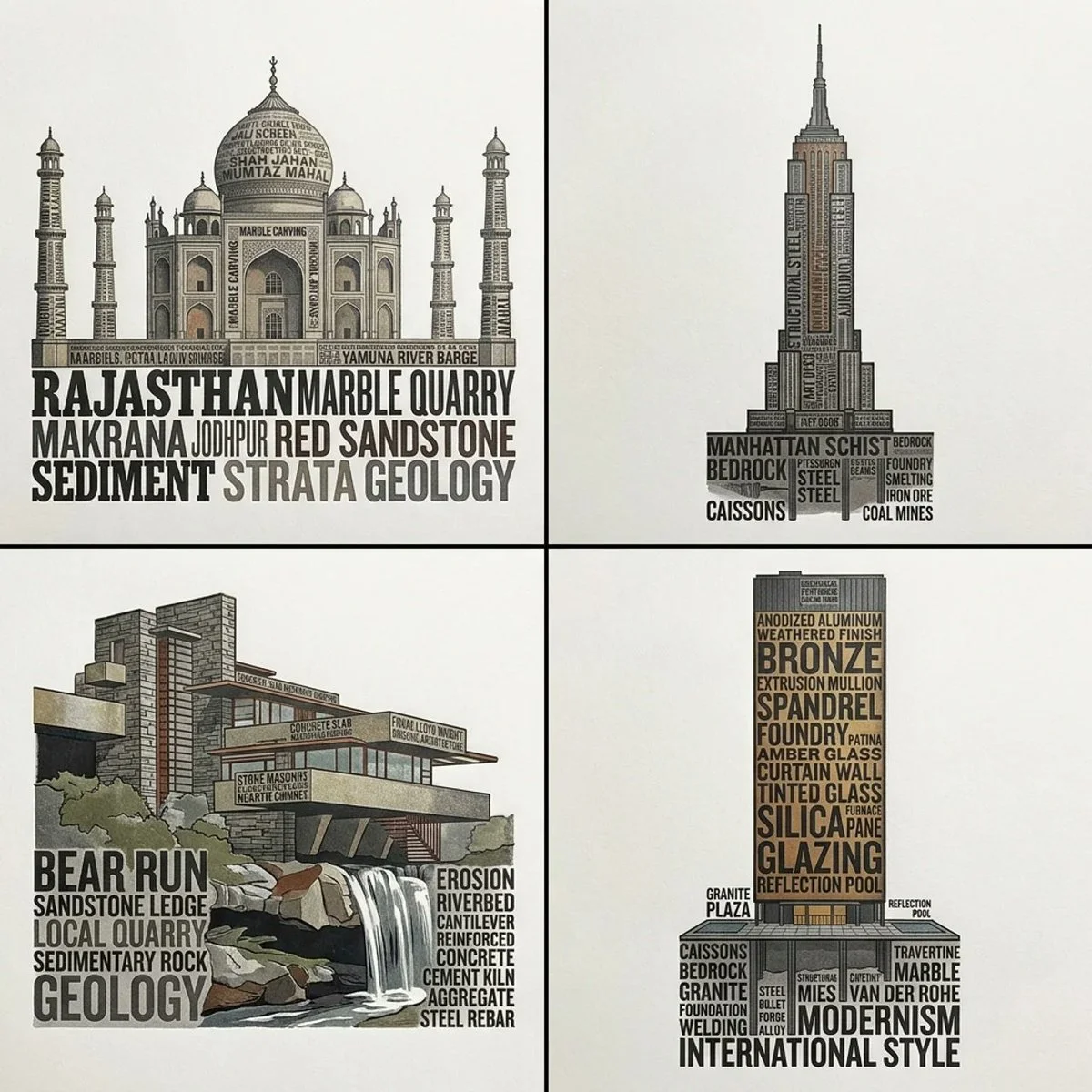
Explore a 2x2 grid showcasing four iconic buildings. Each structure is crafted from words that narrate the journey of their materials, reflecting their unique geological and industrial heritage.
Prompt
Create one image arranged as a 2x2 grid featuring 4 famous buildings, one per quadrant.

Variable:
$ provenance_scene = A vertical architectural cutaway where each building is made entirely from words tracing the geographic origin, extraction, fabrication, transport, and processing history of its materials.

Function Draw($provenance_scene){
<composition>
Each building should read as a monument built from its own supply chain and geology.
The four quadrants should feel like comparative industrial-era maps transformed into architecture.
Balanced spacing, crisp silhouettes, minimal background.
</composition>

<semantic_inference>
Infer the likely provenance of the key materials in each building.
Use quarry, foundry, forge, kiln, mill, timber, ore, limestone, marble, glass, smelting, transport, and fabrication vocabulary appropriate to the building.
Show how raw matter became architecture.
</semantic_inference>

<letterpress_spec>
MEDIUM: Hand-set lead type on dense archival cotton vellum.
INK: Charcoal black, quarry gray, ore-gray, muted rust and mineral undertones.
IMPRESSION: Strong embossing with layered density to suggest geological compression and industrial fabrication.
STYLE: Geological atlas meets architectural letterpress broadside.
</letterpress_spec>

<transformation>
Foundations use geology and earth words like bedrock, strata, limestone, shale, sediment in massive slab-serif.
Structural zones use forge, steel, billet, casting, rivet, smelt, alloy in dark industrial type.
Wall and surface zones use quarry, ashlar, marble, sandstone, concrete, aggregate, kiln, fired in textured serif blocks.
Window zones use silica, float glass, pane, furnace, glazing in airy transparent sans-serif.
Roof and finishing zones use copper, lead, slate, membrane, flashing, patina in jagged weathered display type.
The entire image should feel like architecture assembled from the memory of its materials.
</transformation>

<buildings>
1. Taj Mahal
2. Empire State Building
3. Fallingwater
4. Seagram Building
</buildings>

Output: one image
}
Published: April 21, 2026 by Gadgetify