Image ChatGPT Image 2
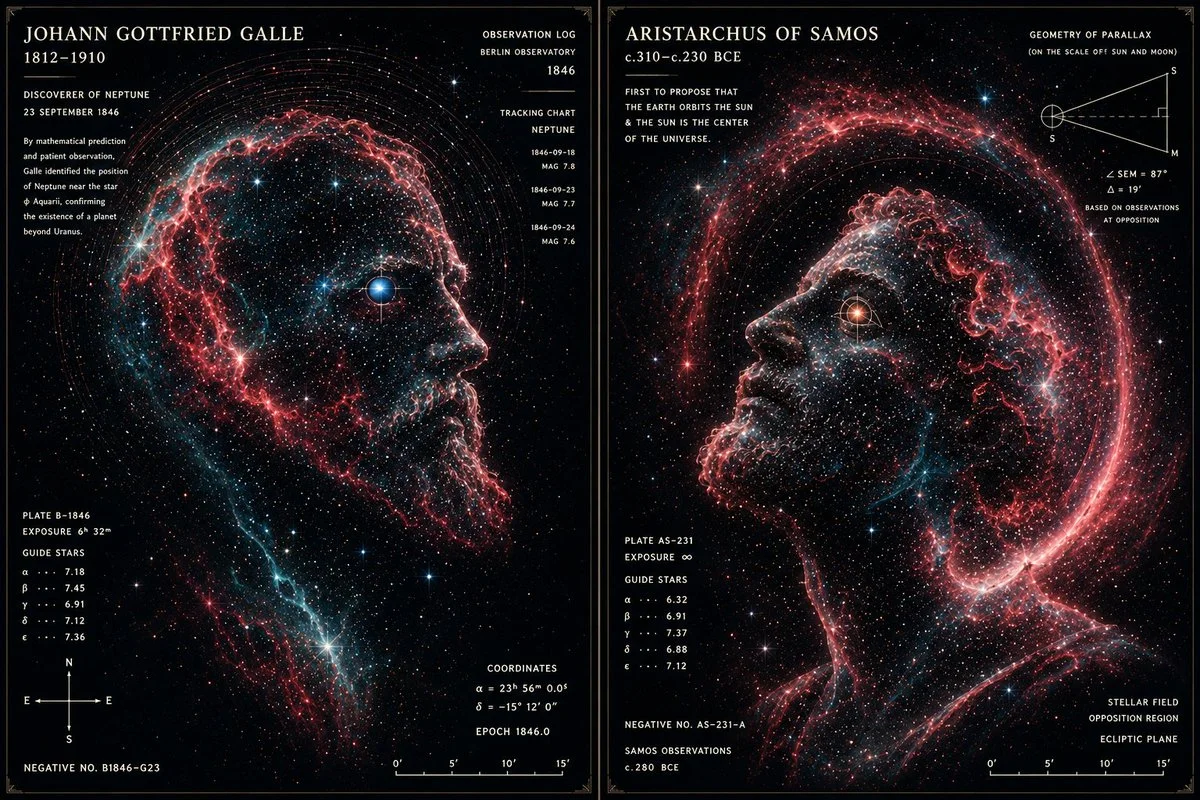
Aristarchus of Samos sees cosmic dust swirl into a nebula portrait
A long-exposure astrophotograph captures Aristarchus's face formed by stellar trails, nebula filaments, and cosmic dust, with a planetary body in the eye socket.
Prompt
<instructions> input = 1 pioneering astronomer input = ai inferred celestial phenomenon they first documented function render_parallax($ astronomer, $ phenomenon) anchor: [long-exposure astrophotograph of $ phenomenon] :: [the stellar trails, nebula filaments, and cosmic dust arranged into a gazing portrait of $ astronomer looking upward]::5 morphology: the star trail arcs sweep around the cranium, the nebula's emission clouds blush across the cheeks, a planetary body sits in the eye socket as if observing through a lens, the accretion disk rings the head like a halo, interstellar dust lanes obscure the far side of the face in silhouette, redshift gradients warm the receding contours::4 material physics: photographic plate grain from a large-format telescope camera, slight emulsion defects, diffraction spikes on bright stars, cosmic ray hits as thin white streaks, guide star annotations in grease pencil on the plate edges::3 illumination: the celestial objects are entirely self-luminous, no reflected light, hydrogen-alpha red dominates with OIII teal in the nebula regions, the background is absolute vacuum black::2 render stack: Palomar Observatory Sky Survey aesthetic, astrophotography, Hubble Palette composite, 8k, planetarium dome projection concept::1 negative: [telescope hardware, observatory domes, human eyes visible, earth's atmosphere, lens flares, star filters, clean digital render, artist's impression paintings]::-1 </instructions>
Published: May 23, 2026 by Gadgetify