Image ChatGPT Image 2
Capillary action drives self-wetting cutting board for dry kitchens
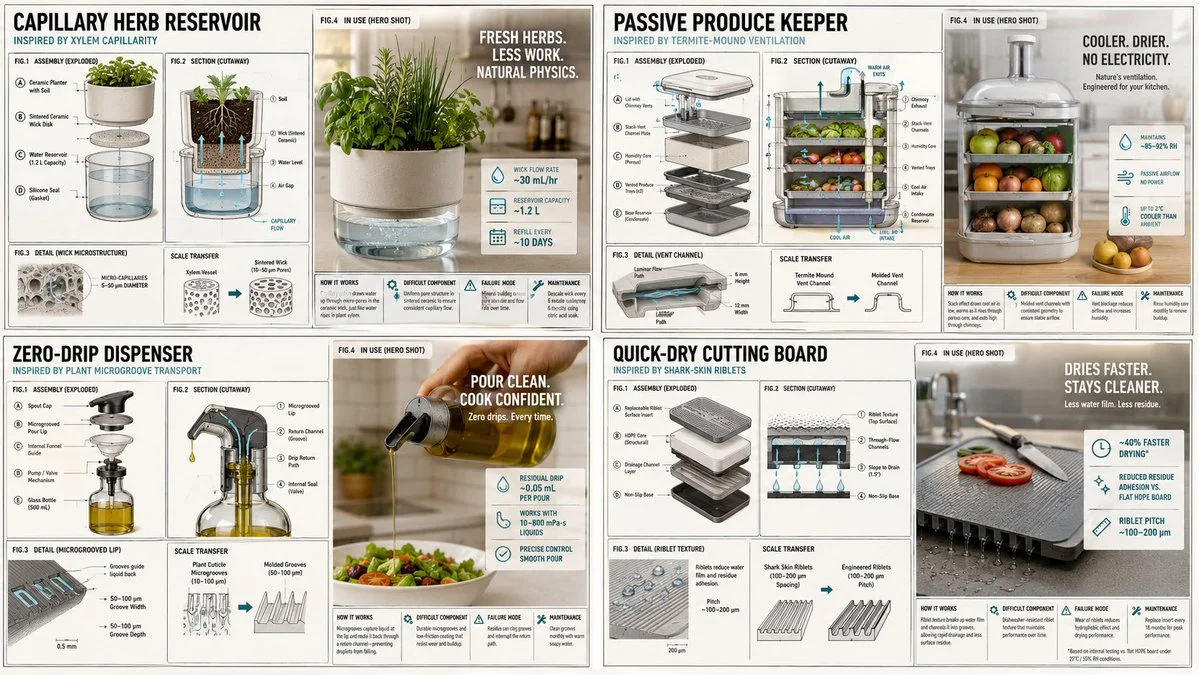
A patent plate style image showing a cutting board with micro-channels that draw moisture from a reservoir to keep herbs fresh during chopping. FIG.1 assembly, FIG.2 cross-section of channels, FIG.3 detail of capillary flow, FIG.4 large Kickstarter campaign render.
Prompt
2x2 grid, 16:9 do this for 4 home or kitchen products inspired by nature: INPUT ::= NATURAL_PHENOMENON + STUBBORN_FRICTION + FIELD_SETTING

STEP_1 :: extract the mechanism, discard the appearance
  - the physics actually doing the work: adhesion, capillarity,
    buckling, phase change, resonance, gradient
  - the length scale it operates at, and what happens outside it
  - the condition under which the phenomenon stops working
  - why this solution arose here and nowhere else

STEP_2 :: characterise the friction
  - who endures it, how many times per day, at what cost
  - the current workaround and why people tolerate it
  - what previous attempts got wrong
  - the tolerance the field setting will actually permit

STEP_3 :: transfer across scale
  - state the scaling law; if it does not survive the jump, say so
  - substitute a manufacturable analogue for each biological element
  - name the one component that current production cannot yet make
  - specify the failure mode and the maintenance interval

STEP_4 :: reject mimicry
  - the device must not resemble its source organism in any way
  - no claim without a measurable unit attached
  - if the phenomenon is decorative to the function, remove it
  - physics first, manufacturability second, form third

RENDER :: 16:9 patent plate — FIG.1 assembly, FIG.2 section,
  FIG.3 detail of the transferred mechanism, FIG.4 Largest one: Kickstarter campaign
Published: July 27, 2026 by Gadgetify