Image ChatGPT Image 2
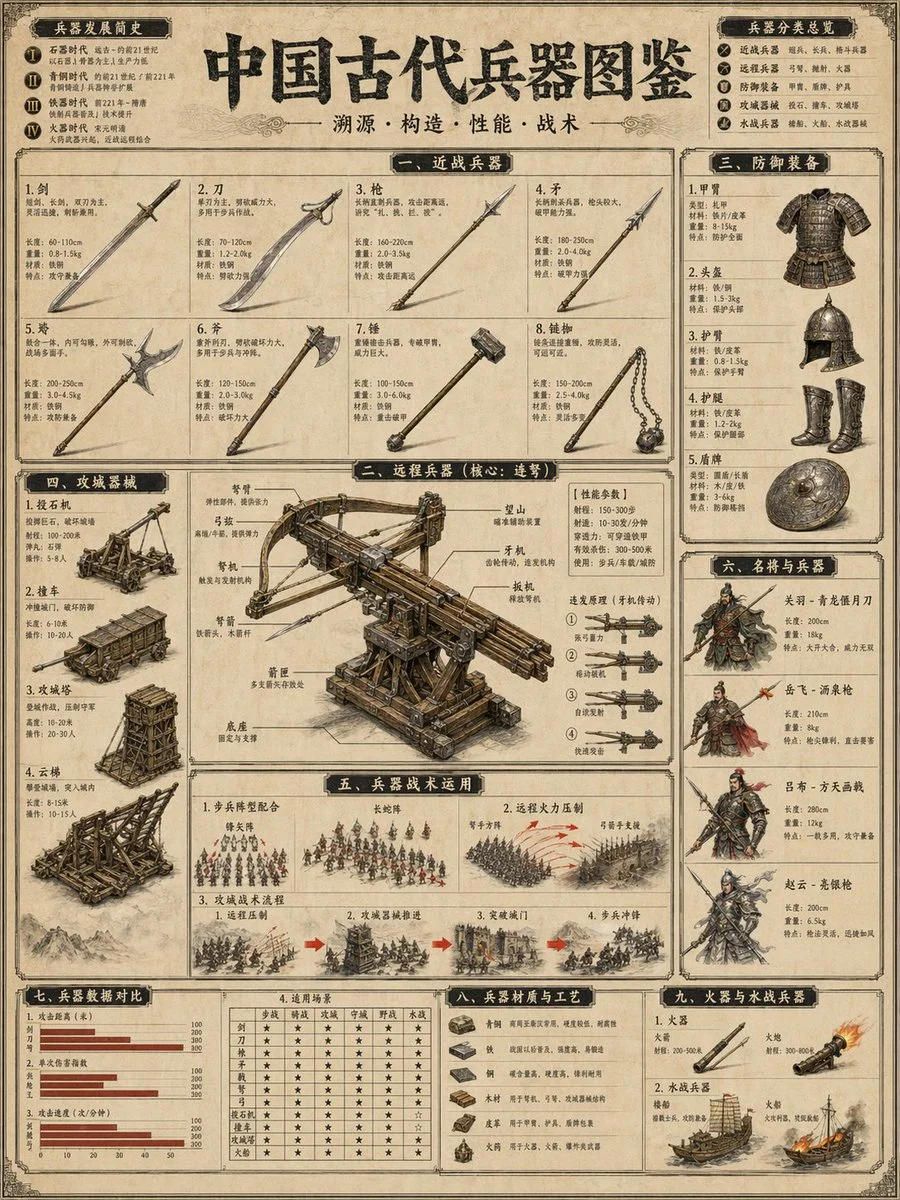
Decoding Ancient Chinese Naval Warfare: A Tactical Infographic
This technical masterpiece intricately details ancient Chinese naval strategies, employing charcoal ink and weathered textures. It blends meticulous line art with modern blueprint styles to showcase tactical units and their formations, capturing the essence of historical military precision.
Prompt
COMPOSITION: [选择一个: 主从卫星布局 / 45度等轴测全景]. Information gravity flows in a logical tactical sequence.
BOUNDARIES: Professional editorial layout with clean margins; negative space serves as “tactical breathing room” to separate different combat phases.
MODULE TOPOLOGY: [N] distinct information modules depicting different scales (e.g., individual weapon detail vs. macro formation).

[DIMENSIONALITY & GRAPHIC PHYSICS]
STYLE: Fusion of Traditional Chinese Gongbi (meticulous line-art) and modern military tactical blueprints (like “Osprey Publishing” style).
LINE LANGUAGE: 0.8pt sharp technical outlines / 0.3pt faint background grid lines / 2pt bold borders for the main title seal.
SURFACE EFFECTS: Realistic material rendering — wood grain on ballistas, metallic sheen on lamellar armor, and subtle ink-wash shading for terrain.

[TYPOGRAPHY ECOSYSTEM — ADAPTIVE DENSITY]
TYPOGRAPHY DENSITY: Map-dominant (65% visual / 35% text).
T1 MACRO HEADER: Massive, ultra-bold Traditional Songti characters for the main title “[主题中文名]”. MUST be strictly pure Chinese Hanzi with an ink-pressed texture.
T2 MODULE HEADERS: Kaiti font enclosed in dark rectangular “military rank” badges, labeling different tactical zones.
T3 BODY TEXT: Clean, medium-weight Heiti (sans-serif) for weapon specifications and tactical roles. Every character must be razor-sharp.
T4 ANNOTATIONS: Micro-text with ultra-crisp technical lines pointing directly to components (e.g., trigger mechanism, fletching, armor joints).

[NARRATIVE FLOW]
NARRATIVE MODE: [选择一个: 流程顺序型 / 核心辐射型].
VISUAL ENTRY POINT: The most significant tactical unit (e.g., the command chariot or the primary siege engine).
PATH MECHANISM: Numerical sequence (1, 2, 3…) or bold cinnabar-red arrows guiding the viewer through the battle logic.

[ICONOGRAPHY & METAPHOR]
ICON STYLE: Highly detailed historical pictograms for units (infantry, cavalry, archers).
CORE METAPHOR: Military order as a precise clockwork mechanism.
CONSISTENCY: All symbols must adhere to the [时期/王朝, 如: Tang Dynasty] military aesthetic.

[MODULE STRUCTURE — SUGGESTED BLOCKS]
[MOD 1: CENTER-PIECE] — The primary [Weapons/Formation] with an exploded-view detail showing internal mechanics.
[MOD 2: TACTICAL MAP] — Top-down schematic showing unit movement and line-of-fire.
[MOD 3: SOLDIER EQUIPMENT] — Close-up side-by-side comparison of offensive vs. defensive gear.
[MOD 4: LOGISTICS/STATISTICS] — Small icon-based charts showing range, weight, or troop density.

[FINAL EXECUTION LOCK]
Render as a single, ultra-detailed educational plate. All visual systems must be internally consistent with a professional museum archive aesthetic. Every pixel must serve the purpose of clarifying complex military history.
Resolution target: Maximum information density, print-ready encyclopedia quality.

主题:中国古代兵器图鉴 3:4 4k文字清晰可读
Published: April 22, 2026 by 知识猫图解