Image ChatGPT Image
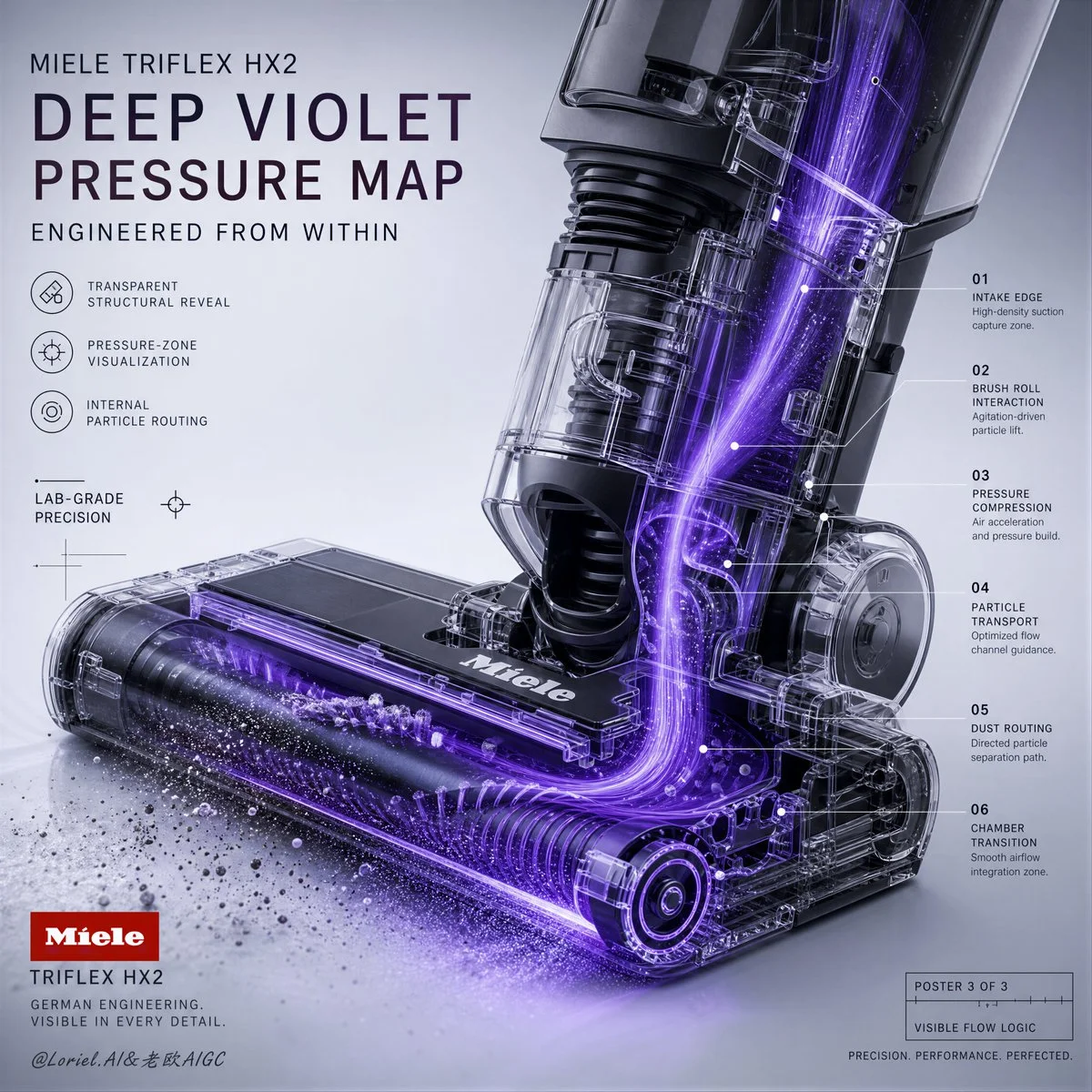
Deep-violet pressure maps visualize airflow inside Miele's premium vacuum
Scientific visualization of suction zones and particle routing within the HX2, combining laboratory clarity with luxury advertising aesthetics.
Prompt
Copied. Make it your own here.
Prompt prefilled · Suggested: ChatGPT Image 2 · 4 credits/image
Create an ultra-premium flagship campaign poster for Miele Triflex HX2, designed as Poster 3 in a cohesive series, combining a laboratory-grade transparent cutaway housing with a deep-violet pressure-map visualization system. The image must feel hyper-real, scientifically precise, visually striking, and exceptionally refined, showing the internal engineering truth of the product through a clean experimental-display aesthetic. The final result should look like a world-class German engineering poster, not a generic tech ad or fantasy CGI render.

Core concept:
The hero is the Miele Triflex HX2 shown in an extreme macro close-up with an ultra-clean transparent outer shell, revealing the internal airflow logic, brush interaction, particle routing, suction pressure zones, and internal engineering architecture. The image should feel like a premium laboratory demonstration model fused with a luxury advertising visual. The transparent shell must be crystal-clear, disciplined, and elegant, while the internal airflow system is visualized as a deep-violet pressure map with luminous gradients and technically believable flow behavior.

Composition:
Use a strong vertical poster layout with one enlarged close-up of the Miele Triflex HX2 floorhead or lower cleaning assembly dominating the frame. Show the product in a side or three-quarter cutaway view, with the housing partially transparent and precisely sectioned to expose internal systems. The product should fill most of the image and feel sculptural, premium, and technically exact.
Inside the product, organize the visible internal zones clearly:
intake edge,
brush-roll interaction area,
pressure-compression regions,
particle transport channels,
dust-routing pathway,
and chamber transition logic.
Leave controlled negative space for title placement and refined technical annotation.

Product realism:
Render the Miele Triflex HX2 with absolute realism and exact premium-brand fidelity:
accurate floorhead geometry,
true shell thickness,
precise transparent material behavior,
realistic internal partitions,
authentic brush-roll structure,
engineered airflow channel routing,
subtle metallic components,
premium matte and satin outer-surface transitions,
and unmistakable Miele industrial design language.
The product must feel physically exact, luxurious, and mechanically credible in every detail.

Transparent shell design:
Make the transparent housing exceptionally clean, laboratory-grade, and premium. The shell should feel like polished scientific demonstration material:
crystal-clear transparency,
minimal distortion,
precise edge definition,
clean sectional boundaries,
subtle reflection control,
and elegant material depth.
The transparency should reveal the internal structure without visual clutter. It must feel more like a high-end engineering prototype or museum-grade lab display than a consumer cutaway graphic.

Deep violet pressure-map system:
Visualize the internal performance using a refined pressure-map language built around deep violet, electric indigo, and controlled blue-violet gradients. Show different airflow and pressure regions through:
luminous pressure bands,
flow-density gradients,
velocity-transition ribbons,
micro turbulence zones,
fine-particle lift behavior,
and directional suction streams.
The violet-map visualization should feel scientifically grounded and product-specific, not decorative. Pressure intensity should shift naturally across internal zones, from concentrated intake regions to routed channel flow and separation logic. Keep the system elegant, readable, and visually powerful.

Airflow and particle simulation:
Use highly realistic internal physics visualization:
fine dust suspension,
micro-debris acceleration,
brush agitation behavior,
channel-guided suction flow,
pressure compression around the intake path,
and smooth routing toward the inner collection zone.
Particles must move according to believable suction mechanics and internal geometry. The interaction between structure and effect must feel rigorous and physically justified.

Environment:
Use a minimal premium technical-lab environment with a refined neutral platform or floor. The background should be clean, quiet, and controlled, supporting the product without distraction. A subtle studio-lab gradient or pale neutral technical backdrop is preferred, helping the transparent shell and violet pressure-map effects stand out with maximum clarity.

Typography:
Use only elegant English typography with strong premium technical hierarchy.
Possible title directions:
“MIELE TRIFLEX HX2”
“DEEP VIOLET PRESSURE MAP”
“ENGINEERED FROM WITHIN”
“VISIBLE FLOW LOGIC”
“LAB-GRADE PRECISION”
Use refined supporting text such as:
“Transparent Structural Reveal”
“Pressure-Zone Visualization”
“Internal Particle Routing”
Typography should feel clean, modern, and luxurious, with restrained technical callouts and minimal annotation lines.

Graphic accents:
Add only subtle engineering-style graphic marks:
fine callout lines,
pressure-zone indicators,
cutaway boundary labels,
micro arrows,
transparent structure markers,
and minimal calibration-style notation.
Everything must remain premium, sparse, and precise.

Brand coding:
Preserve Miele identity through:
German precision,
quiet luxury,
timeless engineering,
technical intelligence,
premium material discipline,
and refined industrial design clarity.
The poster should communicate that Miele Triflex HX2 is engineered beautifully both outside and inside.

Lighting:
Use exquisitely controlled studio-lab lighting with scientific precision. The lighting should define the transparent shell, internal structures, and pressure-map glow with exceptional clarity. Transparent surfaces should show subtle controlled reflections, never messy glare. Internal violet illumination should appear embedded and physically integrated, while the product exterior remains solid, premium, and realistic.
Shadows should be soft, smooth, and elegant.

Color direction:
Use a premium precision-tech palette built around:
deep violet,
electric indigo,
cool ultraviolet blue,
ice silver,
smoked titanium,
and restrained white highlights.
The internal pressure-map system should lead with violet and indigo gradients, while the outer housing remains neutral, clean, and laboratory-premium. The final palette should feel colder, sharper, and more advanced than earlier posters.

Mood:
technical, hyper-real, premium, laboratory-grade, precise, engineered, controlled, luxurious, visually striking, intelligent, futuristic but believable.

Rendering style:
hyper-real Miele Triflex HX2 engineering poster, laboratory-grade transparent cutaway housing, deep violet pressure-map visualization, realistic airflow and internal particle simulation, premium technical studio environment, elegant English typography, German industrial design precision, world-class appliance realism, 8k.

Negative prompt:
generic tech ad, fake CGI fantasy structure, impossible internal geometry, cartoon airflow, messy infographic layout, cheap transparent plastic look, oversaturated neon glow, unrealistic particle behavior, cluttered background, weak product focus, low-detail cross-section, gimmicky sci-fi effects, low-end retail flyer
Published: July 13, 2026 by Loriel.AI