Image ChatGPT Image 2
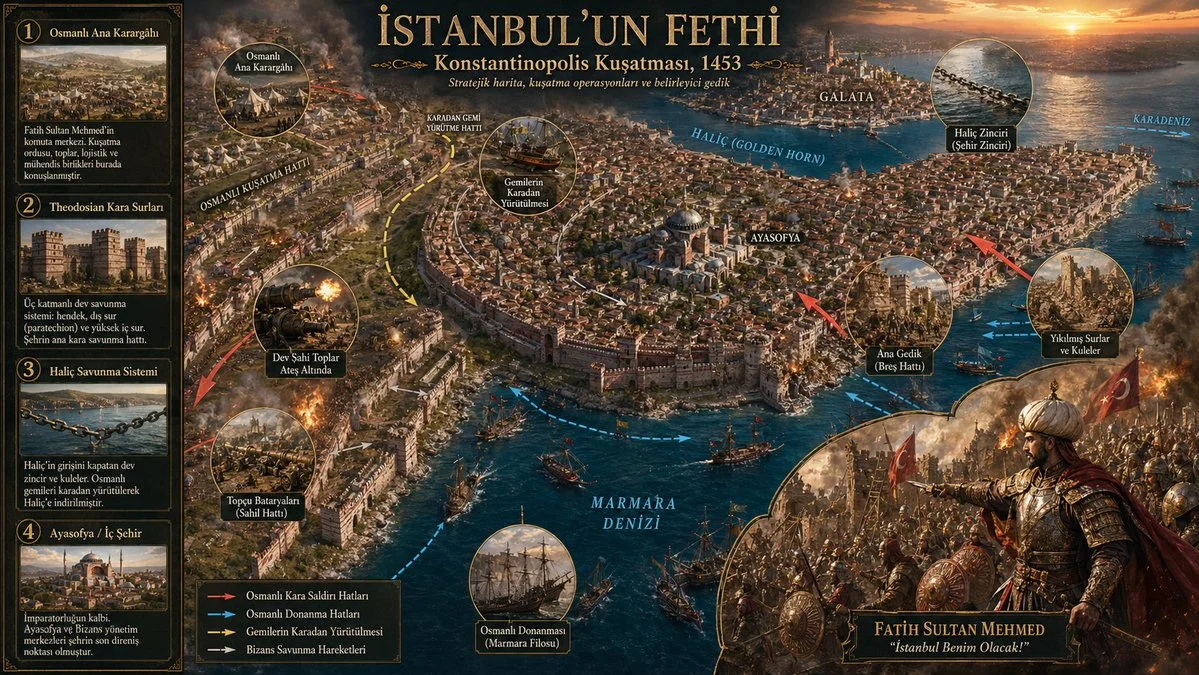
Detailed Historical Infographic of the Fall of Constantinople
A meticulously crafted infographic poster depicting the dramatic siege of Constantinople, highlighting strategic points, troop movements, and intense destruction during the conquest.
Prompt
Create a premium 16:9 historical infographic poster for the [Buraya savaş adını yaz] designed as a highly realistic HISTORICAL EVENT MAP GUIDE.

CORE OBJECTIVE:
Generate a visually striking, historically grounded, ultra-detailed poster that reconstructs the conquest of Constantinople directly on top of a believable real-world historical map.

The image must feel like a realistic historical reconstruction, not a fantasy illustration and not a modern city map. It should clearly visualize the geography, major strategic points, troop positions, siege operations, movement routes, fortifications, and the decisive breach.

VERY IMPORTANT — BATTLE INTENSITY AND DESTRUCTION:
The scene must show the brutal violence and destructive power of the siege much more clearly.

Add visible signs of intense bombardment and devastation:
- the great bombards must be actively firing
- show muzzle flashes, smoke bursts, fire, recoil, and artillery blasts
- add flaming cannon fire and dense smoke around artillery positions
- show damaged and partially collapsed wall sections
- add shattered towers, broken battlements, breached gates, rubble, and fallen masonry
- include burned or ruined areas near the breach sector and siege front
- show scorched ground, smoke clouds, drifting dust, and debris
- make the battlefield feel harsh, chaotic, and violent

The siege must visibly look destructive and relentless.
Do not make the battle look too clean or symbolic.
The damage to the city defenses and surrounding battle zone must be clearly visible.

VERY IMPORTANT — EVENT-SPECIFIC HISTORICAL DETAIL:
The poster must include not only the main siege map, but also the unique historical details and iconic operations that define the event.

These must be clearly visible in the image:
- the Golden Horn chain
- Ottoman ships dragged overland into the Golden Horn
- great bombards / artillery batteries
- Ottoman siege lines and camp
- Theodosian land walls
- the main breach sector
- the Ottoman fleet
- Hagia Sophia and the inner city

Do not reduce the image to only walls, troops, and arrows.
The image must visibly tell the story of how the conquest happened.

VERY IMPORTANT — RIGHT LOWER CORNER HERO SCENE:
In the lower-right corner, include a large dramatic inset scene showing the decisive moment of the conquest.

This scene must feature the main historical protagonist of the event as the focal figure:
Sultan Mehmed II.

He must be shown in a historically appropriate and visually heroic pose inside the conquest / battle scene.
Examples of the pose:
- commanding the final assault while pointing toward the breached walls
- standing in a powerful leadership stance amid the conquest
- mounted or standing with authority near the battlefield
- directing troops forward during the decisive moment
- shown as the central commanding figure of the victory

This hero scene must not be generic.
It must clearly feel like the key historical figure leading the defining moment of the event.

The protagonist must:
- appear visually important and clearly readable
- be larger or more prominent than surrounding soldiers
- have a strong, iconic, historically grounded pose
- be integrated naturally into the conquest scene
- wear historically appropriate 15th-century Ottoman attire / armor
- not look fantasy-like, theatrical, or from the wrong era

The surrounding scene should include:
- Ottoman troops storming or advancing
- breached walls or active siege action
- rubble, ladders, smoke, banners, shields, and close combat
- Byzantine defenders in historically appropriate appearance
- active destruction, falling stones, shattered defenses, and fire-lit smoke
- a cinematic and decisive conquest atmosphere

LEFT PANEL:
Keep the left-side panel clean and limited.
Use only 4 main numbered sections:
1. Ottoman Main Camp
2. Theodosian Land Walls
3. Golden Horn Defense System
4. Hagia Sophia / Inner City

Each item should include:
- one number
- short heading
- very short description
- thumbnail image

Do not overload the left panel.

MAP-INTEGRATED HISTORICAL POPUPS:
Secondary but important historical details must appear directly on the map as circular callouts, popup bubbles, or round inset previews.

These popup callouts should show:
- great bombards actively firing
- ships dragged overland
- the Golden Horn chain
- Ottoman fleet activity
- breach sector
- artillery positions
- special siege operations
- ruined wall sections
- burning or damaged areas

Each popup should feel like a mini historical reconstruction and should be placed at the correct location on the map.

CITY AND LANDMARK DENSITY:
Reduce unnecessary building clutter.
Do not fill the city with too many repetitive generic houses.

Instead:
- simplify urban density
- use more breathing room
- emphasize symbolic and historically important landmarks
- show fewer but more meaningful buildings
- make the city easier to read
- keep the layout clear and strategic

The city should feel historically authentic, but more iconic and legible than overcrowded.

ARCHITECTURE RULE:
All visible buildings, walls, towers, gates, ports, docks, religious structures, and civic landmarks must be appropriate to the year 1453 and the Byzantine–Ottoman setting.

Do NOT show:
- modern-looking buildings
- modern roads
- modern urban planning
- glass buildings
- contemporary skyline elements
- generic fantasy castles
- mixed-era architecture

The city must look like late medieval Constantinople.

SOLDIER AND MILITARY ACCURACY:
All soldiers must look historically and culturally appropriate to the event.

Important:
- Ottoman troops must look like believable 15th-century Ottoman soldiers
- Byzantine defenders must look like believable late Byzantine soldiers
- do not use generic fantasy warriors
- do not mix wrong-era armor, helmets, shields, weapons, or uniforms
- the two sides must be visually distinguishable
- all forces must look historically believable

MAP REALISM:
The map must be based on real or historically accepted geography.

Show:
- Sea of Marmara
- Golden Horn
- Theodosian walls
- harbor entrance
- defensive chain across the Golden Horn
- Ottoman camp areas
- siege lines
- artillery positions
- breach sector
- naval activity
- inner city

All geography must feel strategically logical and historically believable.

ROUTES AND STRATEGIC MOVEMENT:
Use elegant, clear route arrows and movement lines.

Differentiate:
- Ottoman main assault routes
- Byzantine defensive movements
- Ottoman naval routes
- overland ship transport route
- artillery or siege pressure zones

The routes should be readable but should not overpower the realism of the map.

LIGHTING AND MOOD:
Use a dramatic golden-hour atmosphere, either sunrise or sunset.
Add warm highlights, bright water reflections, fire glow, smoke haze, and strong cinematic contrast.
The image must be vivid and attention-grabbing, not flat or dull.

STYLE:
The overall style must be:
- hyper-realistic
- historically grounded
- cinematic
- editorial
- premium
- clean but rich in detail
- readable
- museum-quality

It should look like:
- a realistic 3D historical map-diorama
- an elevated terrain reconstruction
- a premium documentary-style strategy poster
- a historical visualization with strong event-specific storytelling

TEXT QUALITY:
All text must be sharp, readable, and correctly spelled.
Use only historically relevant labels.
No gibberish text.
No random labels.
No unrelated landmarks.

NEGATIVE PROMPT:
clean undamaged walls, inactive cannons, no cannon fire, no destruction, no rubble, no breach damage, weak battle intensity, generic battle scene, missing main historical figure, hero not visible, fantasy warrior, wrong-era armor, wrong-era costume, wrong-era weapons, theatrical pose, modern buildings, modern skyline, excessive city clutter, repetitive houses, overcrowded left panel, too many numbered entries, empty markers, hollow pins, unreadable text, fake geography, mixed historical periods, cartoon style, low-detail map, anachronistic architecture
Published: May 11, 2026 by ai.gezgini