Image ChatGPT Image 2.6
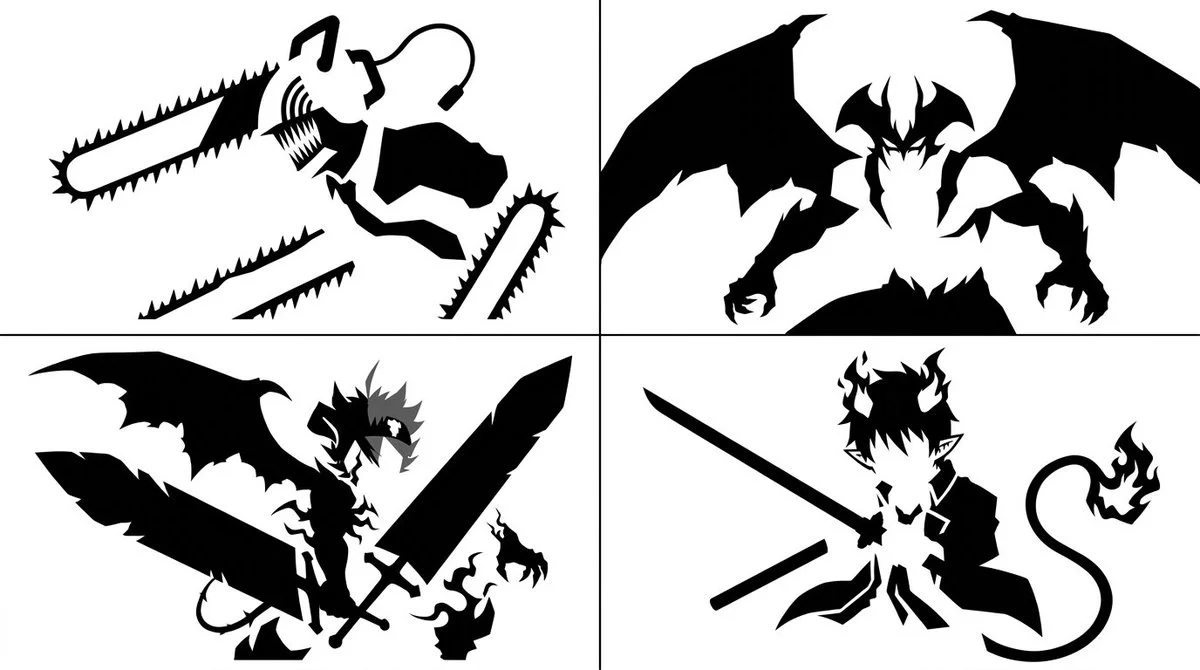
Devil Manga Silhouettes Haunting the Empty White Space
Each quadrant holds a ghost of a devil manga hero, broken into floating black masses whose missing contours and quiet gaps invite the eye to complete the figure.
Prompt
Copied. Make it your own here.
Prompt prefilled · Suggested: GPT Image 2.6 Flare · 4 credits/image
2x2 grid, 16:9, do this for 4 devil mangas: Prompt: INPUT = [SUBJECT]

V = {
  HERO       : iconic subject silhouette | strongest visual metaphor,
  FRAGMENTS  : adaptive 3–9 detached shapes,
  FEATURES   : 1–4 essential recognition cues,
  GAPS       : anatomy | motion | depth | conceptual separation,
  TOPOLOGY   : vertical | horizontal | radial | diagonal | asymmetric,
  GEOMETRY   : organic curves × bold geometric masses,
  MOTIF      : one optional subject-derived symbol,
  BLACK      : 8–25% coverage,
  WHITE      : 75–92% negative space,
  STYLE      : pure black/white precision vector,
  TEXT       : none
}

C₁  SUBJECT → INVISIBLE MASTER SHAPE (master)
    infer SUBJECT identity, iconic silhouette, defining features, gesture and geometric structure; construct a complete invisible [HERO] as the reference for selective deconstruction, never as the final visible artwork.
    ¬C₁ = generic icon / arbitrary metaphor / conventional complete silhouette.

C₂  SEMANTIC GESTALT FRAGMENTATION
    split HERO into [FRAGMENTS] at natural joints, curvature transitions, structural intersections or meaningful boundaries; simplify each into bold solid-black geometry while preserving its perceptual relationship to the invisible whole.
    ¬C₂ = random floating blobs / puzzle-piece cuts / excessive fragmentation.

C₃  NEGATIVE-SPACE ARCHITECTURE
    use [GAPS] as active structural elements: missing contours, invisible joints, implied motion, anatomical openings or absent connections. White space must complete the subject through perception rather than drawn outlines.
    ¬C₃ = filled-in anatomy / thin connecting strokes / meaningless empty gaps.

C₄  MINIMUM RECOGNITION ENGINE
    rank fragments by contribution to subject recognition; preserve only the highest-value silhouettes and [FEATURES]. If recognition weakens, adjust alignment, curvature or gap width before introducing additional geometry.
    ¬C₄ = excessive details / ambiguous identity / redundant shapes / generic features.

C₅  FLOATING FORM RELATIONSHIPS
    balance grounded masses with detached extensions, hovering features, suspended symbols or separated structural forms. Align invisible contours through proximity, directional continuity and optical tension.
    ¬C₅ = randomly scattered pieces / rigid assembly / weak perceptual connection.

C₆  SUBJECT-RESPONSIVE TOPOLOGY
    choose [TOPOLOGY] from HERO geometry: tall → vertical; wide → horizontal; circular → orbital; moving → diagonal trajectory; otherwise asymmetric central cluster. Preserve the implied silhouette without reconstructing it completely.
    ¬C₆ = fixed layout / disconnected orientation / crowded central mass.

C₇  SEMANTIC MICRODETAIL + MOTIF
    integrate 0–4 essential [FEATURES] as simple cutouts or detached marks; add [MOTIF] only when it improves recognition or creates meaningful interaction. Every visible element must justify its presence.
    ¬C₇ = obligatory eyes/ears / arbitrary stars/hearts / decorative filler.

C₈  GESTALT PERCEPTION LAWS
    optimize closure × proximity × good continuation × figure–ground ambiguity × simplicity; fragmented curves and masses must invite the viewer to mentally reconstruct ONE coherent SUBJECT.
    ¬C₈ = unrelated silhouettes / obvious complete outlines / weak optical illusion.

C₉  EXTREME VECTOR MINIMALISM
    pure-black flat shapes on uninterrupted white; [BLACK] coverage, [WHITE] negative space, smooth precise edges, subtle asymmetry, no strokes or texture. Keep fragments large enough for thumbnail recognition.
    ¬C₉ = gradients / shadows / outlines / gray tones / photographic depth / tiny fragments.

η   PERCEPTUAL COMPLETION PRECISION
    FAR → iconic fragmented form;
    MID → unmistakable subject identity;
    CLOSE → clever missing-contour logic.
    Maximum recognition through minimum geometry, intentional spatial tension, elegant visual economy.

FORBIDDEN = complete silhouettes · random floating shapes · puzzle-piece geometry · generic clipart · thin outlines · excessive fragments · unrelated motifs · text · gradients · shading · texture · 3D · weak gestalt closure
Published: November 17, 2026 by Gadgetify