Image ChatGPT Image 2
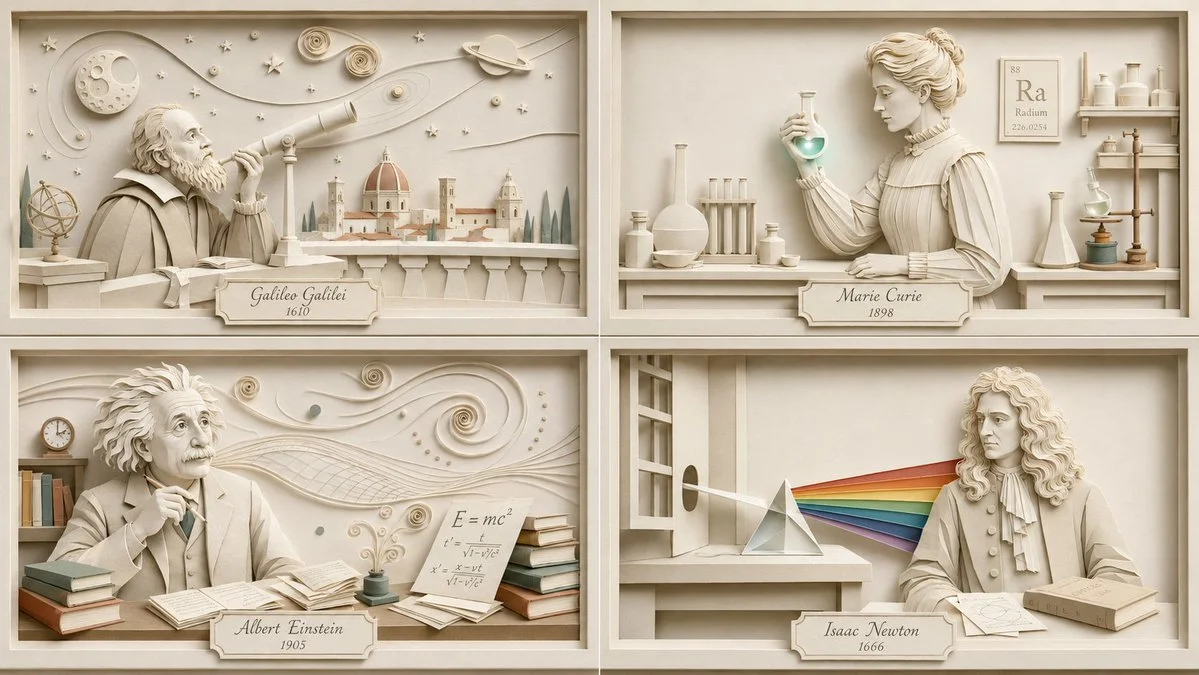
Einstein's thought experiment unfolds in layered ivory paper.
Einstein at his blackboard, chalk lines turned to thin cut-paper inlays, deep shadows between each fiber.
Prompt
2x2 grid, do this for 4 famous scientists experiencing their most famous day in this style: Style = { <minimal_paper_relief_diorama> ESSENCE: A subject rebuilt as a handcrafted layered-paper relief, set in a near-empty warm-white gallery frame — smooth matte planes against finely combed paper fiber, a few earthy Mediterranean accents, and soft shadows that betray every cut edge. MEDIUM: Layered paper-cut relief / quilled illustration / miniature diorama, photographed flat-on as a gallery piece. SHALLOW relief, never full 3D volume. MATERIALS: Heavy ivory cardstock, textured matte paper, thin stacked cuts, rolled quilling strips, folded tabs, hand-painted paper edges. CORE MOVE — translate textures into paper, don't render them realistically: smooth surfaces (walls, faces, bodies, sky, water) → clean matte planes, gently curved fur / hair / feathers → dense parallel combed strips or fine incised grooves, following growth direction foliage / canopy → granular quilled dots, torn-paper flecks, layered fringe fabric / drapery → fanned vertical paper pleats smoke / cloud / flow → curled, rolled quilling spirals fine detail (eyes, windows, hardware) → the smallest crisp cut-paper inlays — the ONLY sharp marks in the piece Keep the subject's silhouette, pose, and identity intact; only the material logic changes. TWO MODES (the reference uses both): (a) PORTRAIT — a single subject, centered or low on an empty white field, no environment. (b) DIORAMA — the subject inside a sparse miniature scene built from the World Kit below. Both obey the same texture, color, light, and emptiness rules. FORM: Elegant simplified profiles stacked as shallow planes — thin, precise, visibly paper-made, with clean cut edges and soft curvature. No bulky toy volume. Readable across a room; rewarding up close. COLOR: ~90% warm white / ivory / cream. Accents used sparingly, ONLY as earthy Mediterranean notes — terracotta & brick-orange, dusty teal, sage & olive, ochre / mustard, muted red, warm brown. No neon, no heavy saturation, almost no black (shadow carries the contrast). LIGHT: Soft, diffuse, near-frontal studio light. Short, soft-edged drop shadows in the gaps BETWEEN layers — those shadows are the proof of construction. No drama, no rim light, no hard cast shadows. COMPOSITION: Aggressive negative space — leave 40–60% of the frame as quiet white paper, usually open above. Anchor the scene low on a single soft rolling cut-paper horizon. Place every element with restraint; let it breathe. WORLD KIT (for diorama mode): cubic whitewashed Mediterranean buildings, terracotta tile roofs, arched doors and shuttered windows, Italian umbrella pines and round shrub-balls on slim brown trunks, tiny walking figures (often one in red), a small dog, a stray rooftop tree or cat, an occasional bright umbrella or awning. Tiny scale, gentle human-scale narrative. FINISH: Matte, tactile, serene, refined — a quiet gallery photograph of a delicate, collectible paper installation. Poetic and faintly magical. AVOID: photorealism; clay / plastic / vinyl / metal / glass / plush logic; glossy surfaces; dark or cinematic lighting; hard outlines or comic linework; cluttered maximalism; thick chunky proportions; neon or high-saturation color; realistic grime, pores, or weathering; filling the white space. </minimal_paper_relief_diorama> }
Published: July 2, 2026 by Gadgetify