Image ChatGPT Image 2
F1 underfloor aerodynamics guide reveals ground effect downforce secrets
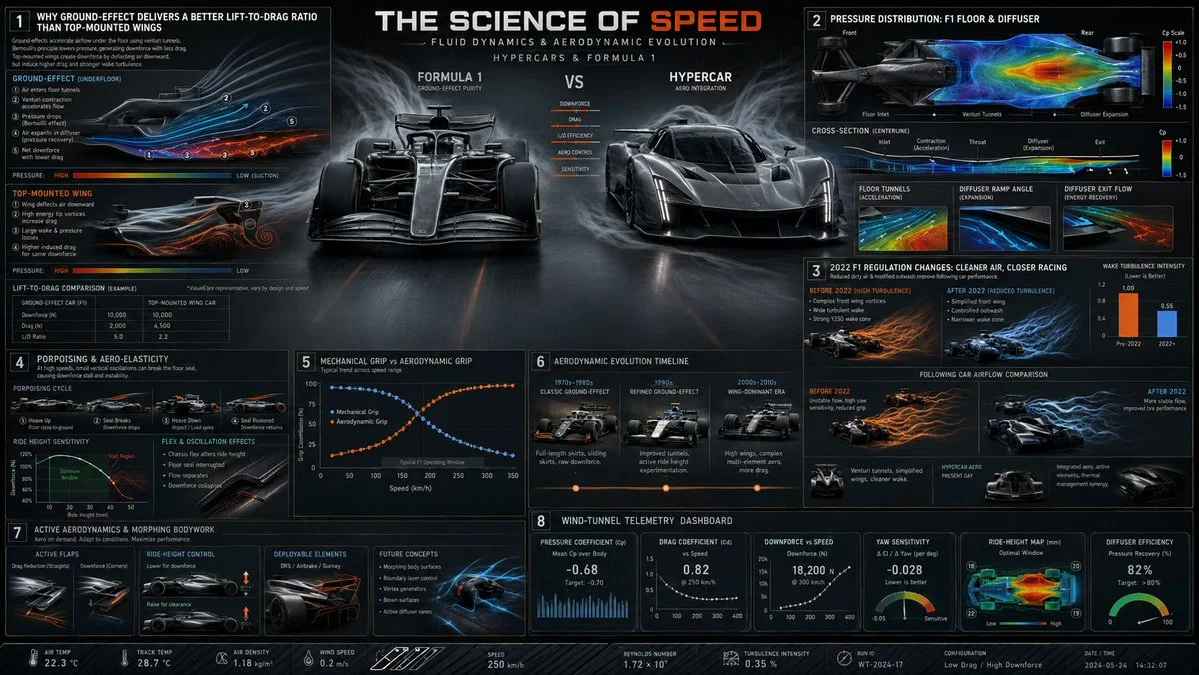
Cutaway of F1 car showing venturi tunnels and CFD pressure maps, explaining Bernoulli's principle for better lift-to-drag ratio.
Prompt
Create an automotive engineering infographic analyzing the fluid dynamics and aerodynamic evolution of hypercars and Formula 1. Visual style: glossy carbon fiber textures, Computational Fluid Dynamics (CFD) heat maps, smoke-tunnel flow visualizations, metallic paint reflections, and wind-tunnel telemetry data. ANALYTICAL COMPONENT: Add telemetry panels examining "Why does generating downforce via underfloor ground-effects yield a better Lift-to-Drag ratio than top-mounted wings? Analyzing Bernoulli’s principle in venturi tunnels." Draw pressure distribution maps over an F1 car's floor and diffuser. Include tech callouts: "2022 F1 Regulation changes: How managing 'dirty air' and outwash changed wake turbulence" with vortex generation sketches. Create supplementary analysis: scatter plots comparing mechanical grip (tires) vs. aerodynamic grip at varying speeds. Add physical limits: "Porpoising and aero-elasticity: when the chassis flexes and breaks the aerodynamic seal." Render projection curves for "Active aerodynamics and morphing bodywork" in glowing wind-tunnel smoke trails. Automotive design studio, Unreal Engine 5, photorealistic.
Published: May 25, 2026 by Gadgetify