Image ChatGPT Image 2.6
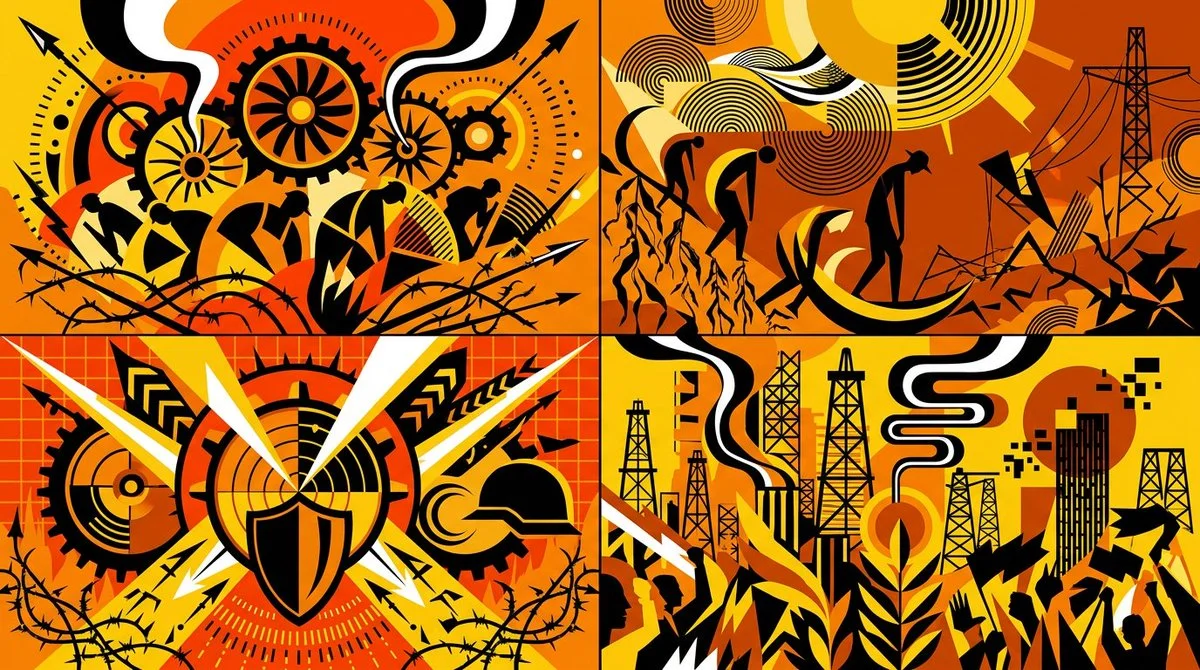
Four Decades of Bold Geometry Reimagined as Abstract Portraits
Each panel translates a subject into sweeping ribbons, segmented discs, and gold-ringed botanical flourishes, keeping identity alive through pure shape.
Prompt
Copied. Make it your own here.
Prompt prefilled · Suggested: GPT Image 2.6 Flare · 4 credits/image
2x2 grid, 16:9, do this for 4 hard decades:

Create a sophisticated abstract geometric illustration of
[SUBJECT], using a distinctive artistic style combining
Bauhaus-inspired geometry, mid-century modern graphic design,
Art Deco ornamentation, and flowing botanical abstraction.

Use the uploaded image as a STYLE reference when provided.
Preserve its visual construction, geometric vocabulary,
ornamental rhythm, color intensity, and compositional logic
without literally copying the depicted abstract motif.

C₀  SUBJECT IDENTITY + ABSTRACT TRANSLATION (highest priority)

    Analyze [SUBJECT] and identify its defining silhouette,
    characteristic shapes, proportions, recognizable features,
    physical structure, movement, and visual personality.

    Preserve the subject's essential identity while translating
    its appearance into an entirely new geometric-organic
    illustration.

    Reduce recognizable features into combinations of bold
    circular shapes, decorative curves, pointed extensions,
    sweeping black-and-white ribbons, and negative space.

    For recognizable people, reinterpret defining hairstyles,
    facial profiles, clothing silhouettes, or characteristic
    gestures through abstract geometric structures.

    For animals, preserve recognizable species traits through
    stylized silhouettes and ornamental reinterpretation.

    For flowers, plants, or other organic subjects, translate
    natural growth into geometric petals, leaves, stems,
    and radial botanical structures.

    For objects or abstract concepts, preserve characteristic
    geometry without automatically introducing flowers,
    faces, or human anatomy.

    The result should remain visually connected to [SUBJECT]
    even when highly abstracted.

    ¬C₀ = generic abstract symbol / unrecognizable subject /
    literal copying of reference motif / random decorative
    shapes / forced botanical anatomy / unrelated symbols.

C₁  GEOMETRIC-ORGANIC SHAPE FUSION (master)

    Build the entire composition from an elegant combination
    of rigid mathematical geometry and flowing organic forms.

    PRIMARY GEOMETRIC ELEMENTS:

    - Large segmented circles.
    - Semicircular discs and quarter-circle shapes.
    - Circular fans and radial segments.
    - Bold black circular masses.
    - White geometric cutouts.
    - Concentric arcs.
    - Overlapping crescent shapes.
    - Precisely positioned curved wedges.

    PRIMARY ORGANIC ELEMENTS:

    - Elongated pointed leaf-like shapes.
    - Flowing black-and-white ribbon forms.
    - Tapered calligraphic strokes.
    - Stylized petal structures.
    - Abstract botanical flourishes.
    - Sharp spear-like extensions.
    - Curved ornamental tendrils.
    - Asymmetric flower-inspired silhouettes.

    Combine these elements into a single coherent
    abstract interpretation of [SUBJECT].

    Favor large circular structures interrupted by
    fluid, elongated organic forms.

    Let bold black shapes interact with white
    negative-space cutouts.

    Use strong contrast between thick graphic masses
    and extremely thin linear extensions.

    The composition should feel carefully engineered
    but organically expressive.

    Avoid conventional character illustration.
    The subject should appear reconstructed through
    artistic geometry rather than drawn realistically.

    ¬C₁ = realistic anatomy / conventional illustration /
    random geometric collage / ordinary flower drawing /
    generic circular icon / messy curves /
    weak shape relationships.

C₂  ORNAMENTAL BOTANICAL CALIGRAPHY + RADIAL DETAIL

    Introduce a refined system of decorative geometric
    marks and calligraphic botanical structures.

    Use carefully placed ornamental details including:

    - Small circular dots.
    - Short radial black dashes.
    - Thin concentric arc segments.
    - Tiny outlined gold or yellow rings.
    - Delicate looping curves.
    - Short decorative lines.
    - Small asymmetric petal clusters.
    - Fine spear-like extensions.
    - Repeating angular markings.
    - Decorative leaf-like flourishes.

    Arrange small details around larger geometric
    focal shapes to suggest movement and rhythm.

    Use radial markings selectively along
    semicircular or circular boundaries.

    Let some curved elements overlap or connect
    with large discs through thin elegant lines.

    Create unusual botanical structures through
    black-and-white stripe patterns, flowing
    nested contours, and tapered forms.

    Favor organic visual rhythm rather than
    strict repetitive symmetry.

    Decorative elements should feel integrated
    into the subject's abstract identity.

    Each detail must contribute to the overall
    composition, not simply fill empty space.

    ¬C₂ = random floating icons / excessive decoration /
    generic mandala patterns / perfectly repetitive
    radial symmetry / mechanical technical diagrams /
    disconnected ornamental marks.

C₃  ASYMMETRIC COMPOSITION + DIRECTIONAL ENERGY

    Construct a visually dynamic arrangement with
    a strong central geometric-organic motif.

    Use asymmetrical balance rather than conventional
    centered symmetry.

    Establish one large primary focal structure
    composed of intersecting circular and organic shapes.

    Extend selected forms outward using dramatically
    elongated tapered points or flowing ribbons.

    Introduce strong directional contrast:

    - Long horizontal extensions.
    - Sharp vertical downward points.
    - Sweeping circular movements.
    - Diagonal organic curves.
    - Compact central masses.
    - Small circular accents.

    Use dramatic differences in scale.

    Balance large black-and-white shapes with
    fine decorative marks and delicate curved lines.

    Make negative space an active component
    of the design.

    Allow the composition to feel energetic
    without becoming visually chaotic.

    Every major form should connect visually
    to the central structure.

    The result should resemble an abstract
    ornamental emblem with unexpected movement
    and sophisticated geometric balance.

    ¬C₃ = rigid bilateral symmetry / centered ordinary
    logo / repetitive circular patterns / cluttered
    composition / disconnected elements /
    weak directional rhythm / flat visual hierarchy.

C₄  SOLAR ORANGE PALETTE + BLACK-WHITE GRAPHIC CONTRAST

    Use a bold, highly restricted color system.

    PRIMARY COLORS:

    - Brilliant golden yellow.
    - Warm sunflower yellow.
    - Rich orange.
    - Burnt orange.
    - Vermilion.
    - Pure black.
    - Pure white.

    Build the background from large regions
    of warm yellow, orange, and red-orange.

    Use broad rectangular color divisions
    combined with subtle tonal transitions.

    Create a luminous solar atmosphere through
    warm color relationships rather than
    realistic light effects.

    The main ornamental structure should remain
    predominantly black and white.

    Allow small yellow or orange accents inside
    the abstract motif where useful.

    Favor large uninterrupted areas of color.

    Use crisp graphic boundaries with no
    photographic surface detail.

    Selectively introduce gentle color gradients
    within background regions to add warmth
    without creating three-dimensional shading.

    The black-and-white shapes should remain
    exceptionally clean and high-contrast.

    Use color to strengthen the composition's
    energetic and retro-modernist identity.

    ¬C₄ = pastel palette / rainbow colors /
    realistic lighting / metallic reflections /
    glossy shading / textured oil paint /
    photorealistic surfaces / excessive gradients /
    uncontrolled color variation.

C₅  MID-CENTURY ABSTRACT POSTER PRESENTATION

    Present the artwork as a refined geometric
    illustration suitable for a premium
    mid-century-inspired art print.

    DEFAULT COMPOSITION:

    A square canvas with the main ornamental
    composition centered or slightly offset.

    Fill the background with large geometric
    regions of yellow, orange, and vermilion.

    Position the abstract subject so that
    its largest circular structures occupy
    the primary visual focus.

    Allow elongated botanical extensions
    to reach toward the composition's
    horizontal and vertical boundaries.

    Maintain visual tension between the
    central organic motif and the flat
    geometric background.

    Do not add realistic perspective,
    conventional cast shadows, or physical depth.

    Use only graphic overlap, shape intersections,
    and subtle background color shifts
    to establish visual layering.

    Keep all essential forms visible.

    Avoid ornamental frames, typography,
    unnecessary scenery, and decorative borders.

    MULTI-SUBJECT ADAPTATION:

    If multiple subjects are requested,
    create a grid of distinct abstract compositions.

    Preserve the same geometric vocabulary,
    black-and-white ornamentation,
    warm solar palette, and graphic style.

    Give each subject its own unique central
    shape system, direction of movement,
    and ornamental structure.

    Avoid repeating the identical emblem
    across multiple panels.

    ¬C₅ = realistic environment / photographic depth /
    3D studio rendering / elaborate scenery /
    ordinary centered logo / poster typography /
    decorative borders / repetitive compositions.

η   HONEST GRAPHIC RENDER

    Render as sophisticated two-dimensional
    vector-inspired abstract illustration.

    Emphasize:

    - Precisely constructed circular geometry.
    - Large solid black-and-white forms.
    - Sharp pointed organic extensions.
    - Elegant flowing curved ribbons.
    - Fine radial ornamental details.
    - Carefully balanced negative space.
    - Refined asymmetric composition.
    - Dynamic interaction between circles and curves.
    - Brilliant warm background color fields.
    - Controlled high-contrast silhouettes.
    - Clean graphic edges.
    - Subtle mid-century modern design sensibility.

    Preserve an intentional contrast between
    mathematical precision and expressive
    organic movement.

    Avoid unnecessary shading and dimensionality.

    The finished image should resemble a
    sophisticated contemporary geometric
    art print inspired by mid-century modernism,
    ornamental botanical abstraction,
    and experimental modernist illustration.

    Bold, playful, rhythmic, elegant,
    imaginative, energetic, and visually memorable.

FORBIDDEN = photorealism · 3D CGI · realistic anatomy ·
    conventional character illustration · detailed faces ·
    painterly realism · glossy material surfaces ·
    metallic reflections · complex lighting ·
    excessive color variety · random geometric clutter ·
    generic mandala · repetitive floral patterns ·
    realistic flowers · flat stock icons ·
    disconnected ornamental elements ·
    elaborate backgrounds · decorative borders ·
    unnecessary typography · watermarks.
Published: November 21, 2026 by Gadgetify