Image ChatGPT Image 2.6
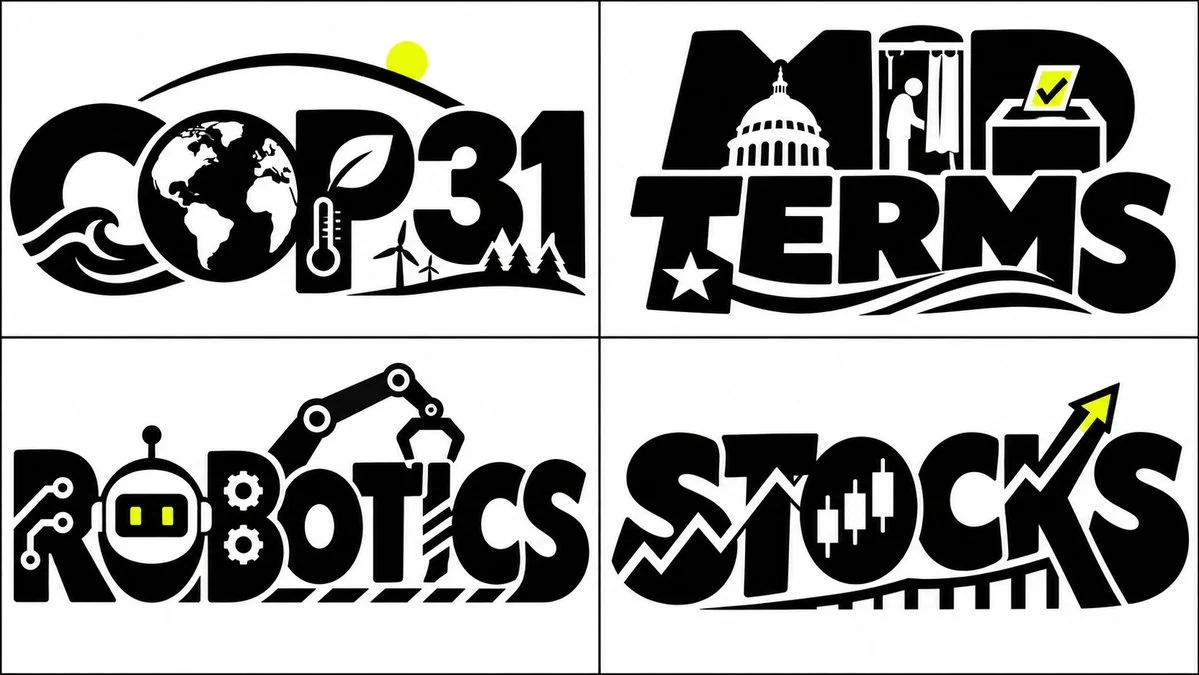
Four News Topics Become Chunky Black Wordmark Identities
Each quadrant turns a headline subject into a monumental black wordmark, where letters and iconic objects merge into one silhouette, with a single tiny accent sparking recognition.
Prompt
Copied. Make it your own here.
Prompt prefilled · Suggested: GPT Image 2.6 Flare · 4 credits/image
2x2 grid, 16:9, do this for 4 topics that were in the news: INPUT = [SUBJECT]

V = {
  WORD       : shortest recognizable name | subject-derived phrase,
  SYMBOLS    : 4–8 iconic subject-specific objects,
  GLYPHS     : 2–5 letters with highest semantic fusion potential,
  FUSION     : silhouette × negative space × structural substitution,
  TYPE       : heavy rounded geometric sans | chunky custom lettering,
  GEOMETRY   : auto | mechanical | organic | architectural | symbolic,
  ACCENT     : neon yellow | one subject-derived pop color,
  MICRODETAIL: one tiny meaningful visual cue,
  LAYOUT     : centered | compact | adaptive wordmark
}

C₁  SEMANTIC WORDMARK DNA (master)
    infer SUBJECT identity, recognizable WORD, iconic objects, actions, visual metaphors and signature geometry; rank symbols by recognizability × glyph compatibility. Select transformations unique to THIS subject.
    ¬C₁ = generic symbolism / random objects / weak subject recognition.

C₂  MONUMENTAL GEOMETRIC LETTERING
    construct WORD in massive rounded, ultra-heavy geometric letterforms; tight optical spacing, unified black mass, confident curves and instantly recognizable silhouette. Treat the entire word as one cohesive graphic structure.
    ¬C₂ = thin fonts / ordinary typography / separated decorative letters.

C₃  SEMANTIC GLYPH ENGINEERING
    mutate [GLYPHS] into subject-derived objects or actions: stems → structures; counters → meaningful openings; diagonals → motion/energy; curves → recognizable silhouettes; repeated letters → distinct complementary transformations.
    ¬C₃ = arbitrary substitutions / repeated gimmicks / distorted unreadable letters.

C₄  NEGATIVE-SPACE OBJECT FUSION
    construct symbols FROM glyph geometry: objects become letter strokes, gaps between silhouettes become letters, counters become expressive micro-icons. Preserve readable letter anatomy while maximizing seamless [FUSION].
    ¬C₄ = objects pasted onto text / floating clipart / disconnected symbols / illegible negative space.

C₅  LETTER-TO-LETTER NARRATIVE
    connect neighboring glyphs through subject-specific physical interactions: pouring, transmitting, growing, colliding, flowing, assembling or transforming. Use one clear visual cause-and-effect sequence where relevant.
    ¬C₅ = isolated letter tricks / unrelated actions / excessive visual storytelling.

C₆  SINGLE-ACCENT MICRODETAIL
    pure-black silhouettes + pure-white negative space + exactly ONE [ACCENT]; reserve color for a tiny eye, signal, cursor, spark, indicator or other subject-specific focal cue. Keep all remaining graphics strictly monochrome.
    ¬C₆ = multiple accent colors / decorative highlights / gradients / excessive accent coverage.

C₇  FLAT VECTOR ABSOLUTISM
    perfectly flat fills, crisp edges, clean silhouette boundaries, consistent geometric logic and zero dimensional rendering. High-contrast minimalist editorial identity with bold, playful conceptual intelligence.
    ¬C₇ = bevels / shadows / 3D / texture / photorealism / shading.

C₈  COMPACT WORDMARK COMPOSITION
    center the integrated wordmark on pure white; adapt width, spacing and glyph mutations to WORD length. Preserve strong optical balance, thumbnail readability and one unified black graphic mass.
    ¬C₈ = scattered icons / weak word silhouette / crowded layout / unnecessary background.

η   SEMANTIC VECTOR PRECISION
    one readable WORD, multiple subject-specific glyph transformations, seamless object–letter fusion, meaningful negative space, strong visual rhythm, one microscopic accent, iconic flat-vector finish.

FORBIDDEN = ordinary text + icons · unrelated letter substitutions · illegible glyphs · repeated visual gimmicks · floating objects · extra accent colors · gradients · shadows · texture · 3D · fragmented wordmark
Published: November 13, 2026 by Gadgetify