Image ChatGPT Image
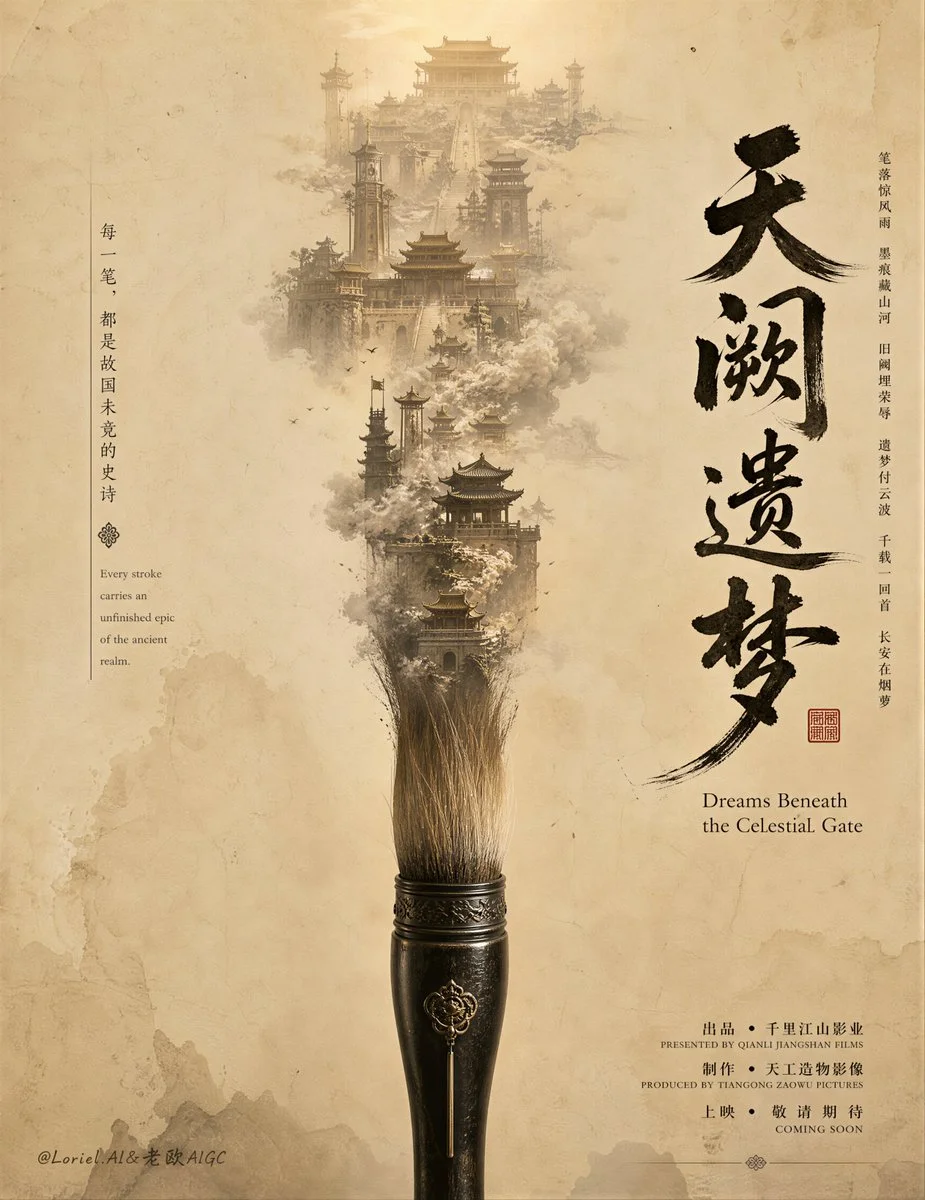
Giant scroll becomes a living world of history in cinematic poster.
An epic film poster where a sweeping scroll evolves into mountains, architecture, and trade routes, evoking a lost civilization with restrained calligraphy and misty negative space.
Prompt
Create an ultra-premium theatrical poster for a fictional Chinese epic film, designed as a festival-level collector key visual with extreme realism, poetic monumentality, and immaculate oriental poster composition. Preserve the exact structural logic of a tall vertical poster built around one monumental ancient scroll as the absolute central visual object. The giant scroll must unfurl through the composition in sweeping vertical and diagonal curves, transforming from physical paper into mountains, palace architecture, desert trade routes, glowing settlements, and the memory of a vanished civilization. The final image must feel like an award-level historical film poster: majestic, quiet, culturally profound, and instantly unforgettable.

Core composition:
Use a tall vertical one-sheet layout with a deep dark upper background, luminous golden center, and mist-filled sand-toned lower half. The giant ancient scroll must dominate the entire poster, descending from the upper left and flowing through the center into the lower foreground in elegant curling layers. The scroll should feel physically real and monumental, with thick aged paper, subtle fibers, curled edges, faint ink traces, and soft gilded highlights. Its inner surface must become a living world of history, so the viewer feels that civilization itself is being unrolled page by page.

Film identity:
Invent an original Chinese film title: “瀚海遗卷”. Add a refined English subtitle: “Chronicle of the Desert Empire”. Place the Chinese title vertically on the upper right in large expressive brush calligraphy, with dry-brush texture, natural ink spread, strong rhythm, and museum-grade elegance. Add a small red seal mark near the title. All text must be newly invented. Do not include any real person names, fictional person names, real company names, or studio names anywhere in the poster.

Scroll-world storytelling:
Inside the unfolding scroll, create a layered historical world with strong vertical narrative progression. In the upper section, reveal luminous palace roofs, ceremonial terraces, watchtowers, and high pavilions emerging from bright paper light, as if an ancient capital is suspended above time. In the middle section, show old streets, timber buildings, beacon platforms, roof ridges, drifting banners, and quiet robed silhouettes embedded in golden haze. In the lower section, allow the scroll to dissolve into sweeping desert dunes, caravan traces, distant fortified settlements, and a small camel caravan crossing through wind-sculpted sand. The transitions between paper, architecture, and landscape must feel magical yet physically believable.

Human presence:
If figures appear, they must be tiny, distant, anonymous, and symbolic only. Show no portraits, no named roles, no celebrity likenesses. Use only small silhouettes such as travelers, guardians, robed witnesses, or caravan forms to establish scale, fate, memory, and epic loneliness.

Material realism:
Render the scroll with exquisite tactile realism: layered aged paper, worn fibers, faint creases, ink absorption, subtle dust, and restrained gold illumination along the edges. The architecture must feature realistic roof tiles, timber joinery, carved railings, weathered surfaces, and warm lantern-like glow. The desert must show fine sand texture, wind erosion, soft ridges, and atmospheric depth. Every material must obey real light behavior and feel premium at close view.

Lighting and atmosphere:
Use a cinematic gold-and-shadow palette with radiant warm light emerging from the heart of the scroll and fading into deep brown-black space above and quiet sand haze below. Add delicate volumetric mist, suspended dust, soft wind trails, and luminous page-edge glow. The mood should feel sacred, melancholic, ancient, and immense, as if forgotten history is resurfacing in silence.

Typography and layout system:
Keep the poster extremely restrained and elegant. Let the large vertical Chinese title on the upper right act as the main typographic anchor. Add one or two slender vertical columns of refined Chinese poetic copy nearby, literary and sparse. Near the lower area, include a very minimal credit zone using only generic film-poster descriptors such as epic feature presentation, theatrical release line, and official teaser wording, without any names of people or companies. Typography must feel architectural, calligraphic, premium, and perfectly integrated into the negative space.

Print and poster finish:
The final image must feel like a luxury printed collector poster suitable for international festivals, museum exhibitions, theatrical key art, and limited-edition art prints. Emphasize paper grain, ink texture, gold dust shimmer, soft shadow falloff, and a highly controlled poster hierarchy. The whole composition must merge one unforgettable central miracle: history has become a scroll, and the scroll has become a living empire of sand, memory, and light.

Creative emphasis:
Combine three layers in one final result:
Orbit-level impact through a more overwhelming giant-scroll spectacle and stronger civilization-unfolding visual drama;
Transit-level maturity through more disciplined title hierarchy, cleaner poetic text placement, and clearer theatrical poster structure;
Port-level completeness through collector-grade print texture, festival-poster restraint, and a fully resolved official one-sheet atmosphere.

No copied wording, no modern elements, no cheap fantasy effects, no chaotic montage, no generic costume-drama styling, no real names, no fictional names, no company names, no weak calligraphy, no low-detail architecture.
Published: August 6, 2026 by Loriel.AI