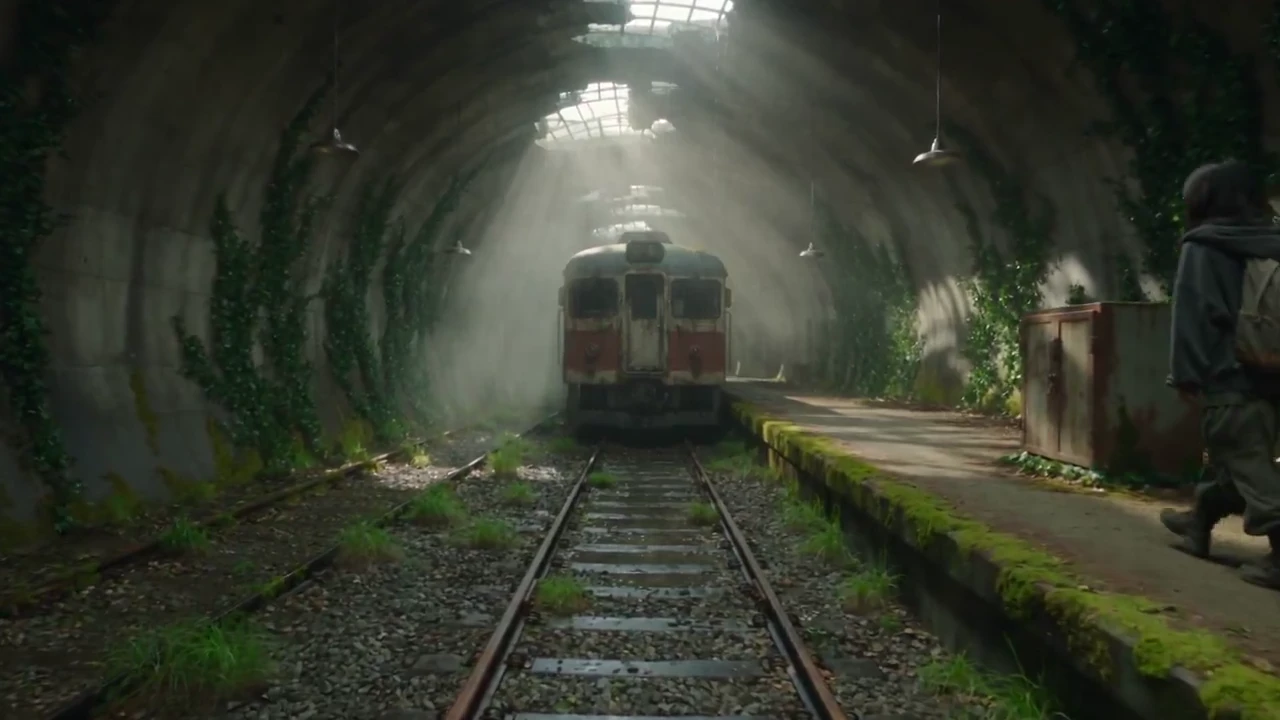
Golden Light and Rust: The Last Train Station Comes Alive
Moss, fog, and sunbeams fill a ruined underground station where a lone woman watches a dormant passenger train stir to life and roll through the mist.
Prompt
Create a 15-second ultra-photorealistic cinematic science-fiction short film titled "THE LAST TRAIN STATION".
CHARACTER CONTINUITY: Feature the exact same 24-year-old Korean woman from Episode 1 of Earth After Us. Long slightly messy dark hair, natural facial features, minimal makeup, oversized dark hoodie, loose dark cargo pants, worn hiking boots and a small weathered backpack. Preserve her exact facial identity, hairstyle, outfit and proportions throughout. She is the only human character.
SETTING: An abandoned underground railway station, approximately 300 years after humanity disappeared. Nature has reclaimed the station. Thick ivy hangs from cracked concrete walls, moss covers the platforms, small plants grow between railway tracks, broken station lights hang from the ceiling, and rainwater drips through cracks above. An enormous old passenger train rests motionless on the tracks. Atmospheric fog, beautiful shafts of golden sunlight entering through a partially collapsed roof.
SHOT 1 — THE DISCOVERY (00:00–00:04):
Begin with a breathtaking wide-angle cinematic shot of an enormous abandoned railway station. The camera slowly glides forward over overgrown railway tracks. An old passenger train stands motionless in the distance, covered in dust, rust and vegetation. The young woman enters the frame from the right, walking cautiously towards the platform. Her small figure emphasizes the enormous scale of the abandoned station.
SHOT 2 — A SILENT WORLD (00:04–00:07):
Cut to a medium tracking shot following the woman from behind as she walks along the deserted platform. Her boots make gentle sounds against the damp concrete. She runs her fingers along an old rusted railing, then notices the train. Dust particles float through the sunlight. A few birds fly out from the station ceiling.
SHOT 3 — THE IMPOSSIBLE MOMENT (00:07–00:11):
Close-up of her curious face as she looks towards the train. Suddenly, one old headlight flickers on. The train's interior lights illuminate one carriage after another. The woman takes a small step backwards in surprise. The train's engine slowly comes alive, releasing a realistic cloud of steam beneath the carriages. The headlight casts a warm beam through the station mist.
SHOT 4 — THE LAST TRAIN (00:11–00:15):
Dramatic low-angle cinematic shot as the old passenger train slowly begins moving towards the camera. Its wheels turn realistically and water ripples along the tracks. The woman stands completely still on the platform, watching in disbelief. Camera smoothly pulls backwards, revealing the enormous train emerging through the golden mist. End just before the train reaches her position, creating a mysterious cliffhanger.
CAMERA: Professional Hollywood science-fiction cinematography, smooth tracking shots, realistic dolly movement, carefully composed wide shots, natural close-ups, cinematic depth of field and realistic motion blur. Seamless visual continuity between shots.
VISUAL AESTHETIC: Ultra-photorealistic live-action appearance, highly detailed abandoned architecture, physically accurate steam, realistic rust and vegetation, atmospheric volumetric lighting, muted forest greens, earthy browns, cool shadows and warm golden highlights. Subtle cinematic film grain.
SOUND DESIGN: Distant birds, dripping water, gentle footsteps, faint metallic creaking, an old electrical relay clicking, train lights humming, deep engine rumbling and realistic railway wheel sounds. No dialogue, no narration and no artificial music.
STRICT CONSTRAINTS: Maintain exactly the same female character throughout. No face morphing, no wardrobe changes, no additional people, no duplicate trains, no distorted anatomy, no unnatural walking, no flickering frames, no abrupt camera movements, no frame skipping, no subtitles, no text, no logos and no watermarks.
The final result must resemble a scene from a high-budget post-apocalyptic science-fiction film.
Published: November 20, 2026 by Ahmad Faraz