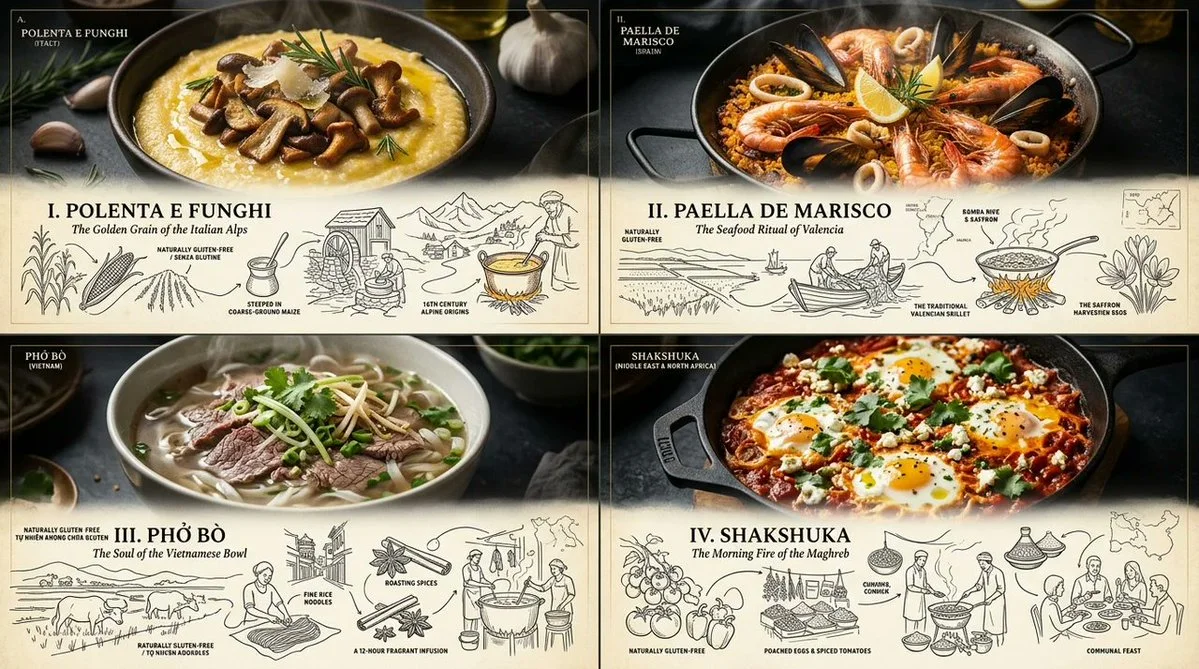
Image Nano Banana 2.1
Luxury Magazine Feature Fuses Gluten-Free Dish With Illustrated Encyclopedia
Warm ivory paper meets dramatic chiaroscuro as a gluten-free meal becomes an elegant continuous-line narrative of its cultural and nutritional significance.
Prompt
2x2 grid, 16:9, do this for 4 gluten free meals: CONCEPT ANCHOR 1:
"Premium cinematic macro photography — an extraordinarily
detailed subject filling the frame, dramatic chiaroscuro,
deep shadows, atmospheric smoke or particles when relevant,
rich physical textures, controlled specular highlights,
dark environmental storytelling, shallow depth of field,
sophisticated commercial photography."

::

CONCEPT ANCHOR 2:
"Minimalist continuous-line historical illustration —
elegant black ink contours, recognizable editorial
portraits where appropriate, flowing illustrated pathways,
tiny architectural and object drawings, significant
milestones, subtle colored accents, beautifully organized
chronological storytelling, delicate line-weight variation."

::

CONCEPT ANCHOR 3:
"Luxury heritage publication design —
warm ivory paper, monumental high-contrast serif
typography, elegant multilingual lettering when
appropriate, generous negative space, thin dividing
rules, finely organized columns, minimalist pictograms,
structured information and understated academic elegance."

::

CONCEPT ANCHOR 4:
"Visual encyclopedia meets instructional editorial —
intelligently organized information, clear sequential
explanations, labeled components, contextual diagrams,
meaningful visual symbols, carefully curated factual
details, sophisticated educational storytelling."

INSTRUCTION:

Find the exact visual intersection of these four concepts.

Ignore the literal foods, recipes, companies,
founders, and products depicted in the references.

Extract only the visual DNA.

Render $ SUBJECT as a premium photographic-editorial
masterpiece where a cinematic physical representation
transitions into an elegant continuous-line
illustrated explanation of its identity and significance.

The result should feel like an extraordinary luxury
magazine feature, museum publication, and illustrated
historical encyclopedia fused into one image.

SEMANTIC INFERENCE:

Before composing, analyze $ SUBJECT and infer:

HERO =
The subject's most recognizable visual manifestation.

MATERIAL =
Its authentic physical surfaces, colors, textures,
reflections, structural characteristics, or symbolic
physical equivalent if abstract.

NARRATIVE =
The most informative story that can be told
about the subject.

Choose the strongest relevant narrative:

- historical evolution
- origin and development
- invention and technological progression
- preparation or manufacturing process
- anatomy and composition
- causes and consequences
- cultural significance
- principles and relationships
- stages of transformation
- essential characteristics
- a comparison of related concepts

ILLUSTRATION_SET =
The people, objects, locations, tools, components,
technologies, and symbols needed to communicate
that narrative.

EDITORIAL_DATA =
The essential factual information that gives
the subject educational value.

PALETTE =
The most suitable sophisticated accent colors
inferred from the subject's identity.

VISUAL COMPOSITION:

Create ONE unified editorial artwork.

UPPER VISUAL ZONE:

Render $ SUBJECT as a breathtaking cinematic
hero composition.

Photographic qualities:

- extremely detailed authentic textures
- precise proportions and defining geometry
- rich directional lighting
- deep natural shadows
- tactile material contrast
- subtle atmospheric depth
- beautiful selective highlights
- controlled background separation
- cinematic visual richness

If the subject is abstract, invent a meaningful
physical embodiment rather than introducing
unrelated decorative objects.

Use a dark, atmospheric environment when it
strengthens the subject's physical presence.

Do not add smoke, food styling, or dramatic particles
unless they make sense for the subject.

LOWER EDITORIAL ZONE:

Transition from the immersive photograph into
a beautifully designed warm-ivory publication.

Introduce:

1. A dominant elegant serif headline.
2. A concise subtitle or philosophical statement.
3. A small number of meaningful identity descriptors.
4. A carefully organized explanatory visual narrative.
5. Delicate supporting illustrations.
6. Relevant information labels or numerical details.
7. A refined concluding insight.

Choose layout according to the information,
not according to a rigid recipe template.

CONTINUOUS-LINE STORYTELLING:

Develop one beautiful flowing illustrated line
that travels through the editorial region.

This line becomes the subject's narrative pathway.

For historical subjects:
Connect genuine historical milestones.

For technological subjects:
Connect major inventions, features, or generations.

For biological subjects:
Connect meaningful developmental stages or systems.

For products:
Connect origin, design, materials, innovation,
and significant evolution.

For places:
Connect history, architecture, geography,
culture, and transformations.

For food:
Connect origin, ingredients, cooking methods,
and cultural context.

For abstract topics:
Connect logically ordered concepts,
principles, or stages of understanding.

Use continuous pen-and-ink contours.

Allow illustrations to emerge naturally from
the flowing line:

- recognizable people when relevant
- miniature buildings
- meaningful objects
- tools and mechanisms
- landscapes
- scientific symbols
- delicate environmental scenes

The illustrations should appear interconnected
rather than isolated infographic stickers.

TYPOGRAPHIC SYSTEM:

TITLE:
Oversized refined high-contrast serif.

SECONDARY TITLE:
Elegant italic or expressive heritage typography.

BODY:
Highly readable editorial typography.

ANNOTATIONS:
Small precise text with fine connecting lines.

OPTIONAL NATIVE SCRIPT:
Use authentic local writing only when relevant.

MICROGRAPHICS:
Thin rules, subtle icons, tiny date markers,
fine visual dividers.

COLOR:

Paper: warm archival ivory.

Ink: near-black, charcoal, or deep forest green.

Accent: one or two meaningful colors
inferred from $ SUBJECT.

Photographic region:
Allow authentic subject colors to remain rich.

Illustrated region:
Mostly monochrome linework with restrained
color accents.

STYLE FUSION RULES:

- Photography communicates physical identity.
- Continuous linework communicates the story.
- Typography communicates importance.
- Editorial sections communicate knowledge.
- Accent colors communicate continuity.
- Negative space provides elegance.

The photograph and drawings must feel
like parts of the same art-directed publication.

FACTUAL INTEGRITY:

Use verified or reliably known subject information.

Do not invent historical dates, technical data,
measurements, quotations, or timelines.

If chronology is not meaningful, use a conceptual
journey instead of forcing historical milestones.

OUTPUT:

A magnificent cinematic visual encyclopedia
for $ SUBJECT.

One image combining spectacular material realism,
flowing black-ink illustrated storytelling,
historical or conceptual narrative,
and luxurious editorial typography.

Immediately beautiful from a distance,
intellectually rewarding up close.
Published: October 17, 2026 by Gadgetify