Image ChatGPT Image 2.5
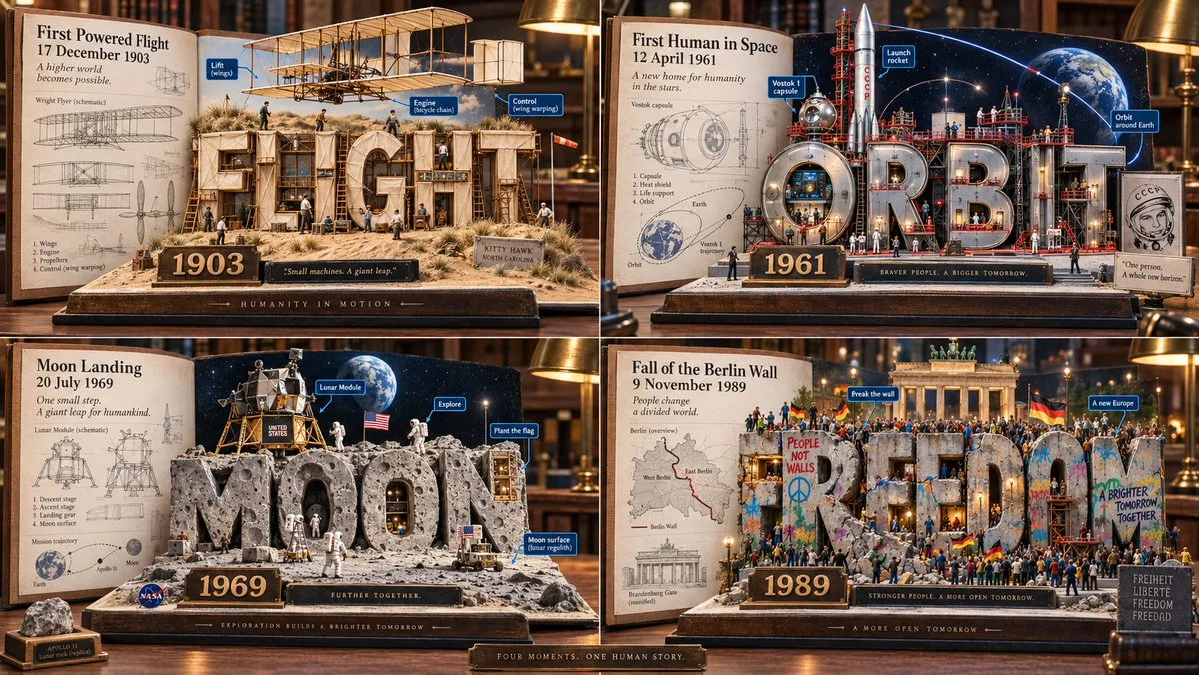
Miniature Museum Diorama Reveals Four Momentous Days for Humanity
A cinematic open-book diorama where giant typography becomes a living exhibit, annotated with timelines and tiny figures.
Prompt
2x2 grid, 16:9 4 momentous days for humanity-> CONCEPT ANCHOR 1: "Open-book artifact diorama — a physical miniature world rising from aged pages, blueprint drawings, diagrams, desk-lamp lighting, shadows, paper texture" :: CONCEPT ANCHOR 2: "Giant edible/object typography storefront — the subject’s name becomes large dimensional letters, architecture, product-form, or landscape, filled with tiny shops, lamps, tables, props, and people" :: CONCEPT ANCHOR 3: "Annotated discovery timeline exhibit — large glossy year numbers, museum plinths, callout arrows, labeled breakthroughs, small historical/scientific props, brass plaques, educational storytelling" INSTRUCTION: Find the exact visual center of these three concepts. Ignore the literal food, science events, brands, and space objects. Extract only the reusable structure. Render $ SUBJECT as a cinematic open-book museum diorama where its name becomes a giant physical world, surrounded by annotated stages, tiny figures, tools, diagrams, and discovery labels. STYLE RULES: - Present $ SUBJECT on an open book, desk, museum plinth, or tabletop exhibit. - Convert the subject’s name or core symbol into giant dimensional typography or sculptural architecture. - The letters should become inhabitable: doors, windows, shelves, terraces, rooms, tiny lights, props, or miniature people interacting with them. - One side of the composition may show diagrams, blueprints, formulas, sketches, maps, ingredient charts, construction notes, or origin drawings. - The other side should show the physical miniature version fully built. - Add large date numbers, era labels, stage markers, or chapter plaques when the subject has history, evolution, versions, or milestones. - Add colorful callout boxes and arrows explaining key parts, meanings, ingredients, mechanisms, tools, or discoveries. - Use strong tabletop lighting: warm lamp glow, deep cast shadows, tactile paper grain, dust, physical scale cues. - Make it feel like a handcrafted museum artifact that explains the subject through miniature worldbuilding. OUTPUT: A cinematic educational miniature where $ SUBJECT becomes a physical title-world rising from pages, annotated like a discovery exhibit.
Published: September 12, 2026 by Gadgetify