Image ChatGPT Image 2.5
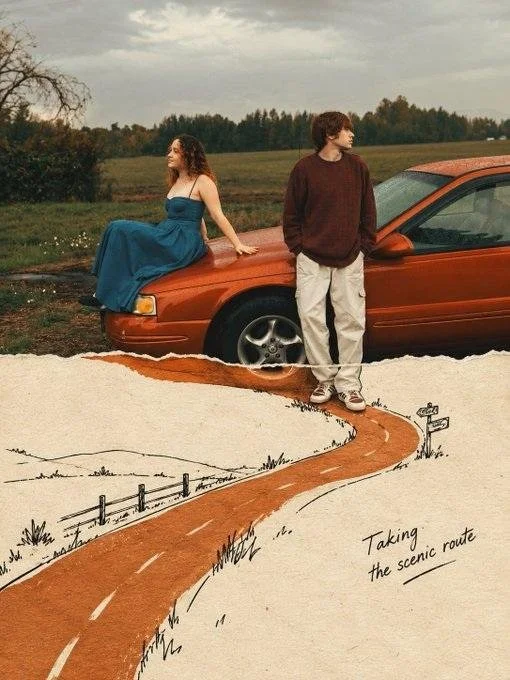
Photograph Splits Into Torn Paper World With Continuous Road
A vertical diptych where the top half preserves the original photo and the bottom half transforms it into a layered paper-cutout scene with hand-drawn outlines.
Prompt
Copied. Make it your own here.
Prompt prefilled · Suggested: GPT Image 2.5 Flare · 3 credits/image
Create a vertical 3:4 canvas divided into two perfectly equal horizontal sections: the top occupies exactly 50%, and the bottom occupies exactly 50%.

The upper and lower sections must feel like one continuous scene, not two separate compositions.

TOP HALF — ORIGINAL PHOTOGRAPH

Preserve the original photograph exactly as it is.

Maintain the original subject, pose, spatial relationships, color atmosphere, composition, and natural lighting.

Do not redesign, recolor, replace, rearrange, or reinterpret any part of the original photograph. Keep its original proportions and visual identity.

Cropping is allowed when necessary.

CONTINUITY — HIGHEST PRIORITY

Identify a natural compositional element that converges toward or passes through the central area of the image. This could be a road, coastline, body of water, reflection, branch, beam of light, architectural structure, or physical movement.

This element must cross the boundary between the two halves and continue naturally into the lower section.

The second world must emerge directly from the original photograph. It should feel as though the same scene continues beyond the dividing line, with only its physical form transforming.

The transition must feel intentional, organic, and visually connected.

TRANSITION EDGE

An irregular torn-paper edge may be used as part of the central design, but it must follow the underlying structure of the composition rather than function as decoration.

The original visual element may touch, follow, break through, or extend beyond the edge.

Avoid repeating the same torn-paper shape across different images. Let the transition shape emerge naturally from the specific photograph.

BOTTOM HALF — THE SECOND WORLD

Create an ivory-colored paper surface with subtle natural fiber textures and generous negative space.

Continue the selected structural element downward from the exact point where it intersects the dividing line.

Reinterpret it using a thoughtful combination of:

- Minimal photographic fragments.
- Cut-paper shapes and layered paper elements.
- Delicate black hand-drawn outlines.
- Subtle handmade collage textures.

The lower world must remain visibly connected to the upper photograph.

Never turn it into an isolated portal, window, stage, or platform unless that structure genuinely originates from the photograph itself.

SECOND-WORLD LOGIC — IMAGE-SPECIFIC INTERACTION

Ask yourself:

If the structure in this photograph became something tangible that could be touched, used, manipulated, or transformed, what would it naturally become?

Create an interactive visual interpretation that is specific to the image.

Examples:

- Water might continue downward as a flowing form that remains physically attached to the original water.
- A road might transform into a hand-drawn pathway that continues through the paper.
- Light might become a tangible object that someone could hold or interact with.

Do not mechanically repeat the same transformation or interaction across different images.

The creative interpretation must emerge naturally from the photograph's subject and visual elements.

CHARACTERS & INTERACTION

Add between 0 and 3 minimal black line-drawn human figures, only when genuinely necessary.

Each character must actively participate in the visual narrative and interact with the transformed structure.

If the original photograph already contains multiple people interacting, do not introduce additional characters.

Never use characters merely as decorative elements.

WORLD TITLE / CAPTION

Add one short, handwritten English caption consisting of 2–6 words.

The caption should naturally describe the action or interaction taking place in the second world.

Keep the language conversational, slightly playful, and subtly humorous.

Ensure correct spelling and natural phrasing.

Avoid motivational statements, generic inspirational quotes, and formulaic expressions such as "Same thing, different world."

VISUAL STYLE & ART DIRECTION

- Authentic, photorealistic photography.
- Warm ivory paper texture.
- Extremely minimal black hand-drawn linework.
- Subtle handmade cut-paper and collage details.
- Independent editorial magazine aesthetic.
- Bright, airy, clean composition.
- Generous negative space.
- Refined visual storytelling.
- Natural integration between photography and paper art.

The final image should feel as though a second dimension was already hidden inside the original photograph and simply continues beyond its boundaries.

The result should be sophisticated, imaginative, understated, and visually cohesive.

NEGATIVE PROMPT

No disconnected bottom-half illustration.

No generic torn-paper templates.

No isolated portals, entrances, windows, stages, or platforms.

No unrelated visual elements.

No broken visual continuity.

No overly dense illustrations.

No random decorative objects.

No unnecessary crowds or additional people.

Do not modify the original photograph's colors.

Do not redesign or alter the upper photograph.

No glossy 3D effects.

No messy scrapbook aesthetics.

No cluttered collage elements.

No distorted or gibberish text.

No watermarks.

No logos.
Published: November 1, 2026 by Ciri