Image Nano Banana 2
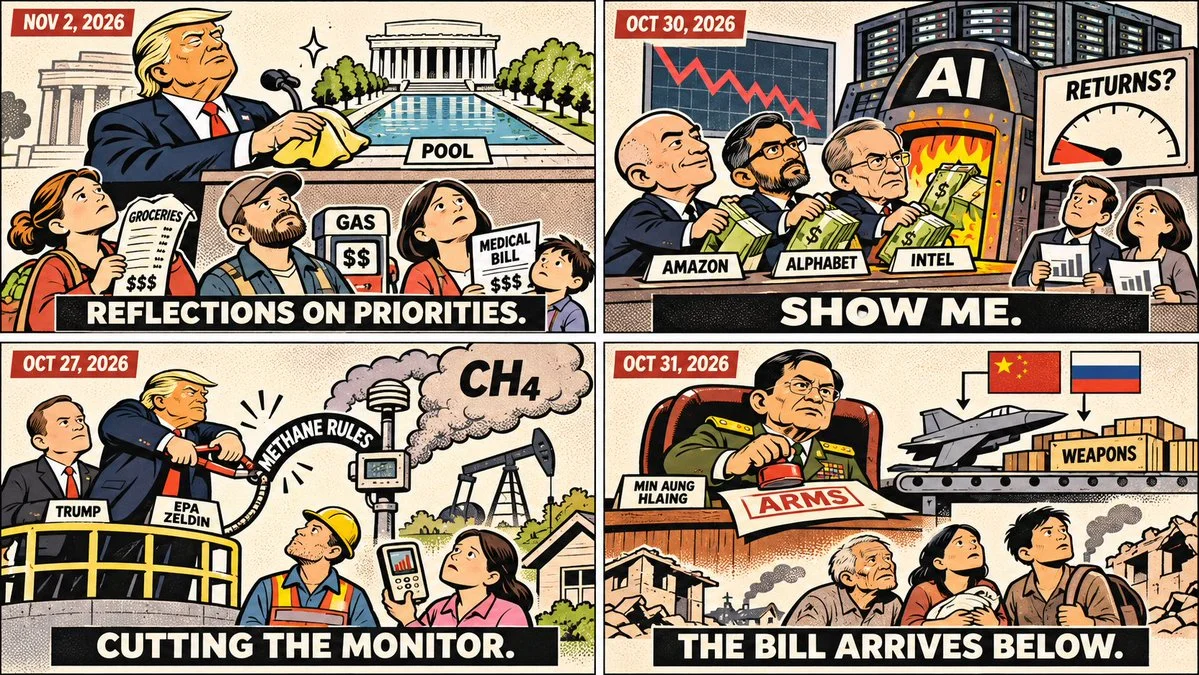
Satirical grid dissects power and caricature in news this week
A 2x2 grid analyzing power dynamics, caricature, and propaganda through visual satire, with each panel critiquing how media depicts figures and groups.
Prompt
Copied. Make it your own here.
Prompt prefilled · Suggested: Nano Banana 2 · 4 credits/image
2x2 grid, 16:9, do this for topics in the news this week, do research: UNKNOWNS P = the power relation in the depicted situation ; whether exaggerated features are the individual's own deviation or inherited from a stock type ; conduct or essence ; who is individuated and who is typified ; what the exaggeration substitutes for

LAWS

the force must land on the party holding power in the depicted relation, and power must be staged Relative scale, height, who acts and who is acted upon, who occupies the frame's dominant position, whose agency is depicted and whose is not. P is readable directly from the staging, which means an inverted aim is visible in the frame rather than being a matter of opinion.

caricature measures an individual against the population mean; typing measures a person against a stock figure This is the operative distinction and it is checkable. Amplifying a target's own measurable deviations is caricature. Importing features from an existing stock type and assigning them to a member of a group is a different operation entirely — it has stopped depicting a person and started asserting a category. The test is whether the features would still identify this individual if the group membership were removed.

individuation is the defence Persons drawn as particular persons, with their own faces, resist the operation. Rendering a group as an undifferentiated swarm, flood, tide, wave or infestation removes personhood as a drawing decision, and the mass-noun rendering is the single most reliable marker of propaganda in the historical record.

animal, insect and disease coding of a people is the propaganda signature Applied to a powerful individual, animal metaphor is ordinary satire with a long and honourable history. Applied to a people, it is the specific figure that precedes and licenses violence, and the record on this is not ambiguous.

the claim must be about conduct This official did this is satire, and it is falsifiable, which is why it has force. These people are this is an assertion about essence, cannot be answered, and does a different job. A cartoon can be checked against which of these it is making.

the body is not an argument Attacking unchosen physical characteristics — weight, height, disability, features — substitutes for the critique instead of carrying it, and it acquits the target of the conduct by changing the subject to their body. Caricature exaggerates to make a person recognisable; it does not propose that their body is the problem.

symmetry of treatment is measurable If the work individuates the powerful and types everyone else, the geometry has inverted no matter what the caption claims. Count the particular faces on each side.

the satirist's position is in the frame too Who the cartoonist is safe from, and who they are not, is part of what the drawing means. Work aimed at a party that cannot answer back is a different object from work aimed at one that can.

CONSERVATION Every exaggerated feature traces to a measurable deviation in the individual depicted. A feature traceable only to a stock type has come from somewhere else, and the work is carrying cargo it did not load.

OVERDETERMINATION P recovered 3× ⇒ 2 redundant equalities P̂_staging (scale, position, who acts on whom) · P̂_features (individual deviation versus inherited type) · P̂_claim (conduct versus essence). All three must agree about where the force is aimed.

HONEST One power relation, encoded in the staging; features that are the target's own; a claim about conduct; everyone in frame individuated.

FORBIDDEN Features imported from a stock type and presented as caricature of an individual ; animal, insect, vermin or disease coding applied to a people ; a swarm, flood, tide or infestation rendering of persons ; the powerful individuated while everyone else is typified ; an assertion about essence dressed as a claim about conduct ; unchosen physical characteristics carrying the attack ; staging that places the dominant party in the diminished position while presenting as satire ; exaggeration that substitutes for the critique rather than delivering it.
Published: November 4, 2026 by Gadgetify