Image ChatGPT Image 2.5
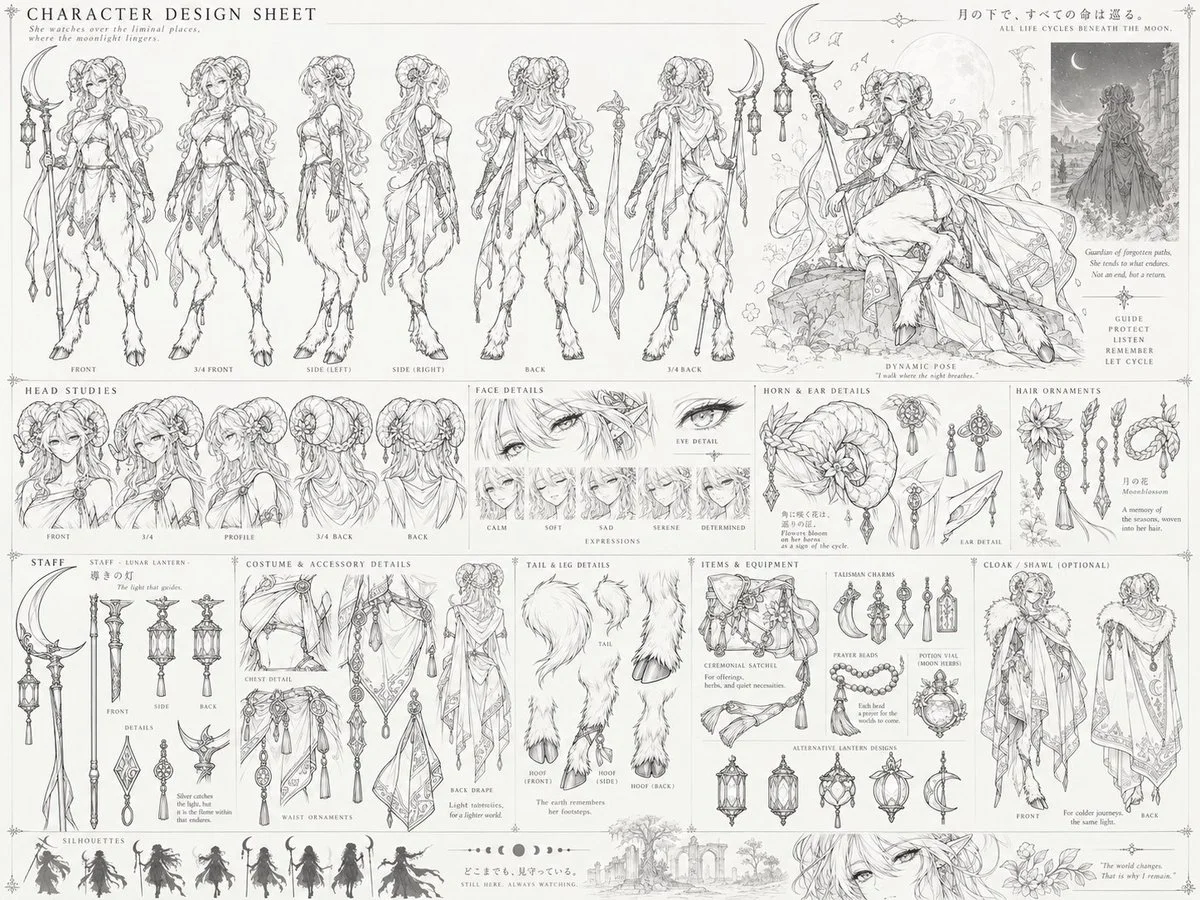
Sci-fi Character Design Sheet Shows Turnaround and Dynamic Pose
A professional character design sheet on ivory paper, featuring full-body turnaround, dynamic pose, head studies, and anatomy details for a customizable sci-fi subject.
Prompt
AI infers scifi subject, 5:4 Create ONE extremely detailed, wide horizontal professional CHARACTER DESIGN SHEET for [CHARACTER / CONCEPT], presented as an elegant production-art bible on warm ivory archival paper. First infer the character’s species, apparent age, role, culture, historical/fantasy era, occupation, personality, body type, environment, narrative function, signature silhouette, recurring motif, materials, costume logic, and most recognizable prop or anatomical feature; then LOCK those decisions so the identical character design is maintained throughout every drawing. Across the upper-left two-thirds of the page, create a rigorous full-body turnaround consisting of FRONT, 3/4 FRONT, LEFT PROFILE, RIGHT PROFILE, BACK, and 3/4 BACK views. Treat these as rotations of one immutable physical model: identical height, proportions, face, hair, costume seams, ornament placement, asymmetrical details, species anatomy, footwear, props, and accessory locations. Use relaxed neutral model-sheet poses with minimal perspective distortion. Make these figures large enough that subtle costume construction remains visible. In the upper-right, create one larger DYNAMIC POSE that demonstrates the character’s narrative role and personality rather than merely showing generic combat. Infer an appropriate action from the character: guardian, scholar, mage, engineer, athlete, musician, hunter, healer, royal figure, creature, etc. Give the pose strong asymmetry, clear silhouette, natural costume movement, and interaction with the signature prop. Beside it, include one small atmospheric grayscale ENVIRONMENT / STORY VIGNETTE showing the character from behind or at a distance inside the world they belong to, with architecture, landscape, climate, celestial conditions, cultural details, and a short poetic lore annotation inferred from the concept. Create a HEAD STUDIES section showing the exact same head from FRONT, 3/4, PROFILE, 3/4 BACK, and BACK, emphasizing hair construction, horn/ear/headgear geometry, jewelry placement, braiding paths, and attachment logic. Beside this, create a FACE DETAILS section containing an extreme close-up of the eye and 5–7 small expression studies inferred from personality—examples might include calm, soft, amused, sad, serene, suspicious, determined, afraid, exhausted, or angry, but select only those appropriate to this specific character. Preserve identical facial identity across every expression. Create a dedicated SPECIES / ANATOMY DETAIL section. If [CHARACTER] is non-human, hybrid, magical, mechanical, or augmented, isolate and diagram the relevant horns, ears, wings, tail, hooves, paws, claws, scales, cybernetics, prosthetics, armor interfaces, bioluminescent structures, tattoos, or magical anatomy from multiple useful angles, showing how each actually attaches to the body and moves. If the character is fully human, replace this with hand, foot, gesture, and posture studies. Create a HAIR & ORNAMENTS section that treats the hairstyle as an engineered structure: show major masses, sectioning, braid paths, knots, buns, back construction, loose strands, functional tie points, and separate isolated drawings of any culturally meaningful pins, flowers, chains, beads, clips, crowns, ribbons, charms, or other hair ornaments. Do not add arbitrary jewelry simply to fill space. Create a large SIGNATURE PROP / EQUIPMENT section for the character’s defining object—such as staff, sword, lantern, camera, instrument, medical implement, firearm, spell device, book, machine, mask, shield, toolkit, or equivalent inferred from [CHARACTER]. Show FRONT, SIDE, and BACK elevations plus close-up construction studies and, where appropriate, an ACTIVE / DEPLOYED state. Explain visually its grip, hinges, fasteners, material transitions, mechanism, symbols, energy/light source, wear, and functional logic. Include only a handful of tiny annotations describing purpose and materials. Create a COSTUME & ACCESSORY DETAILS section with enlarged drawings of chest construction, collar, shoulder interface, waist, belt, back drape, hanging ornaments, hems, fasteners, jewelry, and footwear. Clothing must be layered like something physically wearable, with a clear base layer, structural layer, outer layer, weather or ceremonial elements, and practical fastening points. Every costume feature should communicate at least one of FUNCTION, CULTURE, STATUS, ENVIRONMENT, PERSONALITY, or STORY rather than existing as meaningless decoration. Add a BODY / LOWER-LIMB detail module appropriate to the character. For creature legs, show fur direction, joints, hoof/paw construction, and front/side/back views. For robotic or armored limbs, show articulation and mechanical segmentation. For ordinary human anatomy, devote this area to footwear construction, gait, and movement. Create an ITEMS & EQUIPMENT inventory showing approximately 5–8 small isolated objects that this specific character would plausibly carry or use in daily life—satchel, medicine, map, charms, journal, instrument, key, compass, food container, tools, specimens, communication device, ritual item, etc. Infer these from the role and world rather than adding generic fantasy props. One item may be shown open to reveal its contents. Include one OPTIONAL CLOAK / SHAWL / WEATHER / CEREMONIAL / PROTECTIVE LAYER shown from FRONT and BACK. It must feel like an extension of the primary costume rather than a completely different character design. Add a tiny annotation explaining when or why it is worn. Along the very bottom, include an 8–12 pose SILHOUETTE TEST strip rendered as solid black thumbnails. Show standing, walking, running, prop use, interaction, rest, action, and rear silhouettes. Every silhouette should remain recognizably the same character even with all internal detail removed. Surround this footer sparingly with a few small worldbuilding motif studies—appropriate flora, celestial cycle, architecture, cultural pattern, magical diagram, technology, terrain, constellation, religious emblem, or other elements inferred from the character’s world. Use extremely refined monochrome graphite and fine technical ink, subtle warm-gray pencil wash, very controlled cross-hatching, elegant tapered linework, minimal shading, and large clean areas of white/ivory negative space. Outer silhouettes use slightly stronger lines; anatomy and costume construction use thinner lines; tiny ornaments and annotations use extremely fine lines. The aesthetic should combine elite animation/game concept-art drafting, elegant manga/anime character-design finesse, museum-sketchbook delicacy, and high-end production model-sheet precision. Organize the entire canvas using subtle thin divider rules and delicate ornamental section markers. At the top place a large elegant serif title “CHARACTER DESIGN SHEET,” the character name, one brief poetic subtitle inferred from the character, and optionally a tiny culturally appropriate emblem or fictional-language inscription with a short translation. Section headings should be small elegant capitals such as HEAD STUDIES, FACE DETAILS, HAIR ORNAMENTS, COSTUME & ACCESSORY DETAILS, ITEMS & EQUIPMENT, etc. Keep annotations extremely concise. This is a visual design bible, not a prose document. ABSOLUTE CONSISTENCY LOCK: every depiction represents the exact same immutable character. Face geometry, body proportions, hairstyle architecture, horns/ears/wings/tail, costume construction, materials, symbols, accessory placement, footwear, and signature prop design must remain identical from panel to panel. Only camera angle, facial expression, pose, and natural garment movement may change. Avoid: full-color splash-art rendering, unrelated alternate costumes, random fantasy decoration, inconsistent facial identity, mismatched turnarounds, generic accessories, comic-book storytelling panels, storyboard frames, photorealism, 3D rendering, chibi proportions unless explicitly requested, software-dashboard aesthetics, huge paragraphs of text, heavy opaque shading, cluttered composition, meaningless fictional text, vague prop drawings, or unused empty modules. OUTPUT TARGET :: one extraordinarily dense yet elegant production character-design sheet that looks as though a professional character designer spent weeks resolving [CHARACTER / CONCEPT] from every necessary angle, anatomy feature, costume component, prop, expression, silhouette, and worldbuilding detail.
Published: September 12, 2026 by Gadgetify