Image Nano Banana Pro
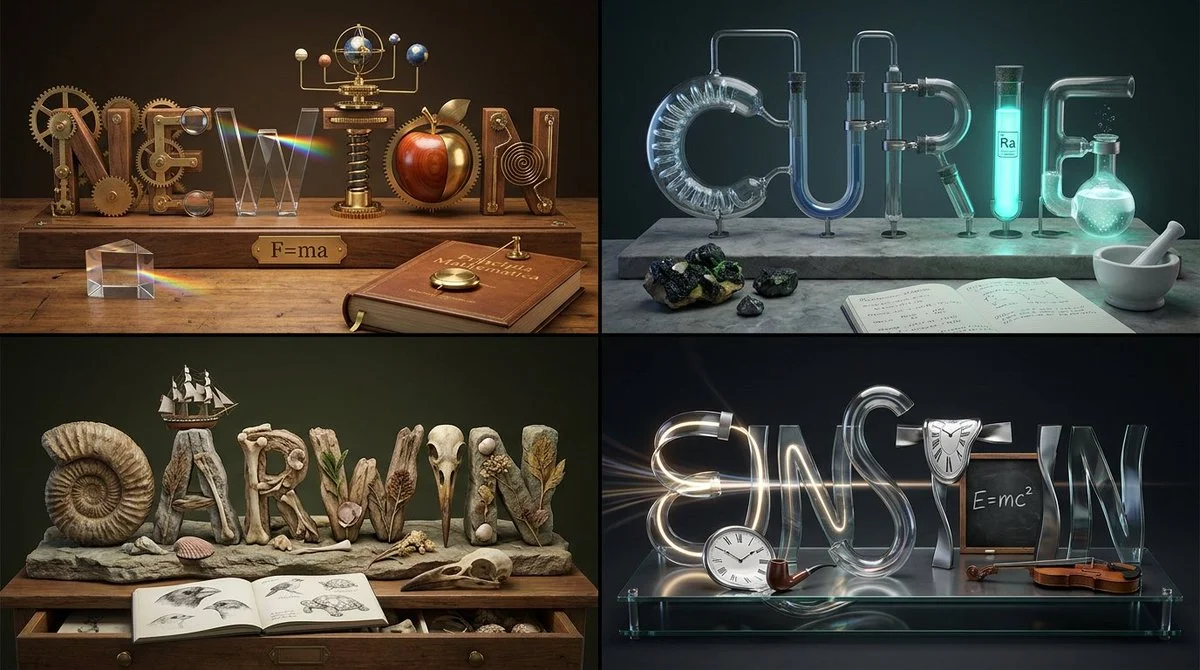
Sculptural Surnames of Four Scientists Form a Grid of Knowledge
A 2x2 grid where each panel transforms a scientist's surname into a dimensional sculpture using their signature materials and objects, blending typography with scientific discovery.
Prompt
I went back to Nano Banana Pro for this. Kind of a fun experiment for visualizing scientists.

2x2 grid, 16:9, 4 famous scientists. Use the modular WORD-AS-OBJECT SCIENTIST SCULPTURE system. Choose four visually distinct scientists automatically. INPUT ::= [GRID] + [CATEGORY] + [OPTIONAL SUBJECTS] Create a [GRID] grid in a single [ASPECT_RATIO] composition. If specific subjects are not supplied, automatically choose [N] globally famous, visually distinct subjects from [CATEGORY]. For each subject, infer: - DISPLAY_WORD = the subject’s surname or most recognizable short name - SIGNATURE_DISCOVERY - SIGNATURE_OBJECT - SIGNATURE_MATERIAL - SECONDARY_PROPS - EQUATION_OR_IDEA - COLOR_ACCENT - HISTORICAL_VISUAL_LANGUAGE CORE CONCEPT: Each panel is a premium conceptual still-life sculpture in which DISPLAY_WORD itself becomes the main physical object. The letters must NOT be ordinary printed typography. Every letter is a thick, dimensional, materially believable sculptural construction derived from that subject’s work, discoveries, personality, or field. VISUAL LOGIC: SUBJECT → IDEA → MATERIAL → LETTERFORM → PHYSICAL SCULPTURE Examples of transformation logic: - physicist → mechanical apparatus, orbital systems, equations, laboratory materials - chemist → glassware, glowing liquids, metal laboratory hardware, mineral/crystal structures - biologist → fossils, wood, stone, leaves, specimens, natural-history materials - astronomer → brass instruments, lenses, celestial models, star maps - inventor → mechanisms, gears, wood prototypes, wires, engineering parts - mathematician → geometric solids, drafting instruments, grids, mathematical diagrams FOR EACH PANEL: 1. DISPLAY_WORD Build the subject’s surname as the dominant centerpiece. The word must be instantly readable from a distance. 2. WORD-AS-OBJECT CONSTRUCTION Convert the letters into a physical sculpture using materials and mechanisms directly associated with the subject. Letters may include: - carved wood - stone - brass - steel - glass - scientific instruments - mechanical linkages - laboratory vessels - fossils - crystals - botanical matter - wires - lenses - gears - books - measuring devices but only when relevant to that subject. 3. SIGNATURE OBJECT Integrate one unmistakable symbolic object into or beside the word: apple, atom model, laboratory flask, fossil, telescope, prism, pendulum, notebook, celestial globe, etc. Infer automatically rather than repeating the same object. 4. SUPPORTING STILL LIFE Add 2–5 compact supporting props: books, handwritten notes, scientific diagrams, instruments, specimen trays, equations, sketches, models, or artifacts. They should explain the subject visually without cluttering the scene. 5. CONCEPTUAL INTERACTION Make at least one object physically interact with the typography: - rests on a letter - becomes part of a letter - balances on the word - passes through a letter - replaces a counter/opening - forms a crossbar - creates a mechanical linkage - grows from the typography - illuminates the letters - transforms one character into the subject’s central idea 6. BASE Place the composition on a refined museum-display base, plinth, desktop, scientific workbench, archival slab, or miniature exhibition platform inferred from the subject. 7. MICRO-TEXT Allow only minimal supporting text such as: - one equation - one book spine - one tiny plaque - one short scientific concept Do not create an infographic. Do not fill the panel with paragraphs. STYLE: museum-quality conceptual object design × premium miniature sculpture × editorial still-life photography × collectible scientific art object × hyper-detailed 3D product visualization CAMERA: high-end tabletop product photography, slightly elevated three-quarter view, 50–85mm equivalent lens, clean perspective, entire sculptural word visible, strong silhouette, medium depth of field, no extreme wide-angle distortion. LIGHTING: warm natural side light mixed with soft studio illumination, subtle window shadows, gentle specular highlights on glass and metal, realistic contact shadows, museum-object atmosphere, polished but tactile. BACKGROUND: warm ivory, stone, pale laboratory wall, or understated neutral studio environment. Avoid busy scenic backgrounds. MATERIAL QUALITY: physically based rendering, real wood grain, machined brass, aged books, translucent glass, stone pores, metal fasteners, subtle scratches, fine craftsmanship, believable scale. GRID RULES: - equal-sized panels - clean thin separators - each panel has a different construction idea - consistent photographic quality across the grid - no repeated composition - no repeated material solution - no repeated prop arrangement - each subject must be identifiable through objects before reading the name CRITICAL: The DISPLAY_WORD is always the visual hero. The scientific concept must be embedded into the physical construction of the word rather than illustrated separately. NEGATIVE: flat typography, ordinary text poster, generic portrait, simple logo, word floating over an image, busy infographic, long captions, random props, repeated compositions, cartoon icons, cheap plastic look, illegible names, letters hidden by objects, scientific objects unrelated to the subject.
Published: September 10, 2026 by Gadgetify