Image ChatGPT Image 2.5
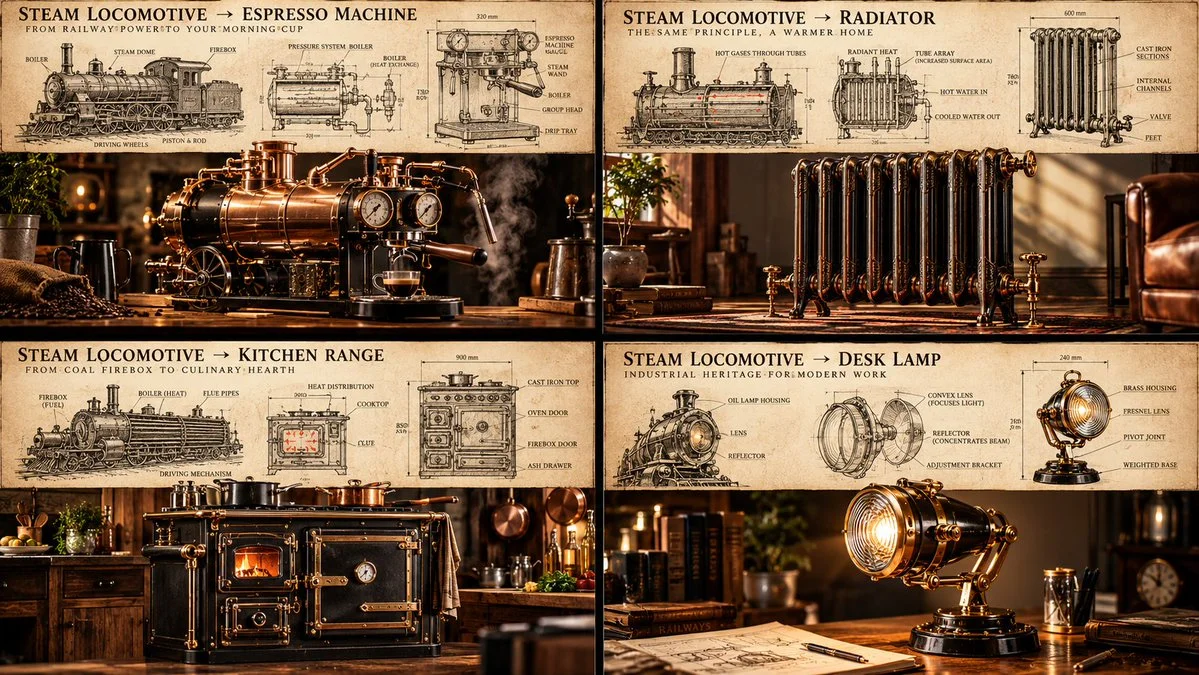
Sepia Draft and Polished Steel Locomotive Homewares in Grid
A 2x2 grid contrasts an orthographic sepia ink drawing with a photorealistic hero shot of locomotive-inspired home products, highlighting material and form.
Prompt
Copied. Make it your own here.
Prompt prefilled · Suggested: GPT Image 2.5 Flare · 3 credits/image
2x2 grid, 16:9, home products inspired by old locomotives: // ═══ THE DUAL-REGISTER MANIFOLD ═══
One design object 𝒟. Two observation registers:

  REG_GEN  (Band A): orthographic projection, sepia ink, abstract material,
                     dimensioned, annotated, time = design past
  REG_PHEN (Band B): perspective projection, full spectrum, real materials,
                     lit by physical sources, time = present moment

  π_gen(𝒟) = sheet      π_phen(𝒟) = hero
  The plate shows π_gen(𝒟) ⊕ π_phen(𝒟).  The viewer's pleasure is
  RECOVERING 𝒟 FROM BOTH — matching panel III's barrel to the hero's barrel.

// ═══ INVARIANT RECOVERY LAWS (what must survive both projections) ═══
For each component c of 𝒟, define invariants measurable in either register:

  INV-1 TOPOLOGY:   genus & part-count of c identical in both
                    (gauge = dial+needle+bezel in ink AND in steel)
  INV-2 PROPORTION: ratio(c) sheet == ratio(c) hero ± 5%
                    (barrel L:D, gauge diameter : barrel diameter, lever sweep)
  INV-3 COUNT:      |{c}| sheet == |{c}| hero   (two gauges stay two gauges)
  INV-4 RHYTHM:     rivet/seam pitch pattern congruent modulo scale
  INV-5 MATERIAL:   callout(c) in panel II/IV == rendered material(c) in hero
                    ("COPPER — BOILER" ⇒ the hero's boiler is copper, lit as copper)

  AUDIT: ∀c, ∀i∈{1..5}: recoverable(π_gen, c, i) ∧ recoverable(π_phen, c, i)
         ∧ equal(·)   — else the plate depicts TWO machines. Reject.

// ═══ REGISTER-LOCAL PHYSICS (why the split reads as truth) ═══
REG_GEN physics:
  light = flat scanner field (no shadows beyond drafted hatching)
  color = ink on aged paper; time encoded as foxing + plate wear
  truth criterion = INTERNAL CONSISTENCY of dimensions (leaders must agree)

REG_PHEN physics:
  light = warm key 2700K + cool rim + filament practicals (inverse-square)
  material response per role:
     polished steel → anisotropic streaks along the brush direction
     brass/copper   → warm bounce onto adjacent steel, colored GI spill
     walnut         → pore-level grain, satin sheen at grazing angle
  truth criterion = PHYSICAL PLAUSIBILITY (steam rises, needles cast
                    micro-shadows on dials, condensation beads on cold copper)

  THE BRIDGE CUE (the single element allowed in both registers):
    one dimension leader from panel IV may "continue" as a specular
    highlight edge on the hero — the drawing's line becoming light's line.
    // one poetic seam, exactly one. More than one breaks the registers.

// ═══ TEMPORAL SEMIOTICS (the narrative the split performs) ═══
  Band A = the machine's PAST: the source artifact and the reasoning.
  Band B = the machine's PRESENT: built, warm, operating.
  Reading order top→bottom = causality: idea → object.
  ⇒ the composite is not a collage; it is a PROOF with a conclusion.

// ═══ COMPOSITION LAW ═══
  split = 0.50 ± 0.05;  gutters: plate border inside Band A, hard seam between bands
  hero focal point (barrel + gauges) sits on the vertical axis of panel III's
  principal primitive — the eye drops from drawing to object along one line.

RENDER: {{SOURCE_ARTIFACT}} → {{TARGET_PRODUCT}}.
One design, two registers, five invariants, one seam of light.
The sheet argues. The hero exists. The plate proves they are the same thing.
Published: October 18, 2026 by Gadgetify