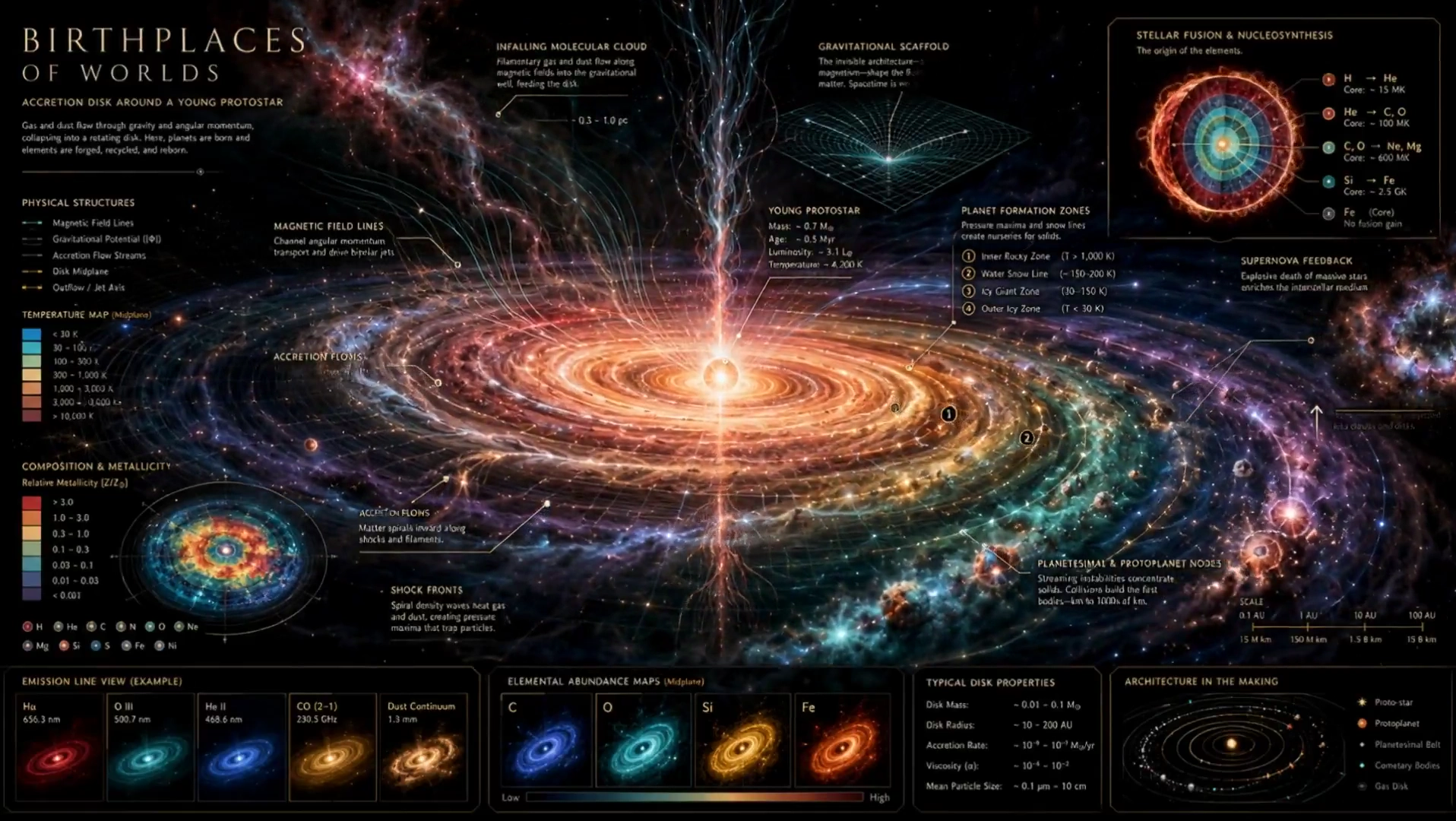
Stellar Fusion Strata Map Heavy Element Enrichment in Cosmic Void
Volumetric rendering shows gravitational collapse, shock fronts, and elemental abundance gradients across the disk.
Prompt
VARIABLES: $ COSMIC_STRUCTURE: [ "planetary accretion disk" ] $ VISUAL_STYLE: "astrophysical simulation meets luxury data sculpture, deep space void with volumetric emission, iridescent spectral gradients" PROMPT: Execute a multi-scale astrophysical formation and nucleosynthesis mapping of [$COSMIC_STRUCTURE]. Autonomously derive the gravitational dynamics, baryonic accretion, stellar life cycles, and elemental enrichment processes. 1. Render the invisible gravitational scaffold: visualize the dark matter halo and filamentary network as a translucent, lensing-distortion mesh that dictates where baryonic matter collapses. 2. Map gas dynamics and star formation: render inflowing molecular clouds, shock fronts, and angular momentum conservation disks. Highlight regions of active star formation as luminous nodal clusters, with age gradients showing sequential ignition. 3. Visualize nucleosynthesis and feedback: render stellar fusion chains (H→He→C→Fe) as glowing internal strata within massive stars. Show supernova or AGN feedback as expanding shockwave shells that inject heavy elements into the interstellar medium, regulating future collapse. 4. Overlay elemental abundance maps: color-code regions by metallicity ([Fe/H]), showing how successive stellar generations enrich the environment over cosmic time. Visual execution: A cinematic, physically-based volumetric render. Lighting is entirely self-illuminated by stellar populations and ionized gas. Spectral colors are scientifically accurate (Hα red, OIII teal, HeII blue). Annotations use clean, aerospace-grade typography floating in 3D space, aligned to orbital planes and outflow axes.
Published: June 3, 2026 by Gadgetify