Image ChatGPT Image 2
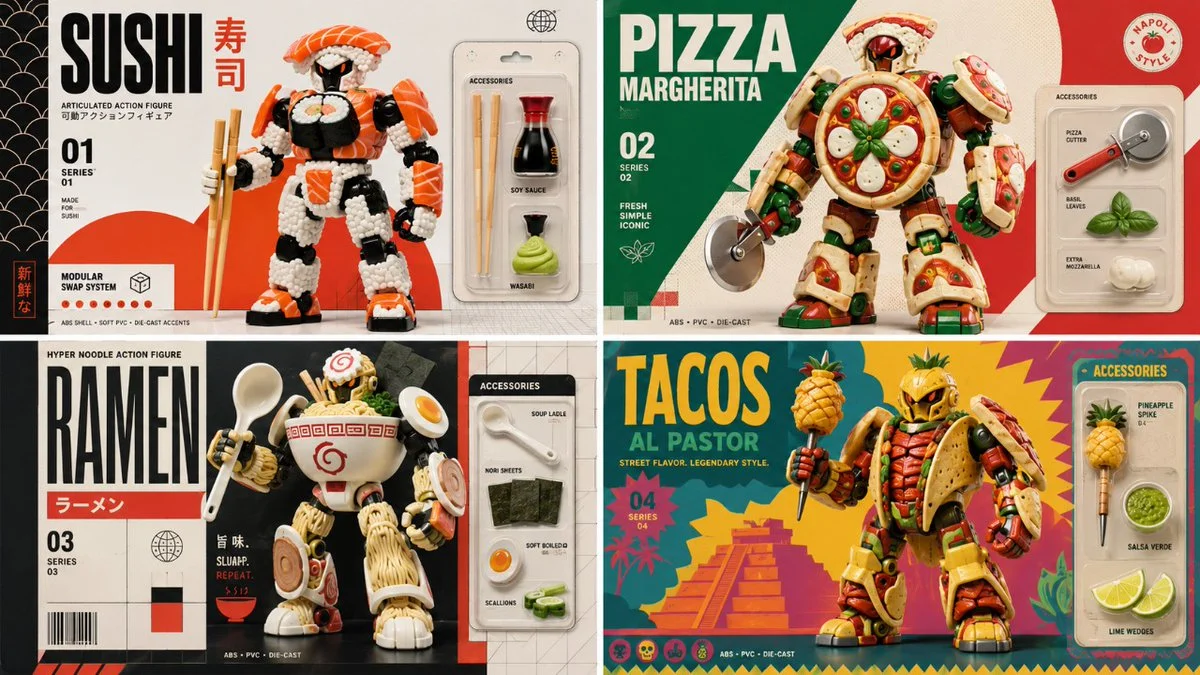
Sushi samurai robot wields chopstick spears in glossy plastic armor
A hyper-realistic 1:12 scale mecha figure built from salmon, nori, and rice, posed with chopstick weapons in a 2x2 toy catalog grid.
Prompt
<instruction>
  1.  Culinary Mecha :
Input A is a Global Cuisine or Iconic Dish (e.g., Sushi, Pizza, Ramen, Tacos).
Deconstruct the dish to generate   4 Toy Design Assets  :
   The Armor (The Ingredients):  Identify the primary visual components to use as robot plating.
   (e.g., Sushi -> Salmon slices, Nori, Rice. Pizza -> Crust shields, Pepperoni discs. Ramen -> Noodle limbs, Bowl torso).
   The Weapons/Tools (The Props):  Identify the eating utensils or primary ingredients to act as weapons.
   (e.g., Sushi -> Chopstick spears. Pizza -> Pizza cutter axe. Tacos -> Pineapple mace).
   The Accessories (The Blister Pack):  Identify 3 side items or condiments.
   (e.g., Soy sauce bottle, Wasabi mound, Lime wedges, Basil leaves).
   The Branding (The Box Art):  Identify a distinct color palette and cultural motif for the packaging.
2.  Toy Catalog Grid
Goal: "Action Figure Packaging" 2x2 Grid.
The Format: A strict 2x2 Grid of four distinct panels.
The Perspective: Front-facing, slightly dynamic "Toy Commercial" angles.
The Setup: Each quadrant represents a complete Toy Box / Backing Card layout.
3. The Content Modules (The Packaging Layout):
The Backdrop (Left/Background): A colorful, graphic design backing card.
Typography: Massive, bold Sans-Serif title of the dish (e.g., "SUSHI", "PIZZA"). Includes subtext like "SERIES 01," bar codes, and native translations (e.g., Kanji).
Graphics: Flat, stylized vector art relevant to the culture (e.g., rising sun, Mayan pyramid, Italian flag colors).
The Action Figure (Center): A hyper-realistic, 1:12 scale Mecha / Robot Action Figure.
The Design: The robot is constructed entirely from the "Armor" (Step 1). It must have mechanical joints (ball joints, hinges) connecting the food elements. It holds the "Weapons" (Step 1) in a combat pose.
The Material: It must look like Glossy Painted Plastic (ABS/PVC), not actual wet food. The food textures are sculpted into the plastic.
The Blister Pack (Right Side): A clear plastic blister bubble attached to the backing card.
Contents: The "Accessories" (Step 1) are neatly arranged inside the plastic bubble.
Labels: Tiny printed text next to each accessory identifying it.
4. Lighting & Atmosphere:
Lighting: Harsh Toy Photography Flash. Bright, sharp lighting that creates strong specular highlights on the glossy plastic armor and the clear blister pack, emphasizing the "Mint in Box" toy aesthetic.
Vibe: Collectible, action-packed, and slightly absurd.
Output: ONE image, 16:9 Aspect Ratio, 2x2 Grid, 3D Render, "Action Figure Packaging" aesthetic, High Plastic Fidelity.
</instruction>
Published: June 3, 2026 by Gadgetify