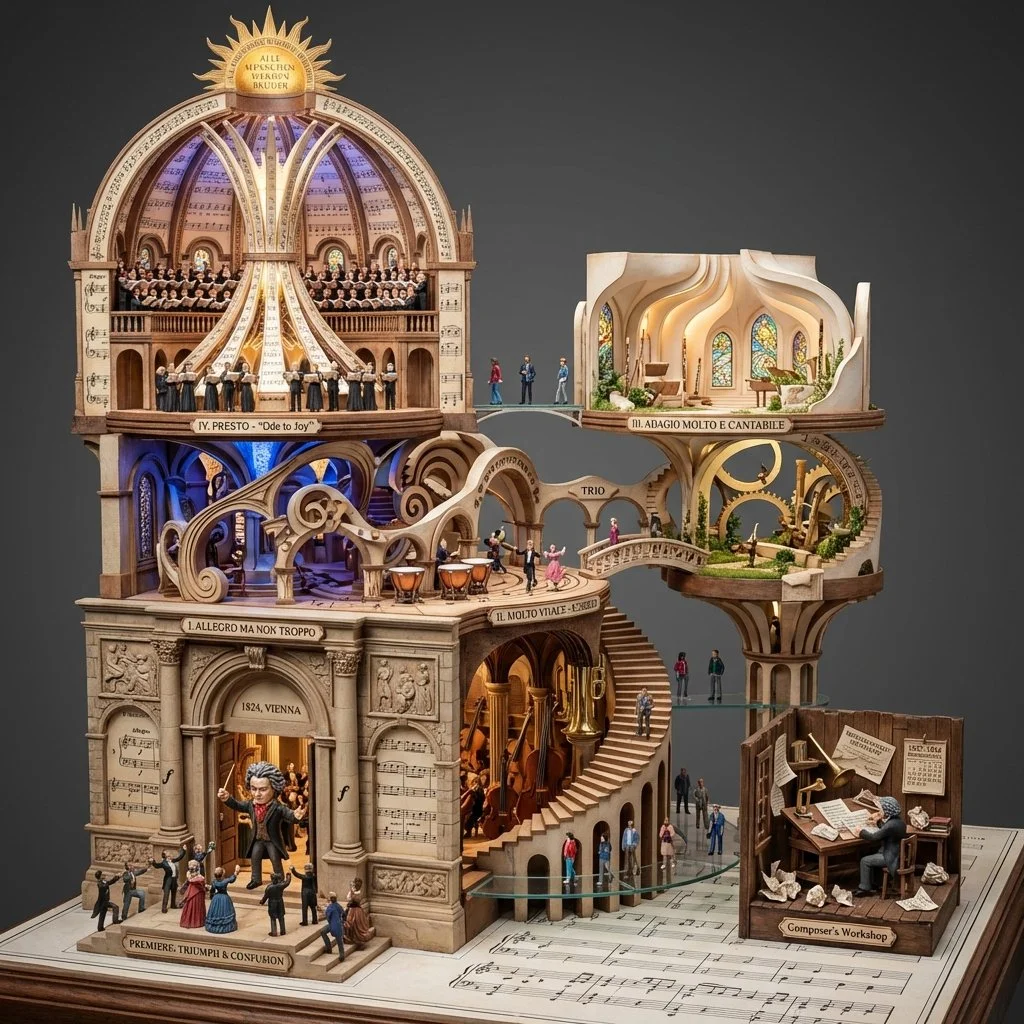
Image Nano Banana Pro
Symphonic Architecture: A Journey Through Musical History
Explore a stunning architectural model where each level represents a composer's work, weaving a narrative of musical evolution. From the grandeur of Bach's Baroque cathedral to the cinematic landscapes inspired by John Williams, discover how structural design encapsulates the emotional journey of symphonies.
Prompt
<instruction>
Input A is a legendary composer (Beethoven, Mozart, Bach, Tchaikovsky, John Williams, Hans Zimmer, etc.) or a specific symphony/score (Beethoven's 9th, Star Wars, The Rite of Spring, etc.).
Analyze: The composer's appearance and era, the musical structure (movements, themes, instrumentation), emotional arc, and historical context/premiere reception.
Goal: A physical architectural model where the symphony is built as a walkable structure with movements as rooms/levels.
Rules:
- Overall structure: Multi-story building/cathedral model representing the complete work
  * Architectural style matching the music's era and character:
    - Baroque = ornate cathedral (Bach)
    - Classical = balanced palace (Mozart)
    - Romantic = dramatic castle (Tchaikovsky)
    - Modern = abstract structure (Stravinsky)
    - Film score = cinematic landscape (Williams)
  * Each movement/section as distinct architectural space
  * Structural integrity showing how movements support each other
- Ground floor entrance: Opening movement
  * Grand entrance hall with main theme carved into walls
  * Composer figurine conducting at threshold
  * Original premiere audience figurines entering (period costumes)
  * Date and location of premiere
  * Initial reception (riot for Rite of Spring, triumph for Beethoven's 9th)
- Interior rooms/levels (one per movement):
  * Movement 1: Foundation/exposition room
    - Main themes as architectural motifs
    - Key signature and tempo as structural elements
    - Instrumentation visible (miniature orchestra sections)
  * Movement 2: Development level
    - Themes transforming through space
    - Harmonic journeys as hallways and passages
    - Tension/conflict as architectural stress points
  * Movement 3: Scherzo/contrast chamber
    - Lighter, playful architecture if scherzo
    - Or slow, meditative space if adagio
    - Rhythmic patterns in floor tiles
  * Movement 4: Finale crown/dome
    - All themes converging
    - Triumphant height or tragic collapse depending on work
    - Choir balcony if vocal finale (Beethoven 9th)
- Musical notation integration:
  * Actual sheet music fragments embedded in walls
  * Leitmotifs as recurring decorative elements
  * Dynamic markings (forte, piano) as physical size changes
  * Crescendos as ascending staircases
  * Tempo changes visible in architectural rhythm
- Include:
  * Instruments as structural supports (strings = foundation, brass = pillars, etc.)
  * Emotional journey marked by color and light through rooms
  * Key changes as transitions between architectural styles
  * Silences/rests as empty spaces, voids, breath
  * The innovative elements that shocked contemporaries highlighted
- Composer's workshop: Adjacent construction office
  * Composer figurine at drafting table with score
  * Crossed-out attempts, revisions
  * Personal crisis visible if relevant (Beethoven's deafness, etc.)
  * Letters describing the work's meaning
  * How long composition took (years often)
- Modern visitors: Contemporary listeners walking through structure
  * Experiencing music architecturally
  * Different interpretations by different conductors shown as lighting variations
  * Famous recordings as alternative walk-throughs
- Materials: Architectural model craftsmanship, sheet music paper, miniature instruments, concert hall details
- Lighting: Each movement lit according to its character (bright major keys, shadowy minor), dramatic spotlighting on climaxes
- Style: Synesthetic experience, music made tangible, architectural precision meets emotional power
Output: ONE image, 3:4 vertical showing full building height, musical architecture visualization
</instruction>
Published: May 15, 2026 by Gadgetify