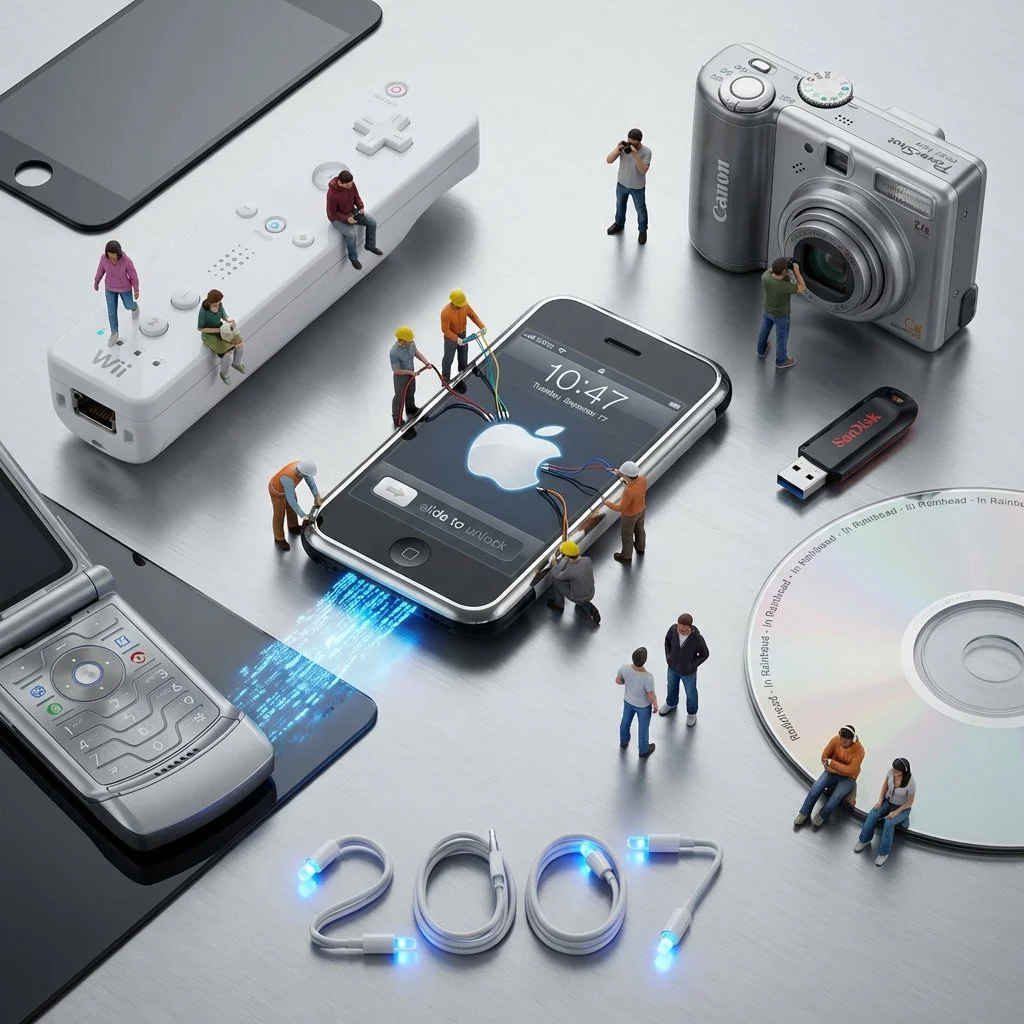
Image Nano Banana Pro
Time Capsule: 1755 Unveiled with Nano Banana Pro
A stunning visual grid brings 1755 to life, showcasing era-specific gadgets, artifacts, and miniature figures in a captivating, organized tableau.
Prompt
<instruction>
Role:  Time-Traveling Set Designer & Knolling Photographer.
Input Year: [User Choice, e.g., 1255, 1955, 2077]

Phase 1: The Era Analysis (AI to Deduce)
1.  Select The "Hero" Gadget: The most iconic, technologically defining invention of that specific year to serve as the centerpiece.
    Constraint (Historical Safety Check): Verify the date. Do not include technology that was "invented" but not yet in common use. (e.g., For 1255, use a Water Clock or Astrolabe, NOT a weight-driven Mechanical Clock).
2.  Select 4-6 "Support" Artifacts: Smaller everyday items from that era (e.g., Wax tablets, Quills, Coins, Tools).
3.  Analyze The "Population": Who are the people? How are they dressed? (e.g., Monks in robes, Blacksmiths in aprons, Flappers in dresses).
4.  Analyze The Background: What material represents this era? (e.g., Vellum/Parchment for Medieval, Linoleum for 1950s, Circuit Board for Future).

Phase 2: Visual Execution
Goal: A "Living Knolling Grid." A perfectly organized flat-lay where the objects serve as the terrain for a bustling miniature world.

1. The Layout (The Grid):
Background: A flat surface made of the Era-Appropriate Material identified in Phase 1 (e.g., Aged Parchment).
Arrangement: The Hero Gadget (Center) and Support Artifacts (Surrounding) are aligned at perfect 90-degree angles. Organized by size and shape.

2. The "Living" Interaction (The Narrative Twist):
The Population: Dozens of Tiny Hyper-Realistic Figurines (dressed in strict Era-Accurate clothing) are interacting with the giant objects as if they are buildings or landscape.
   Action A (Construction): Tiny workers are "building" or "repairing" the Hero Gadget using era-appropriate tools.
    Action B (Usage): Tiny scholars or users are examining the Support Artifacts (e.g., reading the giant book, sitting on the giant coin).
    The Spill: Elements of the era (dust, steam, or scrolls) are spilling slightly from the Hero object into the grid.

3. The Typography:
The Input Year (e.g., "1255") is physically spelled out in the center-bottom of the grid using materials from the era.
 Examples: Twisted Rope, Carved Wood blocks, Neon Tubes, or Scattered Coffee Beans.

4. Atmosphere:
Lighting: Soft, shadowless "Wes Anderson" studio lighting (high-key).
Perspective: Top-down (Orthographic) view.
Vibe: Deconstructed, organized, satisfying, geometric.

Output: 1 x image, 4:5 Aspect Ratio, High-End Commercial Photography, "Miniature World" Aesthetic.
</instruction>
Published: January 4, 2026 by @Gdgtify