Image ChatGPT Image 2.5
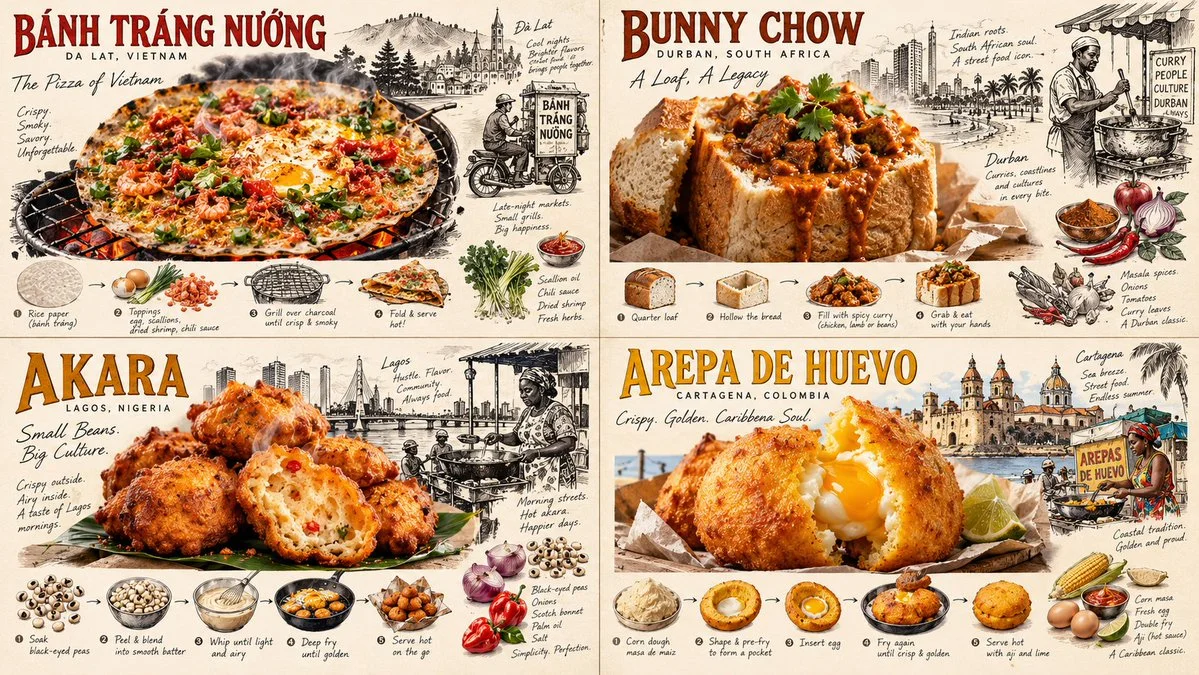
Underrated Street Foods Illustrated in Four-Panel Cinematic Grid
A 2x2 grid merges photographic realism, symbolic engravings, narrative line art, and sketchbook notes to celebrate underrated street foods.
Prompt
>This is very advanced — I’d rate it around 9.3/10 as a multi-system editorial image specification.
Conceptual sophistication: 9.4/10
Art-direction quality: 9.5/10
Semantic structure: 9.3/10
Compositional intelligence: 9.2/10

2x2 grid, 16:9, do this for underrated street foods: [EQUATION]

S = $ SUBJECT

P = Cinematic Editorial Photography
E = Symbolic Engraving / Screen Printing
N = Continuous-Line Narrative Atlas
K = Hand-Drawn Knowledge Sketchbook

VISUAL_ARTIFACT(S) =

      P(S) ⊗ E(S)
    + N(S) ⊗ K(S)
    + TYPOGRAPHIC_HIERARCHY(S)
    - DECORATIVE_NOISE
    - LITERAL_COLLAGE

⊗ = semantic structural fusion

[IDENTITY EXTRACTION]

S → {

  H = visual hero,
  M = defining materials,
  Y = associated symbols,
  Q = meaningful sequence,
  A = conceptual anatomy,
  C = identity-specific colors,
  T = subject-specific typography

}

[PHOTOGRAPHIC TRANSFORMATION]

P(S) = REALISTIC_HERO(H, M)

Apply:

- cinematic directional illumination
- precise material textures
- extraordinary dimensionality
- strong foreground/background separation
- editorial visual hierarchy

If S is abstract:

H = infer_physical_visual_metaphor(S)

[SYMBOLIC TRANSFORMATION]

E(S) = SILHOUETTE(H) + SYMBOLIC_CUTOUTS(Y)

Let Ω represent the dominant subject silhouette.

Let σᵢ represent a meaningful associated symbol.

Construct:

Ω' = Ω - Σ NEGATIVE_SPACE(σᵢ)

Interpretation:

The central silhouette contains
subject-specific symbolic imagery.

The imagery is integrated within the
form rather than pasted on top.

Apply distressed ink, carved edges,
strong contrast, and restrained colors.

[NARRATIVE TRANSFORMATION]

N(S) = FLOW(Q)

Let:

γ(t) = [x(t), y(t)]

represent a graceful visual pathway.

For each meaningful stage qᵢ:

γ(tᵢ) → miniature_illustration(qᵢ)

The pathway may describe:

- chronological history
- manufacturing process
- creative evolution
- scientific explanation
- biographical development
- conceptual relationships
- thematic progression

Select based on $ SUBJECT.

Use factual dates only when reliable.

[SKETCHBOOK TRANSFORMATION]

K(S) = DISCOVERY_MAP(A, Y)

Generate meaningful marginal information:

- diagrams
- close-up sketches
- associated objects
- small handwritten discoveries
- arrows and connectors
- symbolic doodles
- conceptual annotations

Each annotation must contribute
information about the subject.

[FUSION OPERATOR]

F = P ⊗ E ⊗ N ⊗ K

Where:

P supplies dimensional realism.

E supplies cultural symbolism.

N supplies narrative continuity.

K supplies explanatory richness.

The resulting artwork must integrate
these functions through shared geometry.

[COMPOSITIONAL ENERGY]

Define:

D(x,y) = visual detail density.

Require:

D(hero) = high
D(symbolic interior) = medium-high
D(narrative path) = medium
D(negative space) = low

This creates visual breathing room.

[TYPOGRAPHIC BALANCE]

TITLE_WEIGHT = high

SUBTITLE_WEIGHT = medium

ANNOTATION_WEIGHT = low

TYPOGRAPHY(S) =
infer(typeface, subject_personality)

[OPTIMIZATION FUNCTION]

MAXIMIZE:

  SubjectRecognition
+ MaterialAuthenticity
+ SymbolicCoherence
+ NarrativeReadability
+ EditorialElegance
+ MicroDetailQuality

MINIMIZE:

  RandomDecoration
+ FalseHistoricalClaims
+ Overcrowding
+ UnreadableText
+ StyleFragmentation

[VISUAL OUTPUT]

16:9 single artwork.

Dominant dimensional hero.

Black engraved identity details.

Elegant flowing illustrated progression.

Intellectual sketchbook annotations.

Warm white negative space.

Selectively applied meaningful accent colors.

[FINAL INSTRUCTION]

Render $ SUBJECT as the visual solution
to the equation.

Create something that feels like:

a luxury editorial photograph
intersecting a historical screen print,
flowing into an illustrated heritage timeline,
and expanding into a handwritten encyclopedia.

Everything should share one visual identity.

Nothing should look separately pasted together.
Published: October 14, 2026 by Gadgetify