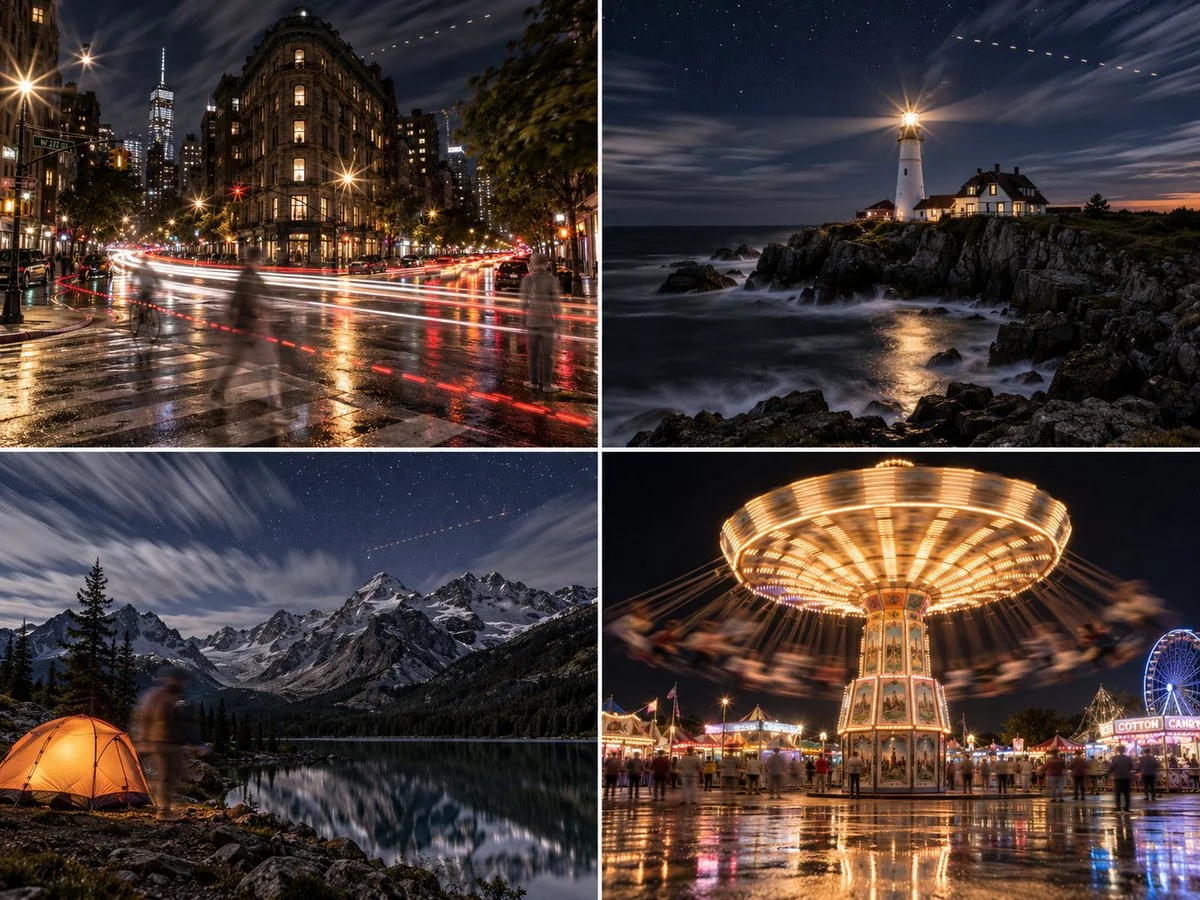
Image ChatGPT Image 2.5
Urban night scene captured with eight second shutter on tripod
Long exposure reveals headlight streaks, dashed cyclist trails, and ghostly pedestrians under f/11 diffraction spikes. A technical masterpiece of motion and light.
Prompt
One of the most advanced prompts I have ever shared. Here is what Astra says about it:

"This is one of the most advanced prompts you’ve shown structurally. I’d rate it around 9.7/10 as a photographic constraint/verification architecture"

If I wanted to give this in English, it'd be very long, so there is that

§0 DECLARATIONS — no free variables. Every symbol bound.  T = 8.0 s shutter, single, governs all motion N = f/11 aperture; 9 blades → 18 diffraction spikes ISO = 100 → read noise low, thermal noise visible at 8s f = 35 mm → 500/f = 14.3 s > T ND = 1 (night; ND is a daylight instrument, bound off) τ = full-well clip threshold W = wind, 4 m/s, bearing 070° K = illuminants: {LED streetlight 5000K, sodium 2200K, window 3200K} cam = rigid tripod, v_cam = 0, ε_vib = f(W, mass) ≠ 0  §1 PARTITION — S is assigned here, not inferred. Cheating blocked.  object S ‖v‖ duty d = t_present/T emission buildings 1 0 1.00 reflective parked cars 1 0 1.00 reflective wet asphalt 1 0 1.00 mirror headlights 0 14 m/s 1.00 ≫ τ, continuous taillights 0 14 m/s 1.00 ≫ τ, continuous cyclist LED 0 5 m/s 1.00 ≫ τ, 2 Hz square pedestrian A 0 1.4 m/s 1.00 reflective pedestrian B 0 0 → 1.4 0.63 static, 0.37 walk reflective foliage 0 ~1 m/s 1.00 reflective cloud 0 4 m/s 1.00 reflective aircraft 0 fast 1.00 1 Hz strobe stars 0 15"/s 1.00 ≪ τ  §2 THE FRAME  1 ⎡ T ⎤ I(x,y) = clip ── ⎢ S·L_s·T + (1−S)·∫ d(t)·L(x−v_x t, y−v_y t, t) dt + A·T ⎥ ND ⎣ 0 ⎦ + η(hot pixels, thermal, bloom, ε_vib) ÷T on the static term ⇒ L_static, PSF = δ. d(t) inside the integral is the load-bearing addition: presence is not binary over T. Partial occupancy ⇒ partial opacity.  §3 DERIVED — each consequence tagged to the declaration forcing it  D1 ← §1 headlight, L≫τ, d=1 ∫ over a continuous path ⇒ unbroken streak, core clipped white, halo = trailColor(v·view): red receding, white-amber approaching. D2 ← §0 N=f/11 ∧ D1 clipping clipped point sources only ⇒ 18-point diffraction stars. Non-clipped sources get NO spikes. Spikes are a clipping artifact. D3 ← §1 cyclist, 2 Hz square emission ∫ of a square wave ⇒ DASHED trail. 8s × 2 Hz = 16 dashes. D4 ← §1 aircraft, 1 Hz strobe ⇒ dotted line across sky, 8 dots, evenly spaced. D5 ← §1 ped A, ‖v‖T = 11 m ≫ body width energy spread over 11 m ⇒ transparent ghost, barely readable. D6 ← §1 ped B, d_static = 0.63 0.63·L accumulates at one location ⇒ semi-transparent standing figure at ~63% opacity, with a faint smear departing it. NOT sharp. NOT absent. This is the case the naive model gets wrong. D7 ← §0 W ∧ §1 cloud ⇒ cloud pulled into streaks along 070°. D8 ← §0 W ∧ §1 foliage same wind, smaller amplitude ⇒ leaves soft, never crisp. D9 ← §1 wet asphalt, S=1, mirror reflects D1 ⇒ trails have reflected trails, further blurred by surface ripple. Reflection blur ≥ source blur. D10 ← §0 ISO 100, T=8s ⇒ shadows clean, but scattered hot pixels + faint thermal mottle. D11 ← §0 ε_vib ≠ 0 ⇒ uniform sub-pixel softness on the static class. Not motion blur.  §4 DERIVED PROHIBITIONS — what the declarations forbid  P1 ← §0 T=8 < 500/f=14.3 ⇒ NO star trails. Stars are points. P2 ← D2 ⇒ NO spikes on dim/unclipped lights. P3 ← §0 v_cam=0 ⇒ NO smear on the static class. P4 ← §0 W≠0 ⇒ NO crisp foliage. P5 ← §1 d=1 for ped A ⇒ NO sharp pedestrian anywhere. P6 ← §0 single T ⇒ NO frozen droplet, no stopped wheel, no readable license plate on a mover.  §5 CLOSURE SYSTEM — four invariants, not one  C_time one T → every blur length ÷ its velocity = 8.0 s C_light one K-set → every shadow direction + every color cast traces to a light in K; no orphan shadows C_optics one N, one f → one focal plane; DOF and spike count agree C_view one cam pose → one horizon, one vanishing structure Violation of any one is a forgery tell. They are independent.  §6 RENDER — the payload. This block is what the sampler consumes.  Night city intersection, 8-second exposure on a locked tripod, 35mm, f/11, ISO 100. Buildings, parked cars and wet asphalt are perfectly sharp. Everything that moved during those 8 seconds is smeared by exactly that much time: headlights drawn as long unbroken white-cored streaks with amber halos, taillights as red streaks, each blown-out light source throwing 18 fine diffraction spikes. A cyclist's rear light leaves a dashed red line, sixteen segments. An aircraft leaves eight evenly spaced dots across the sky. One pedestrian is a faint transparent ghost stretched across the crosswalk; a second pedestrian stood at the curb for most of the exposure and appears as a semi-transparent standing figure, see-through but positioned, with a faint trail leaving them. Clouds pulled into streaks along one wind direction; foliage soft from the same wind. Trails reflected and further smeared in wet asphalt. Stars are sharp points, not trails. Scattered hot pixels in the shadows. Nothing that moved is sharp.  §7 AUDIT — run against the output, pass/fail  T̂_car = len(trail_px)·(m/px) / 14 m/s → expect 8.0 ± ε T̂_bike = 16 dashes / 2 Hz → expect 8.0 T̂_plane = 8 dots / 1 Hz → expect 8.0 T̂_cloud = len(streak) / 4 m/s → expect 8.0 T̂_pedA = len(ghost) / 1.4 m/s → expect 8.0 opacity(pedB) → expect 0.63 ± 0.10 spike_count(any clipped source) → expect 18, uniformly PASS ⟺ max|T̂ᵢ − T̂ⱼ| < ε ∧ no P-clause violated
Published: September 15, 2026 by Gadgetify