Image Nano Banana 2
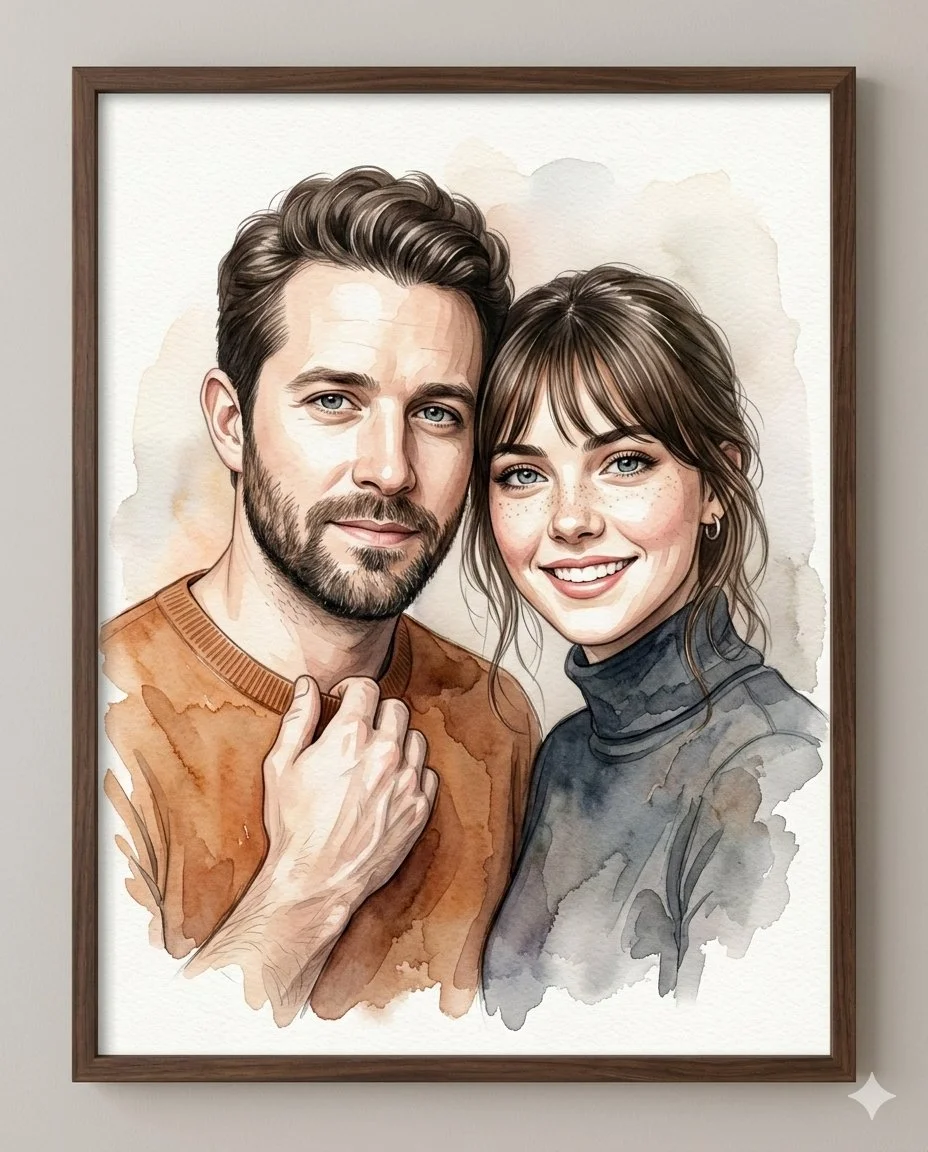
Whispers of Connection: A Watercolor Portrait
A soft, intimate watercolor portrait captures a couple's warmth. Natural poses, gentle smiles, and precise details blend traditional art with digital finesse in a stunning wooden frame.
Prompt
Create a 4k resolution, 4:5 aspect ratio, high-quality digitally rendered watercolor-style portrait of a couple, presented inside a dark walnut wooden frame. The artwork must combine precise digital illustration with the soft, fluid characteristics of traditional watercolor painting.
Use the provided reference image to accurately replicate BOTH subjects identity.

Do NOT beautify, idealize, reshape, smooth excessively, or invent new features.

The final result must look like the exact same two people in watercolor form.
Subject Composition (Strict — Do Not Modify)
Intimate bust portrait, cropped slightly below mid-chest.
Male positioned on the left, female on the right.
Their upper bodies angled very slightly inward toward each other.
Shoulders gently overlapping, with the female subtly leaning into the male’s shoulder for a natural, connected feel.
Heads placed close together with temples nearly touching.
Both faces turned almost straight toward camera with only a minimal inward rotation (very subtle 5–10° inward angle).
Chins level and aligned at similar height (no exaggerated tilt).
Posture upright but relaxed — not stiff, not exaggerated.
Expressions soft and warm:

Male — calm, subtle closed-mouth smile.

Female — bright, open smile with gentle warmth.
Eye contact directed toward the viewer.
No dramatic head tilt. No exaggerated lean. Keep connection natural and balanced.
Outfit  (Automatic From Reference)
Carefully analyze the uploaded reference image and:
Detect exact clothing type (shirt, blouse, jacket, saree, kurta, suit, casualwear, etc.)

Preserve accurate fabric color, texture, and material type.

Replicate neckline, collar style, sleeve length, layering, visible accessories.
Maintain realistic folds and garment structure.
Do NOT replace clothing unless explicitly instructed.

Enhance subtle fabric texture slightly for watercolor realism, while keeping authenticity.
Artistic Style & Watercolor Execution
Medium Simulation:
Blend wet-on-wet soft gradients in background.

Use wet-on-dry precision around facial features.
Allow organic pigment bleeding around edges.
Maintain visible watercolor paper grain texture.
Brushwork Detail:
Fine strokes for eyelashes and individual hair strands.

Controlled detailing around eyes and lips.
Broad translucent washes for clothing.
Subtle pigment pooling and natural gradient transitions.

Soft watercolor blooms around outer edges.
Do NOT over-sharpen or make it look like a digital painting — it must feel like genuine watercolor.
Color Palette (Adaptive + Balanced)
Maintain accurate skin tones from reference.

Use soft warm neutrals (cream, beige, tan) as base tones.
Introduce complementary cool washes when appropriate.

Background should remain light, airy, and minimally dominant.
Avoid heavy contrast or overly saturated tones.
 Lighting & Depth
Soft, natural, diffused lighting from slightly above and front-facing.
Gentle highlight across forehead, cheekbones, and nose bridge.
Subtle shadow under jawline and neck area for depth.
No dramatic side-lighting.
High-key, airy atmosphere.
Enhance depth subtly while maintaining watercolor softness.

Presentation & Framing
Artwork displayed inside a dark walnut or espresso-finished wooden frame.
Modern flat frame profile with subtle wood grain.
No visible matting.
Art extends near edges for a contemporary full-bleed look.
Visible watercolor paper texture inside frame.
Clean neutral wall mockup presentation.
Frame visible evenly on all four sides with centered wall alignment.
Slightly Increased Quality Controls (For Better Results)
Increase fine facial detailing by 15–20% while maintaining watercolor softness.
Improve edge control around eyes and lips for clarity.

Maintain subtle texture contrast between skin and clothing.

Ensure both subjects remain equally sharp and balanced.
Published: March 4, 2026 by @Naiknelofar788