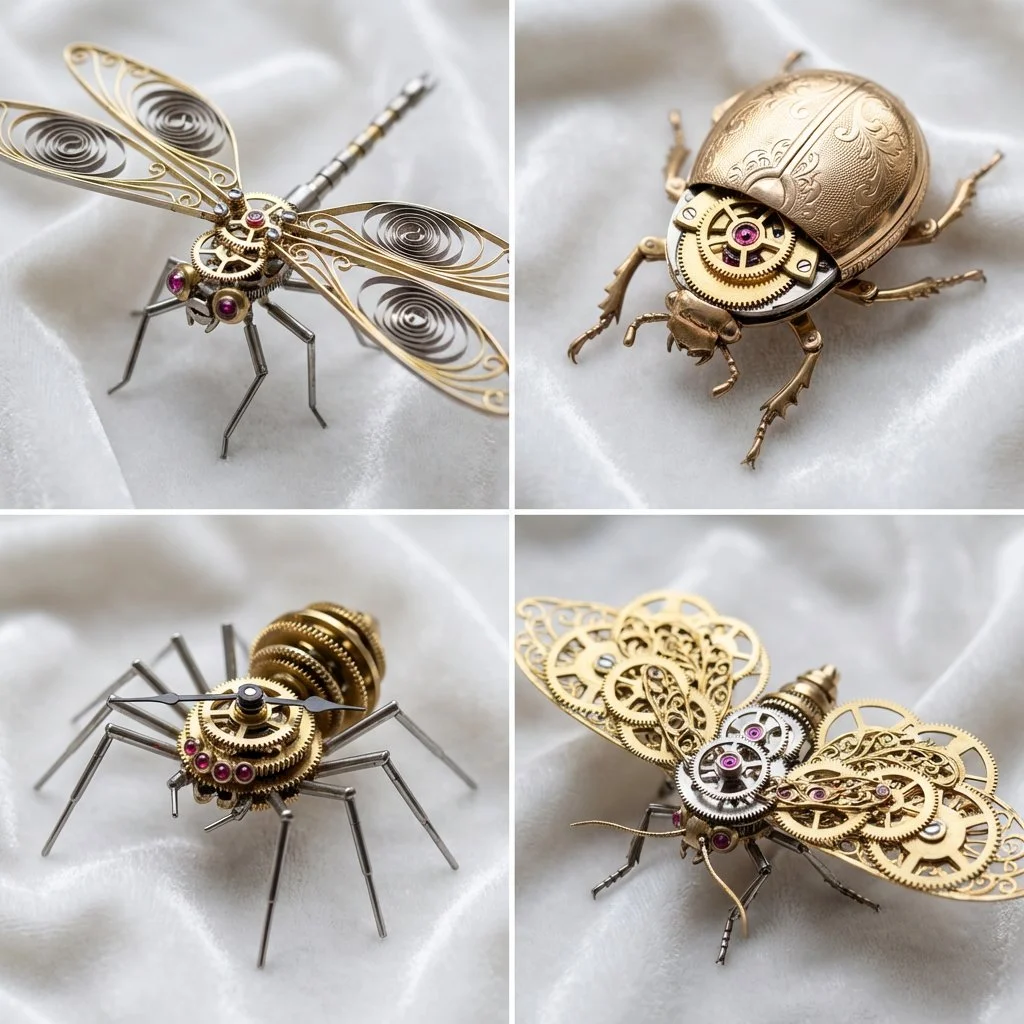
Image Nano Banana Pro
Mechanical Insects: A Clockwork Masterpiece
Explore intricate insect anatomy, transformed into steampunk creations with polished brass, ruby jewels, and delicate watch parts in extreme macro detail against velvet softness.
Prompt
2x2 grid, do this for 4 insects: <instruction>
  1.  Inference Engine (The Clockwork Biology):
Input A is an Insect or Small Creature (e.g., Dragonfly, Scarab Beetle, Spider, Moth, Scorpion).
Deconstruct the biology into   3 Watchmaker Assets  :
     The Wings/Carapace (The Armor):  Identify the largest flat or curved surfaces.
         (e.g., Dragonfly -> Coiled mainspring wire. Beetle -> Engraved gold pocket-watch casing. Moth -> Layered brass gears).
     The Legs/Appendages (The Linkage):  Identify the limbs.
         (e.g., Spider -> Clock hands and steel pins. Beetle -> Articulated brass joints).
     The Head/Thorax (The Core):  Identify the central body and eyes.
         (e.g., Ruby jewel bearings for eyes, exposed escapement wheels for the thorax).

  2.  Container (The Jeweler's Display):
Goal: "Horological Taxidermy" Macro Photography.
     The Format:  A   2x2 Grid   of four variations, or a single high-detail shot.
     The Surface:  A soft, pristine   White Velvet or Silk cloth  . The fabric has gentle, natural folds and catches the light softly, contrasting with the hard metal of the subject.

  3.  Sculpture (The Automaton):
     The Construction:  The creature (Input A) is a purely mechanical object assembled from   Antique Watch Parts  .
     Material Palette:  Polished Brass, Silver steel, Gold plating, and tiny crimson Ruby bearings.
     The Scale:  The object should feel no larger than a pocket watch (approx. 2-3 inches across).

  4.  Syntax
     Detail Level:  Extreme Macro. The viewer must be able to see the teeth on the tiny gears, the engraving on the metal, and the screws holding the joints together.
     No Organic Parts:  Absolutely no real biological textures (no real fur, chitin, or antennae). Everything must be recognizable as a man-made, machined component.

  5. Lighting & Atmosphere:
     Lighting:    Soft Diffused Daylight.   The light should hit the metal surfaces to create clean specular highlights (gleam) without casting overly harsh, dark shadows on the white velvet.
     Focus:    Shallow Depth of Field (Macro Lens).   The central gears/body of the insect are in razor-sharp focus, while the tips of the wings/legs and the velvet background blur softly.

  Output:   ONE image (or 2x2 grid), 1:1 Aspect Ratio, Macro Product Photography, "Steampunk/Clockwork" aesthetic, High Texture Fidelity.
</instruction>
Published: March 13, 2026 by @Gdgtify