Image Nano Banana Pro
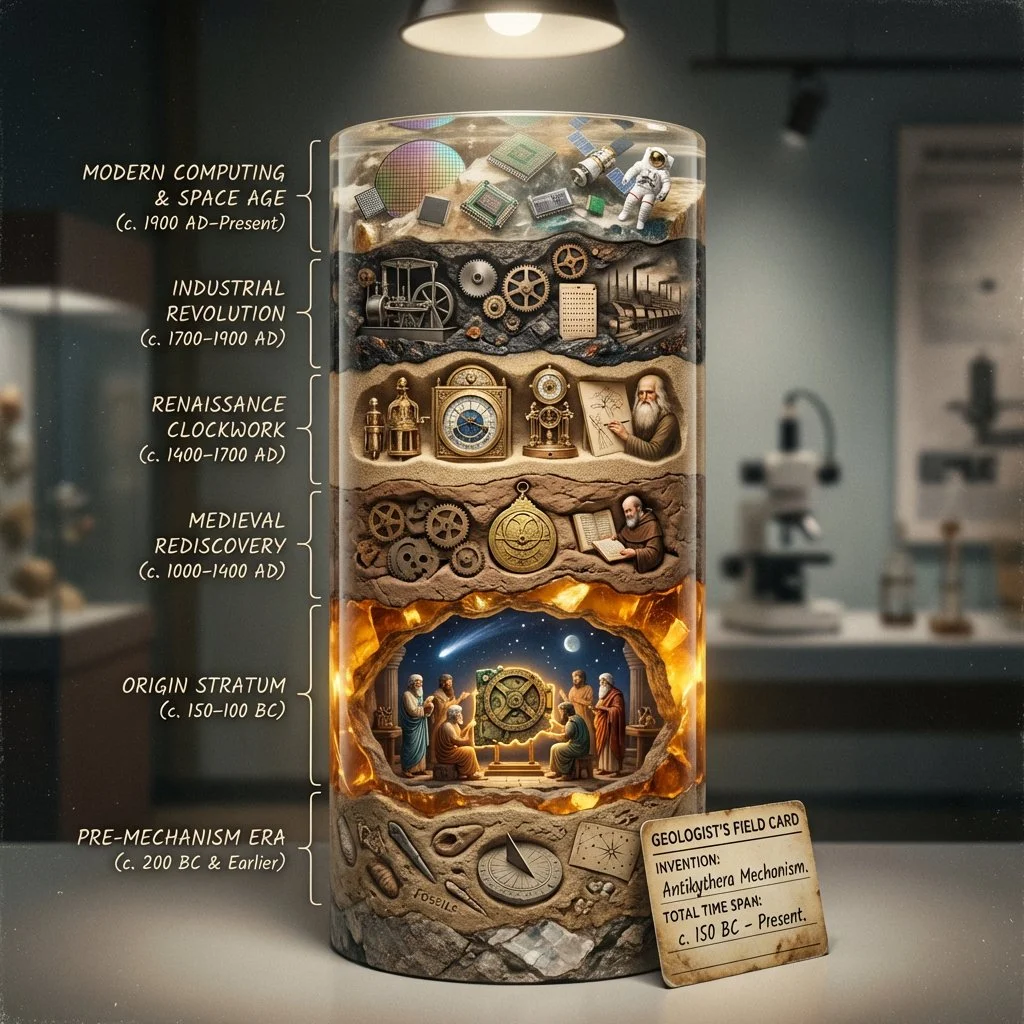
The Evolution of Computers Captured in Geological Layers
A photorealistic geological core reveals the evolution of computers, from primitive beginnings to today's tech marvels, with each era represented in detailed strata.
Prompt
Do this for computers:
<instruction>
Input A is an invention (name or image).
Analyze: its origin era, the technologies it displaced,
the technologies it enabled, and its 3–5 civilizational
ripple effects across time.
Goal: A photorealistic geological core sample — a tall
cylindrical drill core standing upright, sliced open to
reveal cross-section strata. Each stratum layer represents
a different era shaped by the invention:
- Bottom layer: the world before (raw, primitive materials)
- Origin stratum: glowing amber vein, contains a
  micro-diorama of the invention's eureka moment
- Middle layers: miniature scenes of the invention
  changing daily life across successive eras
- Top layer: the modern world it made possible
Rules:
- Label each stratum with hand-etched era name +
  year range along the cut face
- Embed micro-artifacts (tools, machines, figures)
  inside each layer like fossils
- Include a geologist's field card leaning against
  the core with the invention name and total time span
- Materials: real rock textures — sediment, crystal
  veins, compacted earth — not cartoon layers
- Lighting: museum specimen lighting, single overhead
  with soft fill, dramatic edge shadows
Output: ONE image, 2:3, archival scientific-photo aesthetic
</instruction>
Published: March 5, 2026 by @Gdgtify