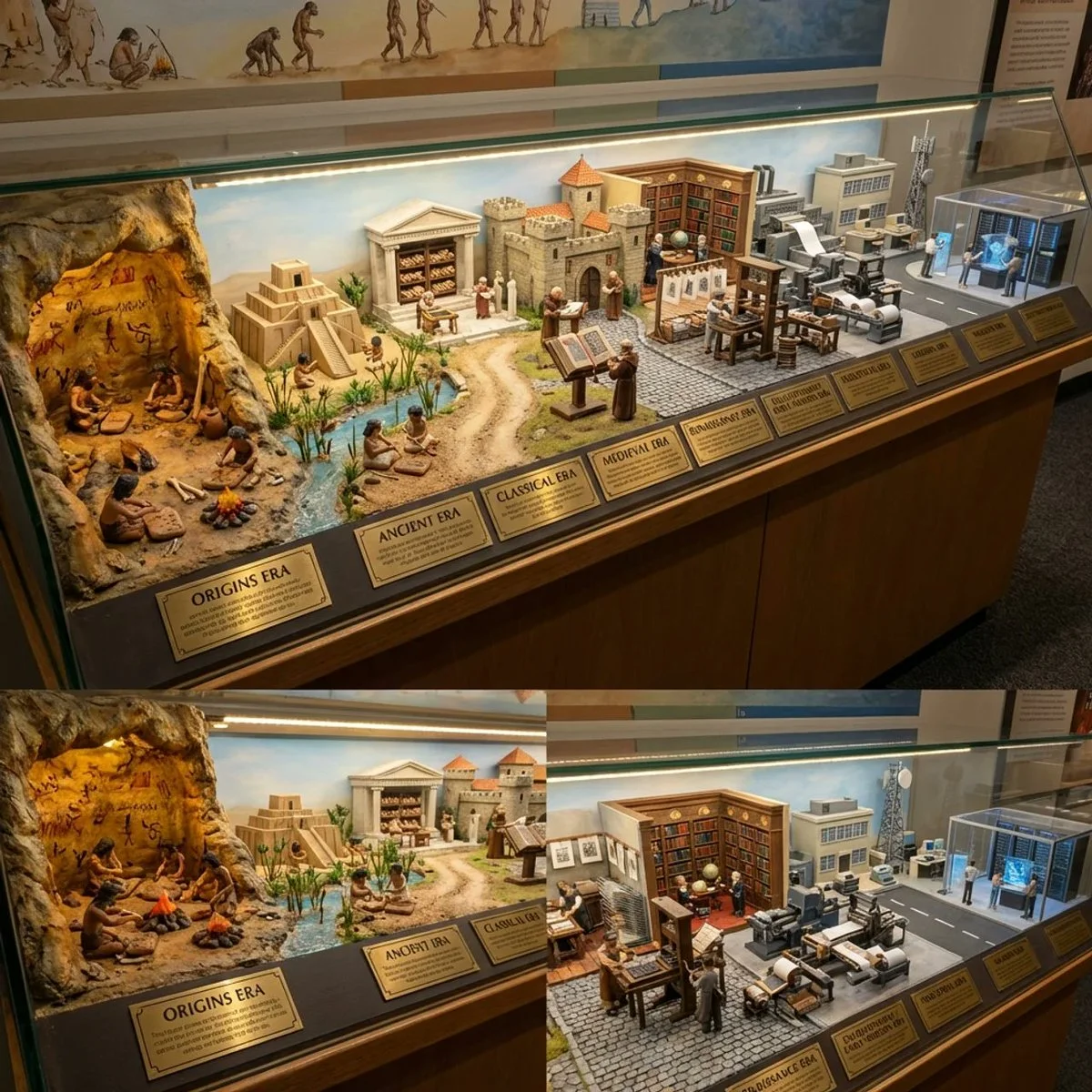
Image Nano Banana Pro
Timeline of Talk: Communication Through the Ages
A meticulously detailed diorama traces communication’s journey from origins to modern digital webs, with a continuous thread linking each era seamlessly.
Prompt
Create a highly detailed, physically plausible museum‑grade diorama that depicts the full historical evolution
of a chosen subject across multiple eras. Do not hard‑code specific cultures or aesthetics; instead infer the
most contextually appropriate details based on the subject itself.

STRUCTURE
Divide the landscape into the following chronological eras, each with a brass-style plaque:

1. ORIGINS ERA — earliest known or hypothesized beginnings of the subject.
2. ANCIENT ERA — early civilizations, foundational systems, first formal uses.
3. CLASSICAL ERA — structured development, codification, and refinement.
4. MEDIEVAL ERA — transitional forms, regional diversification, early institutions.
5. RENAISSANCE ERA — rediscovery, innovation, and expansion of formal techniques.
6. ENLIGHTENMENT / EARLY MODERN ERA — systematization, theory, and global exchange.
7. INDUSTRIAL ERA — mechanization, mass production, and technological acceleration.
8. MODERN ERA — 20th‑century innovation, global culture, and rapid evolution.
9. CONTEMPORARY ERA — present‑day complexity, digital systems, and hybrid forms.

For each era:
- Infer architecture, tools, environments, and cultural markers appropriate to the subject’s natural progression.
- Use environmental storytelling to show how the subject functioned in that era.
- Include human, architectural, or technological elements only when logically relevant.
- Maintain realistic scale relationships and avoid stereotypes.

CONTINUITY
Include a single unifying environmental feature (e.g., a river, road, beam of light, root system, trade route,
energy conduit, or symbolic thread) that flows through all eras, representing continuity and transformation.

TRANSITIONS
- Smoothly blend each era into the next using natural gradients in terrain, lighting, materials, and density.
- Avoid abrupt borders; transitions should feel like time unfolding across a single continuous landscape.

CAMERA & RENDERING
- Present the entire diorama from a slightly elevated three‑quarter angle.
- Use crisp depth of field, realistic materials, and subtle atmospheric lighting.
- Maintain a miniature, museum‑display aesthetic with handcrafted textures.
- Ensure all eras are visible simultaneously and readable at a glance.

OUTPUT
- Produce one coherent diorama showing all eras in chronological order.
- Ensure the viewer can infer the full historical timeline through visual logic alone.
Published: March 14, 2026 by @Gdgtify